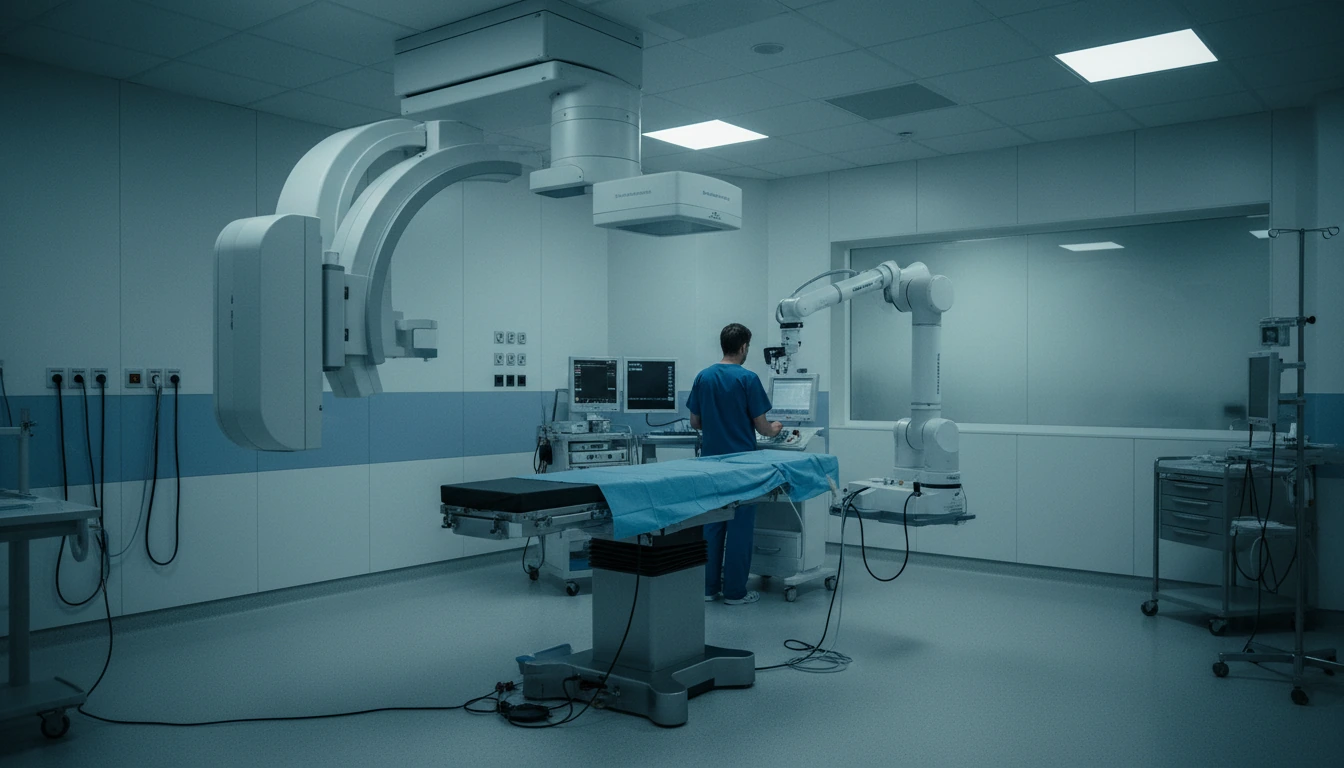
Remedy Robotics, a San Francisco company building an AI-enabled robot for stroke and heart procedures, has raised $62 million in Series B funding. DCVC led the round. The money is meant to carry the company’s N1 System through a planned pivotal clinical trial with the University of California and toward FDA approval for neurovascular intervention, the field that includes clot removal after a stroke. Remedy’s longer-term goal is ambitious: procedures performed on site, remotely or autonomously, so that patients far from a major stroke center can still get specialist care in time.
Quick Take
- The deal: $62 million Series B led by DCVC, with new investors UC Investments, Skip Capital and Australian pension fund Hostplus. Existing backers Build Collective by Tony Fadell, Blackbird, Divergent Capital and KdT Ventures invested again.
- The product: The N1 System, an AI-enabled robotic platform and software suite for endovascular procedures, the catheter-based treatments used for stroke and many heart conditions.
- Next steps: A planned pivotal trial with the University of California, a path toward FDA approval for neurovascular intervention and prototype deployments with clinical partners.
- The problem: Remedy cites estimates that only 2.8 percent of eligible stroke patients worldwide have access to endovascular treatment.
- The caveat: The N1 System is still under development and is not available for sale or clinical use anywhere.
In plain English
When a blood clot blocks an artery in the brain, doctors can often pull it out with a thin tube threaded through the blood vessels, but only a few specialists in big hospitals can do it. Remedy is building a robot that can help perform this kind of procedure, guided by AI and potentially controlled by a doctor from far away. The new money pays for a large clinical trial and the work needed to get approval from US regulators. If it works, patients in smaller or rural hospitals could get treatment much faster.
What happened
Remedy announced the Series B on November 16. “Endovascular intervention is the gold standard treatment for stroke and many cardiovascular emergencies, yet access remains limited to a small number of hospitals,” said Dr. David Bell, CEO and co-founder. “This funding will allow us to accelerate toward deployment of our N1 System so we can bring quality intervention to patients everywhere, regardless of geography.”
According to the company, the funding will support:
- A pivotal clinical trial in partnership with the University of California.
- Progress toward FDA approval for neurovascular intervention.
- Prototype N1 deployments across clinical partners, including through partnerships with SVIN Mission Thrombectomy and the Australian Stroke Alliance.
- Further work on AI and autonomous functions of the system.
“Remedy Robotics represents a new generation of medical robotics and physical AI companies,” said James Hardiman, General Partner at DCVC.
How the N1 System works
Remedy describes the N1 as a robotic platform plus software that uses machine learning to analyze preoperative imaging, simulate a case in advance, register 3D and 2D images in real time and “complete entire endovascular procedures robotically.” It is designed for three modes: on-site, remote and autonomous operation. The company says it works with more than 100 hospitals worldwide, holds 48 patents, including foundational patents in machine learning applied to surgical robotics, and completed what it calls the world’s first remote neurointerventional procedures with the N1 in October 2025.
Background: AI moves into the operating room
Most AI in healthcare so far has been software: documentation tools, diagnostic support and chatbots for clinicians. Physical AI in medicine is harder because errors happen inside a patient’s body and regulators demand extensive clinical evidence. That is why Remedy’s timeline runs through a pivotal trial rather than a quick product launch. Physical AI startups outside medicine have raised large rounds this autumn, such as Eka Robotics’ $150 million round. Our Health & Medical Research section and Engineering & Robotics section follow both sides of that trend.
Why it matters
Stroke treatment is a race against time, and geography decides who wins. Remedy cites estimates that stroke alone carries an annual economic burden of about $891 billion worldwide, and that just 2.8 percent of eligible stroke patients have access to endovascular treatment. A robot that lets a specialist operate from another city, or eventually performs parts of the procedure on its own, could change that math more than any new drug. It also raises hard questions about liability, network reliability during remote procedures and how regulators should evaluate autonomous functions.
What’s still open
- When the pivotal trial starts, how many patients it will enroll and which endpoints it will measure.
- Which functions will be autonomous in the first FDA submission, and which will stay under direct physician control.
- How remote procedures handle connection loss or latency in an emergency.
- What the system will cost hospitals, and whether smaller hospitals can afford it.
About the analysis
This independent i10x analysis is based on Remedy Robotics’ funding announcement. Clinical and market figures are company statements and estimates cited by the company, and were not independently verified.
Sources (plain text, no links):
- Remedy Robotics press release: “Remedy Robotics Raises $62 Million Series B to Bring Life-Saving Cardiovascular Intervention to Patients Everywhere” (PR Newswire, November 16, 2026)
i10x Perspective
Remedy is a good example of where physical AI could matter most: not in warehouses, but in places where a scarce human skill decides life or death. The path is slow by design, through trials and regulators. If the N1 reaches patients, the bigger story will not be the robot itself but the shift from “where is the nearest specialist” to “where is the nearest connected machine.”