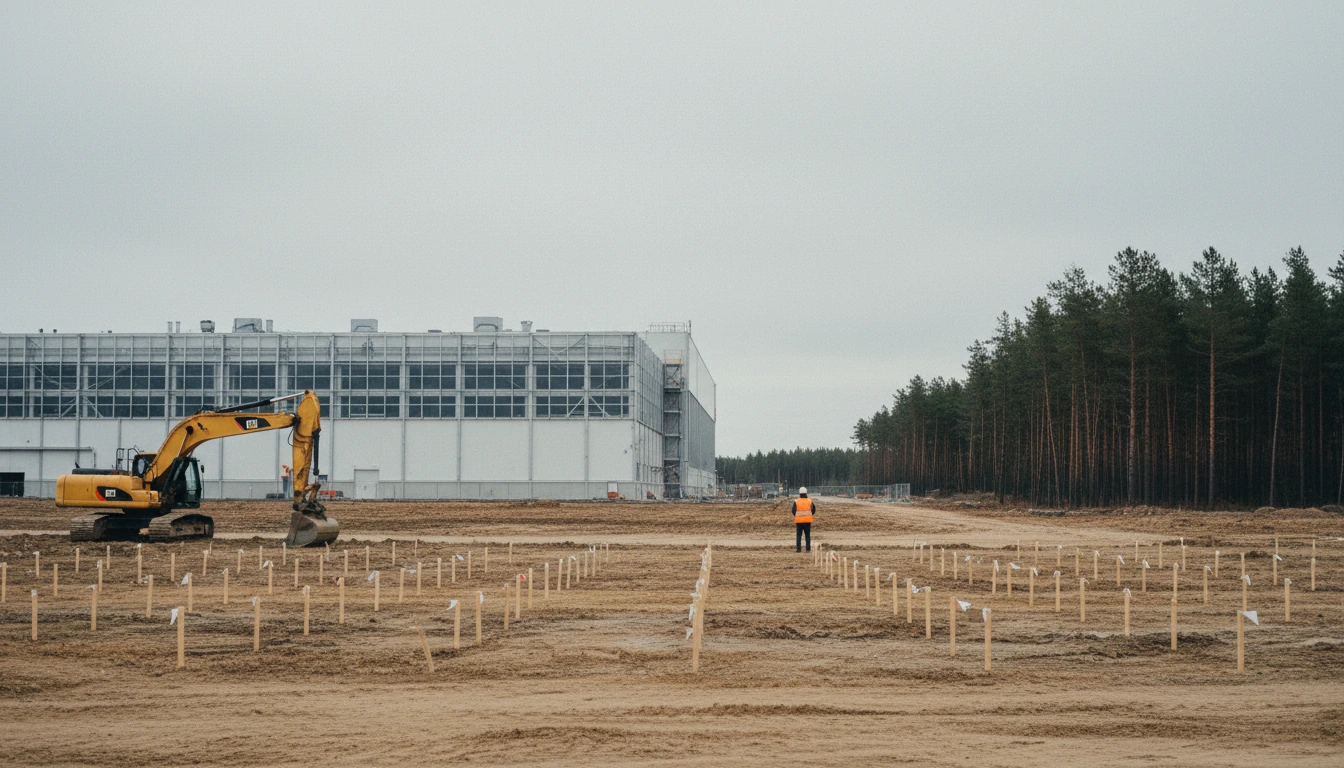
Tesla will build its Cybercab robotaxi in Germany. Plant manager André Thierig announced on November 16 that Tesla is making “a first investment of around €3b in a new manufacturing building” at Giga Berlin in Grünheide, dedicated to Cybercab production. According to Tesla’s statement, construction should start in the first half of 2027 and production in 2029, and the new hall is designed for up to one million Cybercabs a year. It is a large industrial bet on a vehicle with no steering wheel or pedals that, under current EU rules, can only be registered in small numbers in Europe.
Quick Take
- What: Tesla plans a new Cybercab production building at Giga Berlin, with a first investment of around €3 billion.
- Timeline: Building application before the end of 2026, construction start in the first half of 2027, production start in 2029, according to Tesla.
- Scale: The hall is designed for up to one million Cybercabs a year. Tesla calls it “the technologically most advanced Tesla factory in the world.”
- Also included: Ancillary buildings and a second wastewater treatment plant.
- The catch: EU type-approval rules for fully driverless vehicles currently allow only small series of up to 1,500 vehicles per type per year.
In plain English
The Cybercab is Tesla’s self-driving taxi: a two-seater with no steering wheel and no pedals. Tesla now says it will build a huge new factory hall for it next to its existing plant near Berlin, with production starting in 2029. The plan is to make up to one million of these cars a year there. For now, European rules only allow a few driverless cars of each model on the road, so Tesla is betting that the rules will change or that it can export them.
What happened
Thierig, who runs Giga Berlin, announced the plan on X: “If you ever wondered, what we would be doing at Giga Berlin with all the land that we have… We are expanding! Cybercab production is coming to Giga Berlin! Today we announced a first investment of around € 3b in a new manufacturing building.”
According to Tesla’s statement on the expansion, the investment covers a new production hall north of the existing factory, ancillary buildings and a second wastewater treatment plant. Tesla plans to file the building application before the end of the year, start construction in the first half of 2027 and begin production in 2029.
Giga Berlin opened in 2022 and builds the Model Y today. Tesla had already outlined a path to expand the site in earlier permit filings, but this is the first time the company has said what the second phase will produce.
Background: the robotaxi push
Tesla has made autonomy the center of its strategy, from robotaxi services in the US to its Optimus humanoid robot, which has had its own delays: we reported that Tesla Optimus deliveries were pushed to late 2027. The Cybercab is the purest form of that bet, because it cannot be driven by a human at all. In Europe, the legal basis for such vehicles is the EU’s implementing regulation on automated driving systems, which allows fully driverless vehicles only in small series of up to 1,500 units per type per year. Tesla’s driver-assistance software in Europe still requires a supervising driver.
Why it matters
For Germany’s car industry, a robotaxi factory near Berlin is a strong signal that autonomous vehicles will be built in Europe, not only in the US and China. For Tesla, a plant sized for a million Cybercabs a year implies a robotaxi business many times larger than anything operating today. The regulatory gap is the central risk: unless EU rules for large-series driverless vehicles arrive by the end of the decade, much of the Berlin output would have to be exported or sold in very limited numbers in Europe. The project also needs the usual permits for a major industrial site, which have been contested in Grünheide before. Our Engineering & Robotics section follows physical AI from humanoids to autonomous vehicles, and the AI Capex Tracker shows how much companies are investing in AI hardware.
What’s still open
- Whether the €3 billion “first investment” will be followed by further phases, and how many jobs the hall will create.
- How Tesla expects to sell Cybercabs in Europe if EU limits on driverless vehicles are still in place in 2029.
- Which markets Berlin-built Cybercabs would serve if they are exported.
- How the permit process for the new hall and second wastewater plant will go, given past local opposition.
About the analysis
This independent i10x analysis is based on the announcement by Giga Berlin plant manager André Thierig, Tesla’s statement on the expansion and the EU regulation for automated driving systems. Capacity and timeline figures are company plans.
Sources (plain text, no links):
- André Thierig, plant manager of Tesla Giga Berlin, post on X (November 16, 2026)
- Tesla statement on the Cybercab production building at Gigafactory Berlin-Brandenburg (November 16, 2026)
- European Commission Implementing Regulation (EU) 2022/1426 on the type-approval of automated driving systems of fully automated vehicles
i10x Perspective
Tesla is building the factory before the rules exist, which is either visionary or reckless depending on how fast Brussels moves. Either way, the announcement raises the stakes for Europe’s debate on driverless vehicles: a plant that can produce a million robotaxis a year will be a powerful argument for changing the 1,500-vehicle cap. The next milestones to watch are the building application this winter and any EU move toward large-series approval.