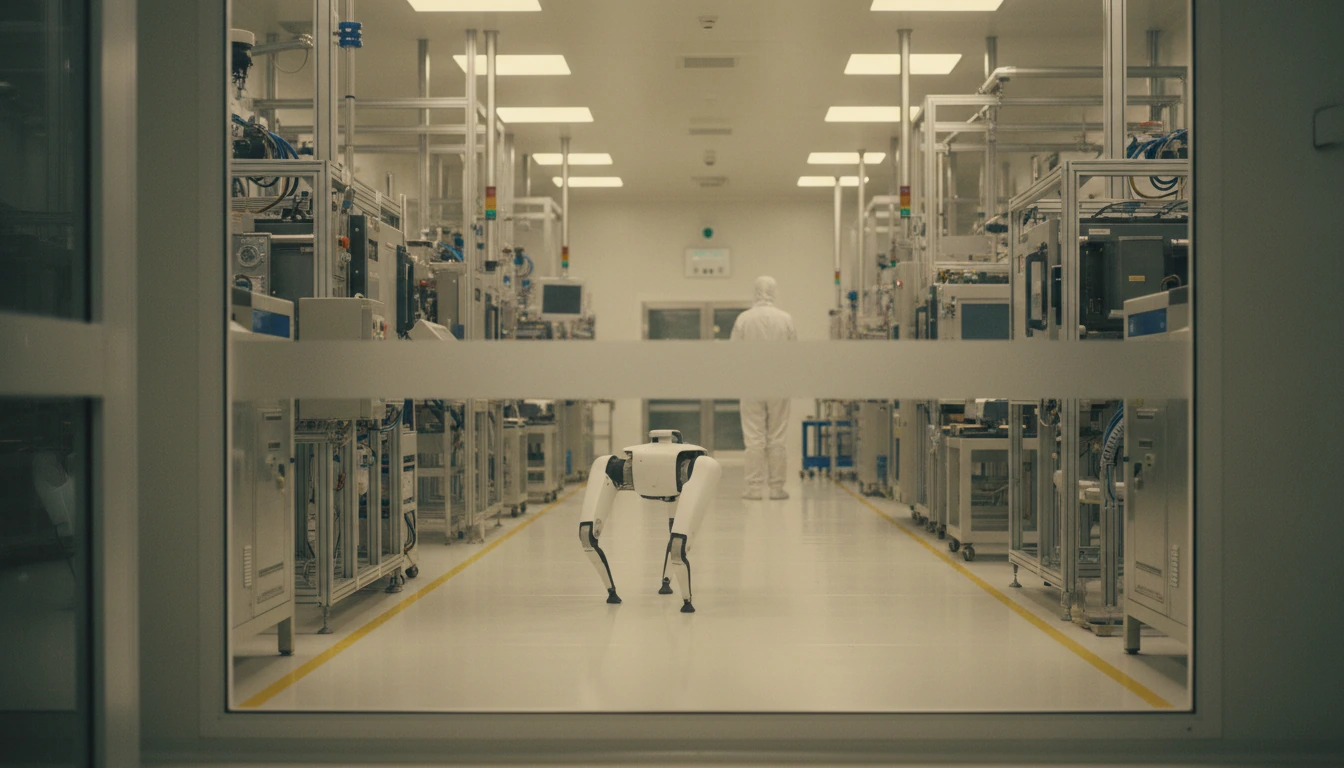
Boston Dynamics will start testing its Atlas humanoid inside GlobalFoundries semiconductor plants in early 2027, the first customer outside the automotive industry to try the robot. The two companies also agreed to expand Boston Dynamics’ four-legged Spot robots across GlobalFoundries fabs in New York, Vermont, Dresden and Singapore. For the humanoid market, it is a first step from car factories into chip manufacturing, one of the most controlled and expensive production environments in the world.
Quick Take
- The deal: An expanded collaboration announced November 17: Spot deployments across GlobalFoundries sites, plus an Atlas early adopter program and skills development workshop.
- Where Spot goes: Malta, New York; Burlington, Vermont; Dresden, Germany; and Singapore.
- Atlas timing: Onsite testing begins in early 2027.
- The first: GlobalFoundries becomes the first customer outside the automotive industry to test Atlas, and the companies call it the first program of its kind for semiconductor manufacturing.
- The caveat: This is a testing program, not a production deployment. Tasks, unit numbers and terms were not disclosed.
In plain English
Chip factories run around the clock and need constant inspection of pumps, gauges and equipment. Spot, the dog-like robot, already walks those routes and collects readings so problems can be fixed before machines break. Now GlobalFoundries wants to see whether a human-shaped robot, Atlas, could take on work that needs arms and hands. In 2027 the two companies will test which jobs make sense and train Atlas on a few of them.
What happened
Under the agreement, Spot will handle autonomous enterprise asset management across GlobalFoundries’ global fabs. The Atlas workshop has three goals, according to the announcement: evaluate potential humanoid use cases, assess customer readiness and integration needs, and begin early testing and training for specific tasks. It complements GlobalFoundries’ program to upskill its employees in AI.
“Spot has helped us shift from reactive to predictive maintenance, collecting data across thousands of inspection points to prevent downtime and keep our fabs running more efficiently,” said Pradip Singh, chief manufacturing officer at GlobalFoundries. “Scaling Spot and testing Atlas are the next steps in our journey to AI-enabled manufacturing, putting physical AI to work across our operations worldwide.”
“Innovative companies like GF are realizing real operational value today while collecting the kind of data that will be extremely useful toward future manufacturing innovation in the next few years,” said Zack Jackowski, chief product and technology officer at Boston Dynamics.
Background: humanoids leave the car plant
Until now, Atlas customers have come from the automotive industry, which is why Boston Dynamics calls GlobalFoundries its first customer outside that sector. Boston Dynamics describes Atlas as its electric humanoid platform “currently in early production.” Rivals are racing on funding and compute, from Figure AI’s $3.5 billion compute deal with Nscale to new rounds for general-purpose robot makers. Our Humanoid Robot Price Tracker follows which robots are actually shipping.
Why it matters
Semiconductor fabs are a demanding proving ground: strict cleanliness, expensive tools and very little tolerance for mistakes. If humanoids can earn a place there, even for narrow tasks, it would show they can work beyond the assembly lines they were first designed around. The Spot side of the deal is also telling: the near-term value of robots in fabs comes from data collection and predictive maintenance, not from replacing workers.
What’s still open
- Which tasks Atlas will test, and in which of GlobalFoundries’ fabs.
- Whether Atlas can meet cleanroom requirements in production areas.
- How success will be measured, and what would trigger a move from testing to deployment.
- How many Spot robots the expansion involves.
About the analysis
Researched and written with AI assistance under the editorial responsibility of the i10X News team. The title image is an AI-generated image. Read our AI Use Policy. Spotted an error? Request a correction.
This independent i10x analysis is based on the joint announcement by Boston Dynamics and GlobalFoundries.
Sources (plain text, no links):
- Boston Dynamics and GlobalFoundries joint press release: “Boston Dynamics & GlobalFoundries Expand Robotics Collaboration” (November 17, 2026)
i10x Perspective
The most important word in this announcement is “testing.” Humanoid makers need new industries to prove their robots are more than automotive experiments, and chipmakers want to know what physical AI can do in their fabs. A year of structured trials will tell more about humanoid readiness than any demo video.