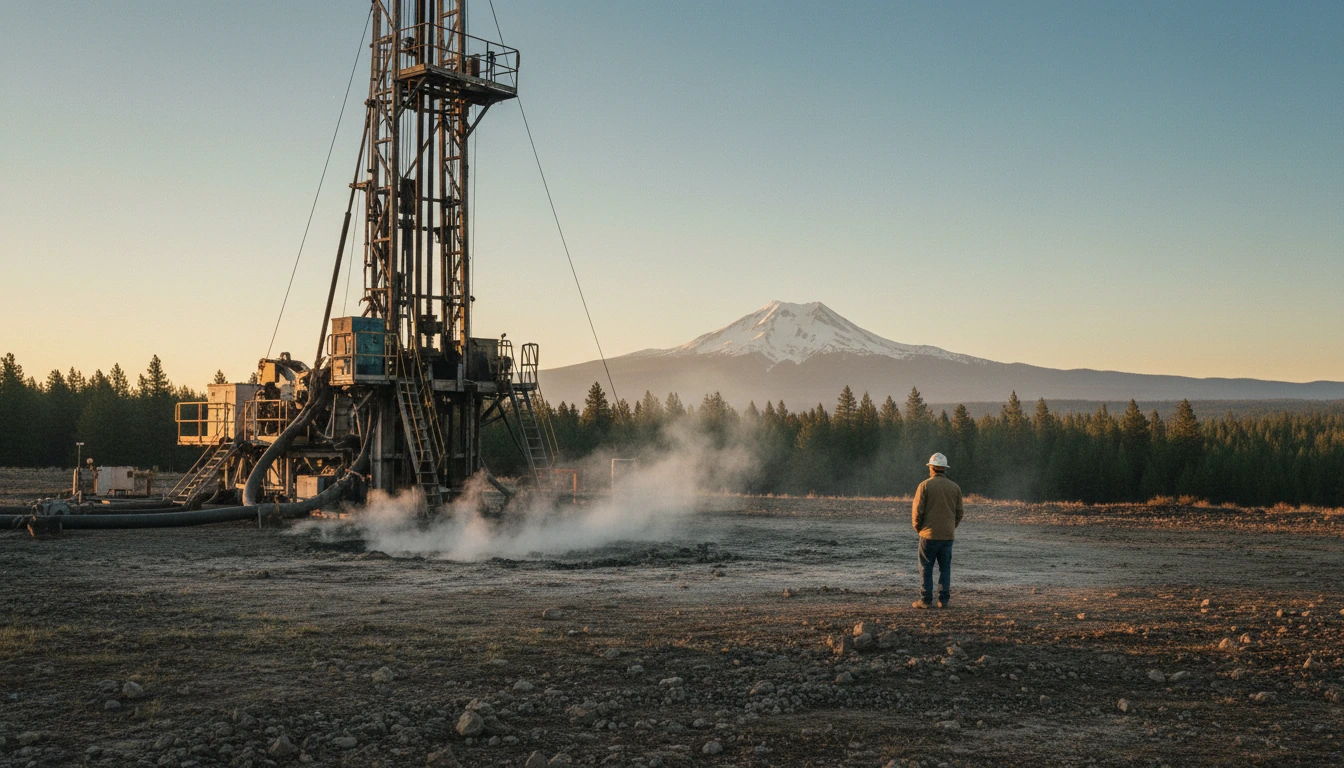
Google has signed a power purchase agreement to buy 50 megawatts of superhot geothermal electricity from Quaise Energy’s Project Obsidian in Central Oregon, with deliveries starting as early as 2030. The always-on, carbon-free power is slated to support Google’s existing data centers in The Dalles, Oregon, and the region’s communities. It is a bet by one of the largest AI compute operators on a geothermal technology that has not yet been proven at commercial scale. Quaise expects the project to support 200 to 400 construction jobs and more than 50 permanent jobs.
Quick Take
- The deal: A 50 MW power purchase agreement between Google and Quaise Energy for power from Project Obsidian, announced November 17.
- Timing: Google buys power beginning as early as 2030.
- Where it goes: Google’s existing data center operations in The Dalles, Oregon, and the region’s communities.
- The technology: Superhot geothermal, which Quaise says can produce up to 10 times more clean power per well than traditional geothermal systems.
- The caveat: The first phase uses conventional drilling. Quaise’s millimeter wave drilling, its core technology, is planned for a second phase and is not yet proven at commercial scale. Price terms were not disclosed by the companies.
In plain English
Deep underground, rock is hot enough to boil water into very high-energy steam. Traditional geothermal plants only work where hot water already sits close to the surface. Quaise wants to drill much deeper into “superhot” rock, which could make geothermal power possible in far more places. Google has agreed to buy part of the electricity from Quaise’s first plant in Oregon to help run its data centers around the clock without burning fossil fuels.
What happened
Quaise, a developer of utility-scale superhot geothermal energy, announced the agreement from Bend, Oregon. The initial phase of Project Obsidian will use conventional drilling technology to access superhot conditions at commercial scale. The second phase is expected to be the first in the world to use millimeter wave drilling, a technology designed to plug into existing drilling rigs and reach superhot rock.
“Together with Google, we are building the commercial foundation for superhot geothermal and cementing the United States as the global leader in geothermal power,” said Carlos Araque, CEO and president of Quaise Energy.
“Google data centers are long-term investments in the communities we call home,” said Lucia Tian, head of advanced energy technologies at Google. “This collaboration with Quaise on superhot geothermal will help fuel local economic growth while helping to build a more robust and affordable energy future for Oregon.”
Background: AI’s hunt for firm clean power
AI data centers need electricity around the clock, which is hard to cover with solar and wind alone. That is why big tech has been signing deals for nuclear, geothermal and long-duration storage. Earlier today we covered Bedrock Energy’s $24 million round for AI-guided geothermal drilling for buildings, a different use of the same underground heat. Google says that from 2010 to 2025 it signed more than 240 agreements to purchase nearly 35 GW of new clean energy, and that its three Oregon data center campuses have already reached 83 percent carbon-free energy. Our Big Tech Energy Deals tracker collects agreements like this one.
Why it matters
Geothermal is one of the few clean sources that can run day and night, exactly what AI workloads need. But conventional geothermal is limited by geography. If superhot drilling works, it could open geothermal power to many more regions near data center clusters. A signed offtake agreement from Google gives Quaise a paying customer before the technology is fully proven, which is often what makes financing for a first-of-a-kind plant possible.
What’s still open
- What Google pays per megawatt hour. The companies did not disclose terms.
- Whether Project Obsidian reaches commercial operation on schedule in 2030.
- When millimeter wave drilling will be ready for commercial wells, and at what cost.
- How much of Google’s Oregon load 50 MW will cover.
About the analysis
Researched and written with AI assistance under the editorial responsibility of the i10X News team. The title image is an AI-generated image. Read our AI Use Policy. Spotted an error? Request a correction.
This independent i10x analysis is based on Quaise Energy’s announcement, which includes statements from Google. Job figures and the 10x per-well claim are company projections and were not independently verified.
Sources (plain text, no links):
- Quaise Energy press release: “Quaise Energy Signs 50 MW Geothermal Power Purchase Agreement with Google” (November 17, 2026)
i10x Perspective
The AI power debate usually centers on gas turbines and nuclear restarts. Deals like this show the hyperscalers are also funding long-shot technologies, because a few successful bets could give them clean, firm power that scales. 50 MW is small next to modern AI campuses; the real prize is proving the drilling technology works.