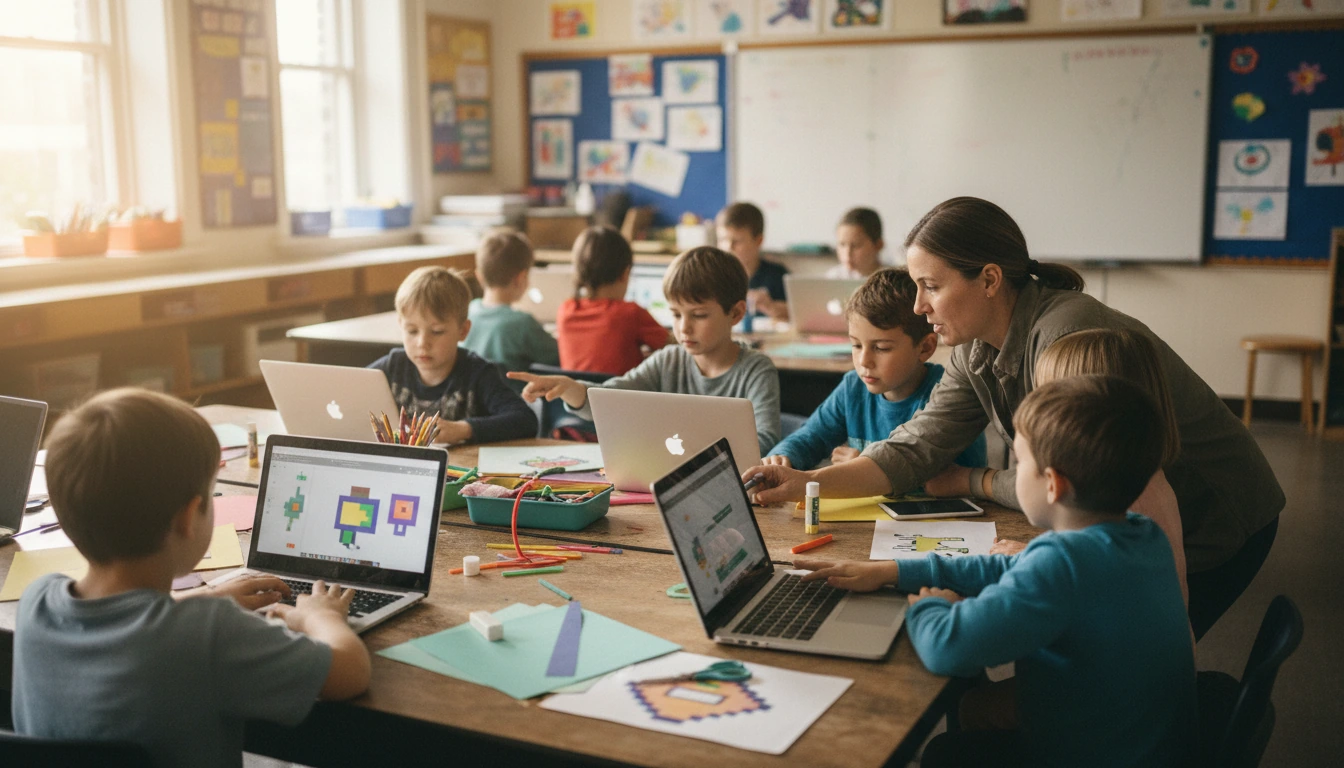
CodeAI, the nonprofit formerly known as Code.org, has launched this year’s Hour of AI activities for students in grades 3 to 12. The 2026 campaign, called “Start Building,” asks students to create their own projects, from a game to a web app, while learning what is behind the technology, such as breaking problems into steps, finding patterns in data, training a simple machine learning model or spotting bias in AI systems. OpenAI is the presenting sponsor, and Microsoft Elevate has co-developed a free 30-minute training course for teachers.
Quick Take
- The launch: Hour of AI 2026 activities, released November 17 ahead of Computer Science Education Week, December 7 to 13, 2026.
- Catalog: More than 250 short activities from organizations including NASA, LEGO Education, Common Sense Media and BrainPOP.
- CodeAI’s own activities: Quest Builder for grades 3 to 8, where students build a game, and AI Makerspace for grades 9 to 12, where students build a web app with AI as co-creator.
- For teachers: A free professional learning module and a 30-minute course with Microsoft Elevate that earns an Hour of AI Educator credential.
- Sponsors: OpenAI is presenting sponsor of Hour of AI 2026.
In plain English
For years, the “Hour of Code” gave millions of students a first taste of programming. The organization behind it now calls itself CodeAI and runs an “Hour of AI” instead. Students build something small, a game or a simple app, and learn along the way how AI works and when it gets things wrong. Teachers who know little about AI can take a short free course first.
What happened
“Parents and teachers are right to have questions about AI. But students are already using it, whether or not schools teach about it,” said Karim Meghji, president and CEO of CodeAI. “Hour of AI starts with learning what’s underneath the technology: how to break a big problem into smaller steps and how to tell when an answer is wrong.”
In Quest Builder, students choose whether to draw images by hand or use AI, and can change anything AI makes; the world and the code stay theirs. In AI Makerspace, students learn to prompt and work with AI while building a project about a topic they care about.
“Every student should have the opportunity to understand AI and discover how they can learn, create and build with it,” said Leah Belsky, VP of Education at OpenAI. Justin Spelhaug, president of Microsoft Elevate, said preparing educators is “essential if students are to engage with AI thoughtfully and responsibly.”
CodeAI says it has reached more than 155 million students across 190 countries and co-founded TeachAI, a global coalition setting standards for AI education.
Background: from coding to AI literacy
The rebrand from Code.org to CodeAI reflects a wider shift in schools from teaching programming to teaching AI literacy. Big AI companies are investing heavily in education, as OpenAI’s expansion of free ChatGPT access for academic researchers showed earlier today. Our AI Tools for Education Compared module and the Education section track the tools reaching classrooms.
Why it matters
Hour of AI reaches classrooms that will never buy an AI curriculum, because it is free and short. That makes its design choices influential: students build things themselves, decide when to use AI and learn to check when an answer is wrong. The sponsorship by OpenAI and Microsoft also shows how central AI companies have become in shaping what children learn about AI, which teachers and parents will watch closely.
What’s still open
- How many students and classrooms take part this year, which CodeAI usually reports after Computer Science Education Week.
- Which AI models power the activities that use generative AI, and how student data is handled.
- Whether the short activities lead to lasting AI courses in schools.
About the analysis
Researched and written with AI assistance under the editorial responsibility of the i10X News team. The title image is an AI-generated image. Read our AI Use Policy. Spotted an error? Request a correction.
This independent i10x analysis is based on CodeAI’s announcement. Reach figures are organization statements and were not independently verified.
Sources (plain text, no links):
- CodeAI press release: “Start Building: Hour of AI Gives Students a Hands-On First Step Into Understanding Technology” (PR Newswire, November 17, 2026)
i10x Perspective
The most important skill in this year’s Hour of AI is not prompting but “how to tell when an answer is wrong.” If an hour of building teaches children to question AI output, it does more for AI literacy than any lecture about the technology. The sponsorship question will not go away, though: who teaches kids about AI matters.