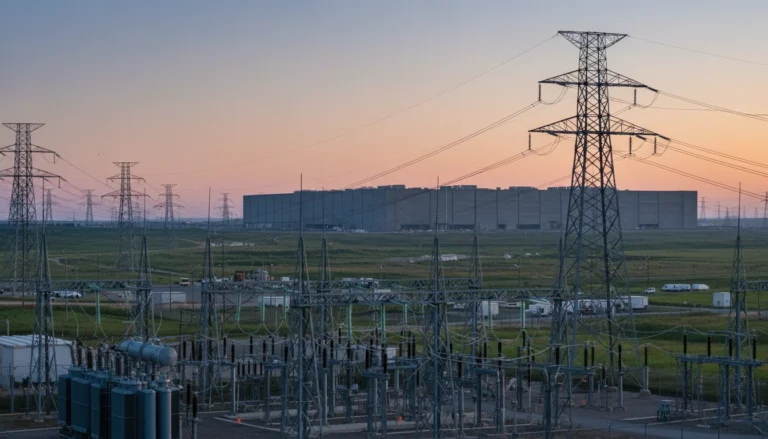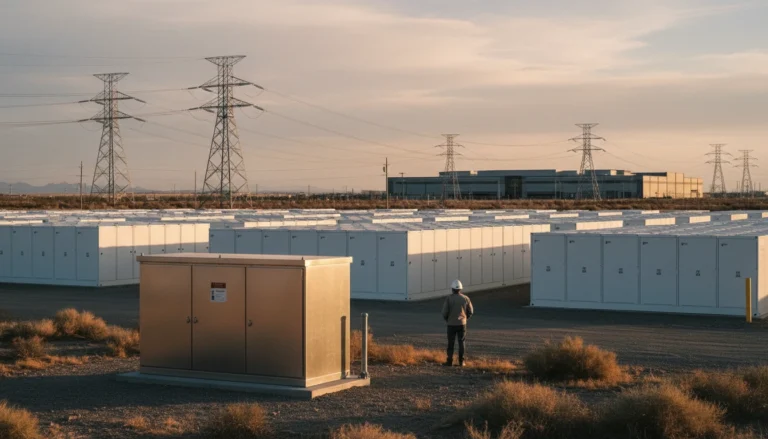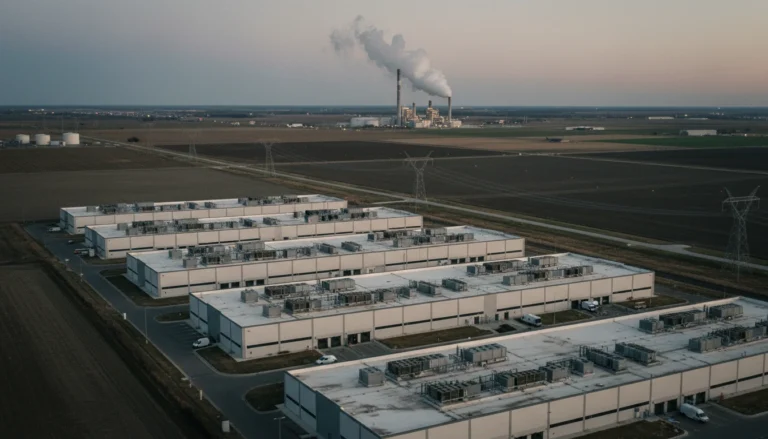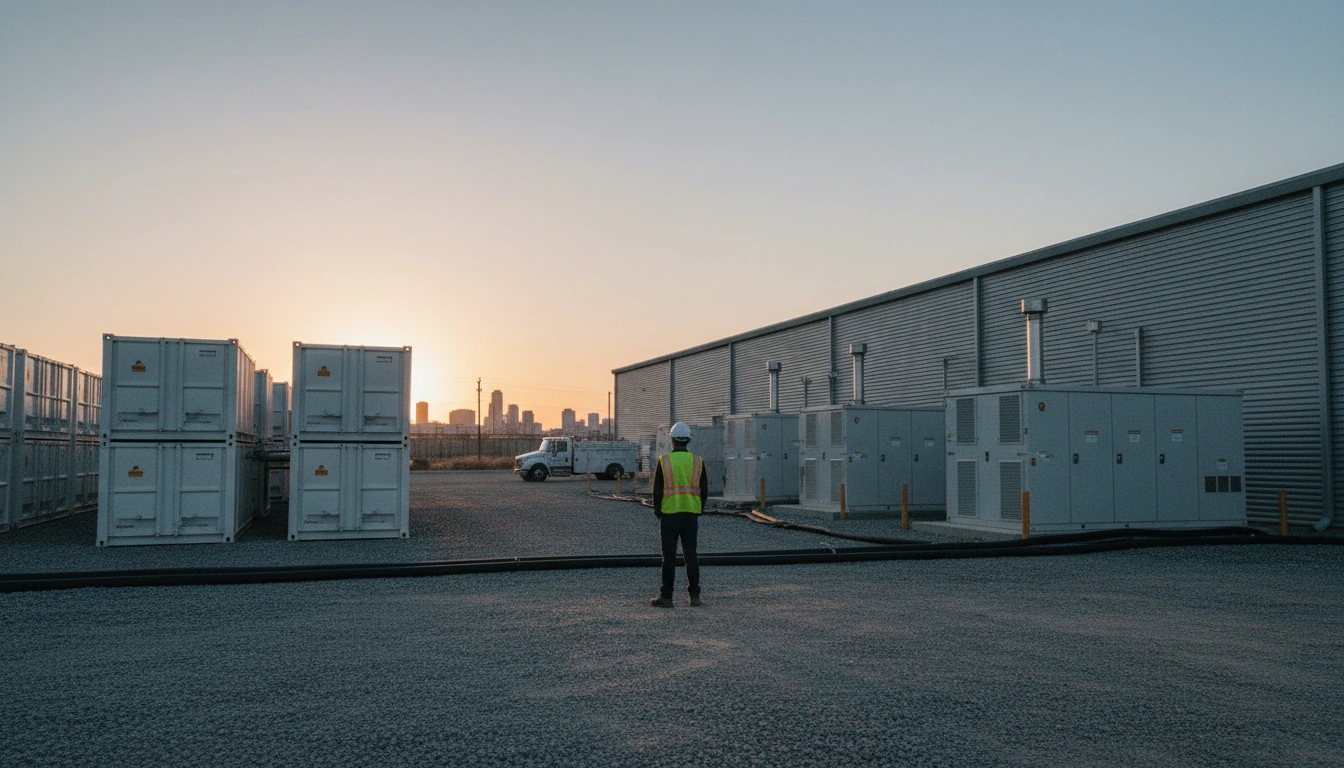
Trina Storage has unveiled Elementa Hybrid Genset, an on-site power system for AI data centers that combines gas engines, battery storage and a hybrid plant controller. It is aimed at data center developers who need power while their grid connection is delayed, limited or not available at all. The company launched the system at the RE+ 2026 trade show in Las Vegas after a preview in September.
Quick Take
- The parts: Gas reciprocating engines of up to 2.5 MW each from qualified partners, Trina Storage’s Elementa DC battery systems and Electra AC platform, and a hybrid plant controller.
- The scale: Battery reference configurations in 5 MW and 10 MW building blocks; the control architecture is designed for sites from 5 MW to 1 GW.
- The AI problem: AI workloads can swing power demand quickly. Batteries cover the sudden jumps while gas engines ramp up.
- Four scenarios: Grid-connected with backup, grid-constrained, bridge-to-grid and off-grid. Solar can be added where it fits.
- Status: Testing of grid-forming functions and hybrid controls is ongoing, alongside certification work.
In plain English
New AI data centers often wait years for a large enough grid connection. Some developers bridge that gap with their own power plant on site. Gas engines can run for long periods but react slowly to sudden changes, while batteries react instantly but run out. Trina’s system packages both and lets software decide, moment by moment, which one supplies the power.
What happened
Trina Storage announced the launch on November 18. Its controller uses three core functions: load transient sensing, which predicts changes in demand and triggers a fast battery response; hybrid power coordination between batteries and gas engines; and fault isolation that cuts off failed equipment while the remaining sources keep critical loads running.
Two architectures are offered. “Load Sensing” prioritizes cost efficiency and performance, while “Double Conversion” provides full electrical isolation and higher power quality. “AI data centers have demanding power requirements, particularly when grid capacity is constrained, or workloads fluctuate rapidly,” said Eric Cao, Vice President of Trina North American PV and BESS Business.
Background
On-site gas has become a common bridge for AI campuses that cannot wait for the grid, as seen in Anthropic’s $3.4 billion gas generator deal. Equipment makers are also redesigning the power chain itself, such as with Tesla’s Powercore solid-state transformer.
Why it matters
Power, not chips, is increasingly the bottleneck for new AI capacity. Systems like this let data centers start running sooner, but if gas becomes the long-term source rather than a bridge, emissions rise. The battery share and the option to add solar will decide how much of that bridge power is clean.
What’s still open
- Which data center developers have signed up, and at what size.
- Final performance specifications, which Trina says will be set per project.
- Expected emissions per megawatt-hour compared with a grid connection.
About the analysis
Researched and written with AI assistance under the editorial responsibility of the i10X News team. The title image is an AI-generated image. Read our AI Use Policy. Spotted an error? Request a correction.
This independent i10x analysis is based on Trina Storage’s press release. All quotes are taken from that source.
Sources (plain text, no links):
- Trina Storage press release: “Trina Storage Launches Elementa Hybrid Genset, a Modular Gas-and-Storage Power Plant for AI Data Centers” (November 18, 2026)
i10x Perspective
The AI boom is turning data centers into small utilities. Products that blend gas, batteries and smart control are a sign the grid will not catch up soon. Follow the deals in our Big Tech Energy Deals tracker.