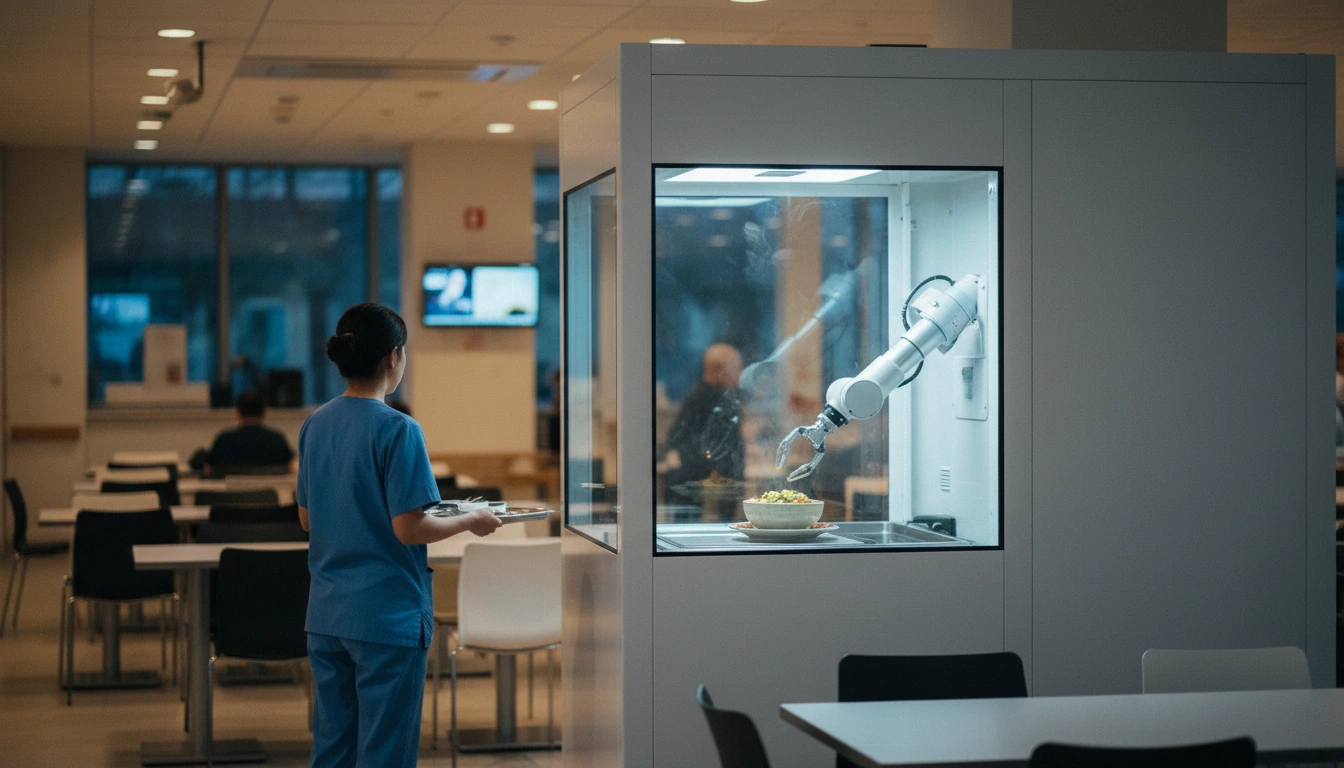
Munich-based Circus SE has launched its CA-1 robot kitchen in a hospital for the first time. Schoen Clinic Munich Harlaching is the launch customer, and patients, medical staff and visitors can now get freshly cooked meals produced autonomously by the robot around the clock. Circus describes itself as a physical AI company that develops AI robotics for autonomous meal production.
Quick Take
- The launch: CA-1 robotic technology now runs at Schoen Clinic Munich Harlaching, an orthopaedic specialist hospital, as Circus’s launch customer in hospital care.
- The operator: The system is run by the Schoen Clinic Group’s food service subsidiary, which serves more than five million meals a year.
- The pitch: Circus says Germany’s roughly 1,800 hospitals treat around 17 million inpatients a year on limited food budgets while labor shortages restrict fresh meal availability.
- The claim: Robotic solutions deliver “stronger cost-per-meal economics at significantly longer service hours,” according to the company.
- Next step: Circus wants to build personalized nutrition programs for care settings, from special diets to meals along a patient’s recovery.
In plain English
Hospital kitchens usually close at night, so shift workers and visitors often fall back on vending machines. Circus builds a cooking robot that stores ingredients, prepares hot meals and serves them without a chef standing at the stove. At this Munich hospital it now runs day and night, so a nurse on the night shift can get a freshly made meal.
What happened
Circus announced the launch on November 19. “Healthcare never sleeps. We have spent decades transforming how hospitals diagnose and treat patients. It is time to rethink the infrastructure that feeds them, too,” said Ilona Schukina, VP Operations at Circus.
Kathy Döhler, Managing Director of Schoen Clinic Munich Harlaching, said the offering “brings more flexibility to everyday hospital life, especially for colleagues working shifts and nights,” and added: “We are proud to be the first hospital in Germany to bring this innovation into everyday care.”
Schoen Clinic is the largest family-run hospital group in Germany, with 17 hospitals and 38 outpatient and day-clinic facilities in Germany and the UK and around 13,600 employees.
Background
Circus is listed in Germany and says it develops proprietary AI models, autonomous robotic systems and a central operating platform for civilian and defense applications, with high-volume serial production of its meal robots already live. Hospitals are becoming a testing ground for robots beyond the operating room, from logistics to clinical procedures.
Why it matters
Food service is one of the largest non-medical costs in hospitals and one of the hardest jobs to staff around the clock. A working deployment at a well-known German hospital group gives physical AI a concrete use case in healthcare that does not touch diagnosis or treatment, and it tests whether autonomous kitchens can meet the hygiene and dietary demands of clinical settings.
What’s still open
- How many meals per day the CA-1 serves at the hospital and at what price per meal.
- Whether Schoen Clinic plans to roll out the system to other hospitals in its group.
- How personalized patient diets, which Circus mentions as a goal, would be integrated with clinical nutrition teams.
About the analysis
Researched and written with AI assistance under the editorial responsibility of the i10X News team. The title image is an AI-generated image. Read our AI Use Policy. Spotted an error? Request a correction.
This independent i10x analysis is based on Circus SE’s corporate announcement of the hospital launch. Quotes are taken from that announcement.
Sources (plain text, no links):
- Circus SE corporate news via EQS: “Circus Brings Autonomous Robotics into Hospital Nutrition; Launched with Schoen Clinic Group” (November 19, 2026)
i10x Perspective
Physical AI is quietly moving into the unglamorous jobs first: welding, warehouses and now hospital kitchens. Those deployments, not humanoid demos, will show whether robots pay off. More on our Engineering & Robotics page and the Health & Medical Research page.