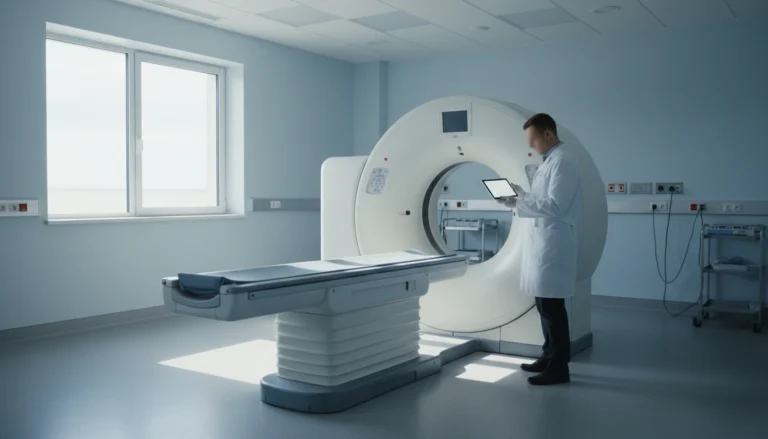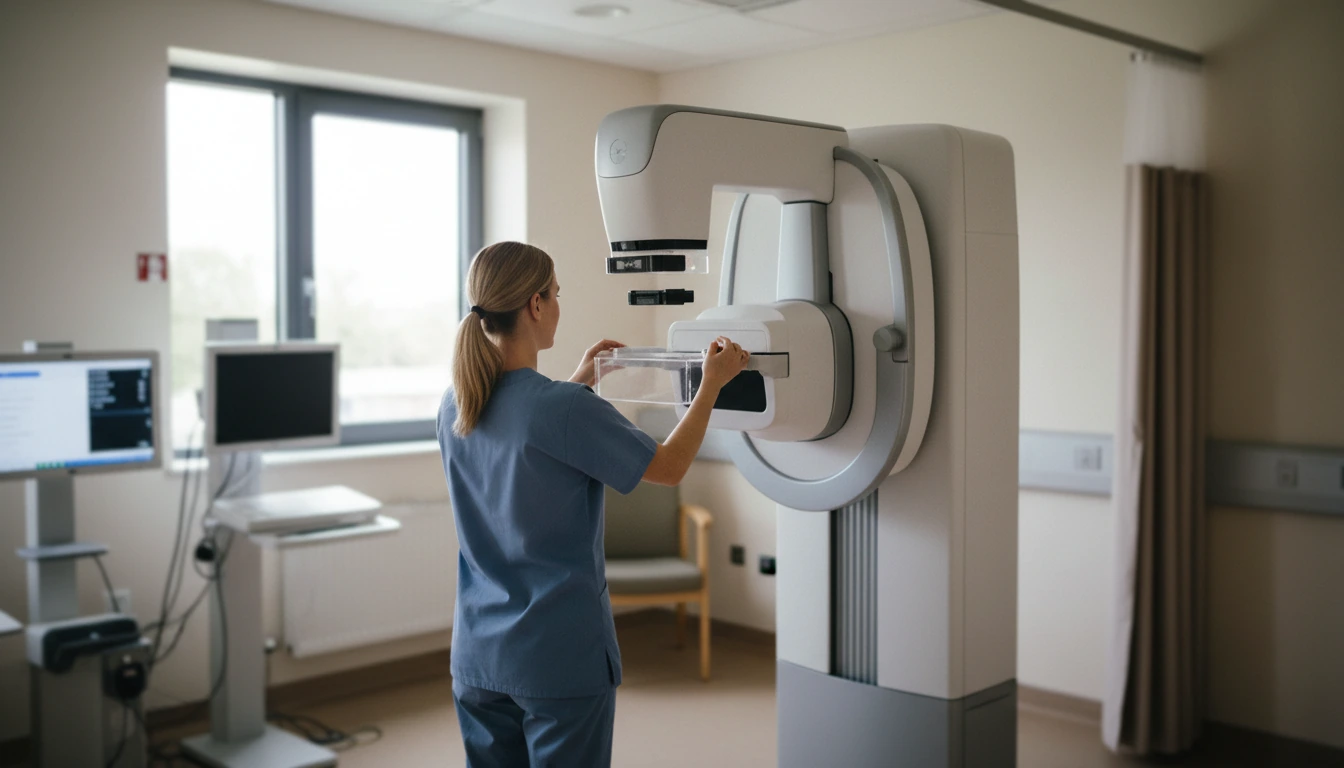
The NHS has started recruiting women into EDITH, a £10 million trial that tests whether AI can take over part of the reading of breast screening mammograms. NHS England’s announcement of November 23 says nearly 700,000 women attending routine screening will take part over the next three years, starting at Cambridge University Hospitals and expanding to 30 sites across the UK. Today every mammogram in the programme is checked by two specialists. EDITH will test whether, with AI support, most images can be safely read by one.
How the trial works
Nothing changes in the screening room. Women aged 50 to 71 receive their usual invitation, with extra information about the trial and an option to opt out. The difference comes afterwards, when images are read: an AI tool works alongside the clinicians and flags areas where a cancer might otherwise be missed. Every image is still seen by at least one human specialist, and all clinical decisions stay with NHS staff.
The trial is funded by the National Institute for Health and Care Research and led by the University of Warwick, the University of Cambridge and Cambridge University Hospitals. Co-lead Sian Taylor-Phillips says the team has tested four AI systems for accuracy before the start. The NHS has not named the vendors.
The scale, in numbers
The UK carries out around 2.1 million breast screenings a year, which the NHS credits with preventing about 1,300 deaths annually. Fewer than 1% of mammograms show signs of cancer, so most reading time goes into images that turn out normal.
Our own arithmetic on what is at stake:
- Trial share: 700,000 women over three years is about 233,000 a year, roughly one in nine of all UK screenings.
- Reading workload: two reads per screening means about 4.2 million human reads a year. If most screenings moved to a single human read, the upper limit of the saving is close to 2 million reads a year. The real figure will be lower, because flagged and unclear cases still go to a second reader.
- Workforce: the Royal College of Radiologists said in its response to the launch that more than a fifth of the breast radiology workforce is due to retire by 2030, while the workforce has grown by an average of only 2% over the past five years. Its president called the trial promising but “not a quick fix”.
What earlier trials already showed
EDITH is not the first large test of AI in breast screening, but it is the biggest. Two European studies set the bar it will be measured against:
| EDITH (UK) | MASAI (Sweden) | PRAIM (Germany) | |
|---|---|---|---|
| Women | nearly 700,000 over three years | about 106,000 | 463,094 |
| Setting | 30 NHS screening sites | population screening trial | real-world use at German screening sites |
| AI systems | four, not named | one | one |
| Main results | pending | 29% more cancers found, 44% less reading work, 12% fewer interval cancers | 17.6% higher detection rate, recall rate not higher |
| Status | recruiting since November 2026 | final results January 2026 | published January 2025 |
Sources: NHS England (EDITH), Lund University and The Lancet (MASAI), Nature Medicine (PRAIM).
The Swedish MASAI trial is the closest comparison. Its final results in The Lancet showed 12% fewer interval cancers (those found between screening rounds) and a higher sensitivity with no rise in false positives, on top of 29% more cancers detected and a 44% lower reading workload reported earlier. Germany’s PRAIM study, published in Nature Medicine, looked at real-world use across 463,094 women and found a 17.6% higher detection rate with AI-supported double reading, without more recalls. Radiology is also where AI tools are most mature commercially: in our FDA AI Medical Device Tracker, 1,230 of the 1,614 AI devices authorized in the US (76%) sit under the radiology panel. Results are less convincing for harder reads, as a recent study on AI agents reading CT and MRI scans in emergency care showed. EDITH’s added value is scale, four different AI systems instead of one, and a national health service setting, which is the kind of evidence the NHS says it needs before it changes how screening works.
What women and clinicians should know
- If you are invited: your appointment is the same as before. The letter explains the trial and how to opt out. Taking part does not mean a machine decides your result.
- Results letters: if the AI flags something, the case goes to a specialist. A recall still means a human recommended further tests.
- For screening services elsewhere: MASAI already supports AI triage in Sweden, and German programmes have real-world data from PRAIM. EDITH will add evidence on several vendors in one system, which matters for procurement.
When answers can be expected
The key safety measure in screening trials is the interval cancer rate, and that needs follow-up time. MASAI started in 2021 and only reported its interval cancer results in January 2026, once every participant had completed two years of follow-up. If EDITH recruits for three years and uses a similar follow-up, full results are unlikely before the early 2030s by our estimate. Earlier readouts on detection rates and workload could come sooner, but the NHS has not published a timetable.
i10x Perspective
This is the right way to bring AI into cancer screening: a large multi-site trial, human readers kept in the loop and a clear safety endpoint. Our concern is the timeline. The radiology shortage is now, and the evidence from Sweden and Germany is already strong. We expect pressure to adopt AI triage in parts of the NHS before EDITH reports, and the trial’s real legacy may be setting the rules for choosing and monitoring vendors rather than answering whether AI works at all.