Chatbot leaderboards rest on a simple idea: people compare two anonymous answers and vote for the better text. A working paper from Stevens Institute of Technology and UMass Boston shows that the vote also depends on how the text reaches the screen. On compar:IA, the French government’s public chatbot arena, a cost-saving cache sometimes replayed a stored answer that appeared almost instantly instead of being written out word by word. Those instant answers lost far more often, even when they were the exact same words that had been streamed to an earlier visitor. For anyone who builds a chatbot or reads a leaderboard, that is a measurement problem hiding in plain sight.
Same words, half the wins
From March 2026, compar:IA kept a store of earlier first answers. When a model had already answered the same opening prompt, a random draw decided whether the visitor got a fresh answer streamed as it was generated or a stored one. The replay was meant to be shown in about fifteen pieces to imitate streaming, but a server quirk cut those pauses short. The median replay filled the screen in 0.3 seconds; the median fresh answer to the same prompts took 4.3 seconds, roughly 14 times longer.
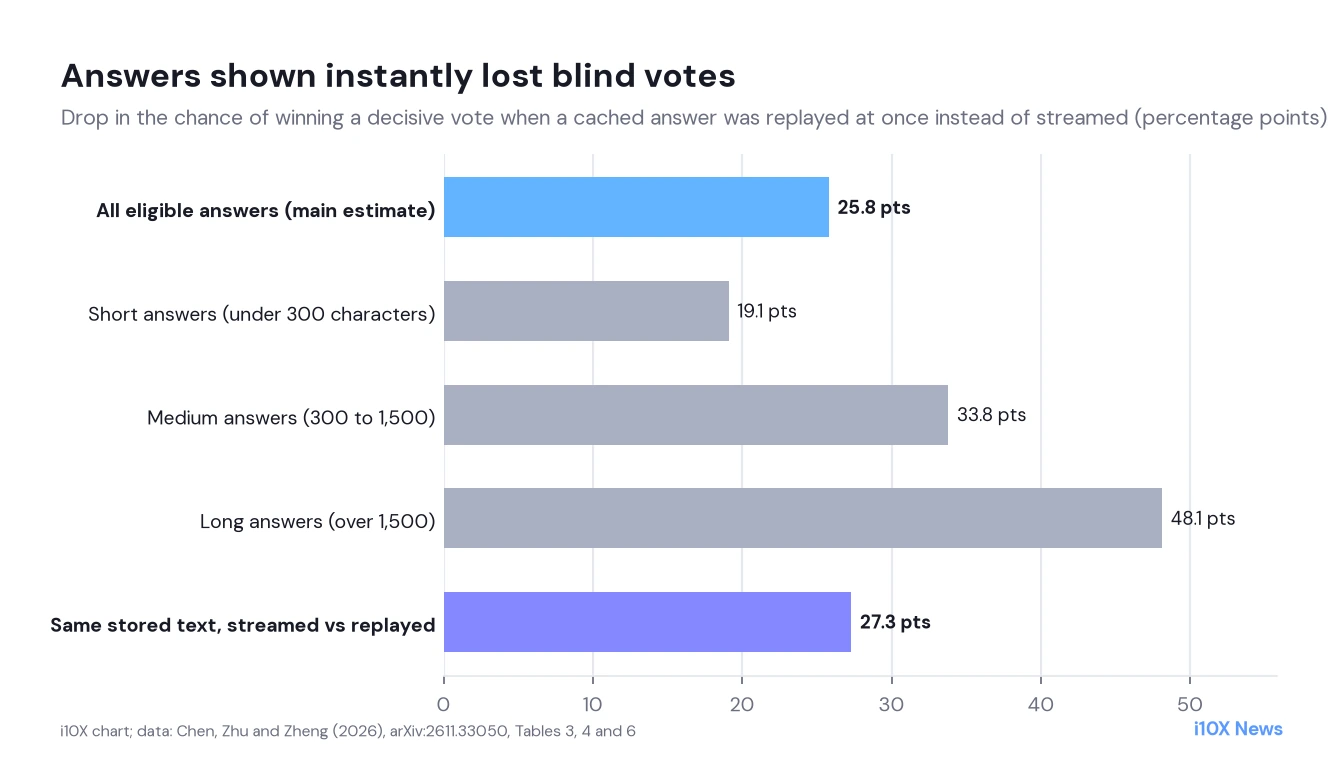
- The headline effect: Comparing answers to the same prompt, a replay cut the chance of winning a decisive vote by 25.8 percentage points. In the 474 decisive votes between a replay and a fresh answer, the replay won only 22%.
- Identical text: 265 stored answers received decisive votes both ways. Weighting each text equally, the same words won 57% of decisive votes when streamed and 29% when replayed, so the win share roughly halved.
- Voters blamed the content: When replayed, an answer was 21.0 points less likely to be tagged complete, 12.7 points more likely to be called superficial and 8.0 points more likely to be called incorrect. Thumbs-up fell by 62%.
- Longer answers lost more: The penalty was 19.1 points for answers under 300 characters, 33.8 for medium answers and 48.1 for answers over 1,500 characters. It appeared with and without reasoning models in the pair.
Waiting earned nothing, but cost follow-ups
A second test used provider congestion, which slowed some streamed answers for reasons unrelated to their content. Across the first exchanges of 324,029 conversations, a slower answer did not win more votes; the estimates rule out a gain of more than about 1.4 points for a doubling of the wait. What changed was behaviour. Each doubling of the wait cut the chance of a second question by about 1.3 points from a base of 23.1%, and most of that loss came in the slowest fifth of chats. In the slowest tenth, with a median wait of 111 seconds, follow-ups were 3.6 points less likely than in the fastest tenth.
A third test looked at 4,378,514 replies in WildChat, a public log of everyday ChatGPT use. There too, replies slowed by congestion made users less likely to send another message.
Why this is stronger than a lab survey
Delivery speed and quality usually travel together: hard questions get long answers, and slow reasoning models are often the strong ones. The replay lottery breaks that link because the platform itself drew at random, within the same model and prompt. The authors check the draw against time of day, visitor history, screen position and answer length and find differences close to zero, and 93% of replays match an earlier fresh answer word for word. The congestion study uses other visitors’ same-day slowness as an instrument. All three data sources are public: compar:IA publishes conversations, votes and reactions under the open Etalab 2.0 license (datasets on Hugging Face), and WildChat is a released research corpus.
Method in brief
- Study 1: 11,699 eligible first answers in 2,460 model and prompt cells, 16 March to 18 May 2026, 65% of them replays; 1,005 decisive votes in the main regression, with prompt and model-pair fixed effects.
- Study 2: Streamed first exchanges from February 2025 to May 2026; slowness relative to answer length, with provider congestion as an instrument; outcomes were votes, thumbs and follow-up questions.
- Study 3: WildChat-4.8M, ChatGPT conversations from April 2023 to July 2025 across GPT-3.5, GPT-4, GPT-4o, GPT-4o-mini, GPT-4.1-mini and o1.
- Status: Preprint, not peer-reviewed. No funding or conflict of interest statement. The authors’ analysis code is not listed as released.
What remains open
- Why it happens: A replay changes speed, the way text unfolds and reading time all at once. The data cannot say whether voters credit visible effort or simply find unfolding text easier to follow. The authors outline an experiment to separate the two.
- Beliefs or excuses: The quality tags are optional and chosen with the vote. They show how voters justify a choice, not whether they truly believed the answer was wrong.
- Narrow prompts: The lottery only covers prompts that were asked repeatedly, which tend to be short and are more often suggested by the site or assigned in class. compar:IA’s audience is mostly French-speaking and includes many students.
- Continuation is not satisfaction: A user may stop asking because the first answer was enough. The paper does not link lost follow-ups to task success.
Context: the second warning about arena votes this month
The same team reported on November 10 that verdicts on unchanged models in Chatbot Arena grew harsher every month, as we covered here: users raised their bar while the models stayed the same. Together the two papers, both filed in our Society & Economy studies, make one point. A blind vote measures the text, the voter and the moment of delivery at once. That matters because arena rankings are now big business: Arena Intelligence, the company behind the former LMArena, raised $200 million at a $3.1 billion valuation in October. Leaderboards already correct for answer length, a well-known bias. In this data, an answer about 2.7 times as long won 13.9 points more often. A replay cost 25.8 points, so the delivery effect was larger than one of the best-documented biases in preference data.
What product teams and leaderboard readers should do
- If you cache answers: Do not dump a stored answer onto the screen in one go. Stream it at a readable pace and test whether that removes the penalty, as the authors suggest. Caching saves money, but in this study instant display also made the same answer look worse.
- If you are tempted to add delay: Do not. Extra waiting on an answer that is already streaming brought no detectable credit and cost follow-up questions.
- If you tune latency: Watch the slowest fifth of requests rather than the median. In compar:IA, that is where follow-up questions dropped. For more on the cost side of caching, see our analysis of the semantic caching market.
- If you read leaderboards: Ask whether answers were shown under the same display conditions and whether caching or streaming pace was recorded. Preference scores also miss latency when both answers are slow, so continuation rates belong next to them.
About the analysis
Based on the full text of arXiv:2611.33050v1 (submitted November 24, 2026), including Tables 1 to 9 and the limitations section. All numbers come from the paper; the 14-fold speed ratio and the comparison of the replay effect with the length effect are our own readings of its figures. The chart is redrawn from Tables 3, 4 and 6 (arXiv non-exclusive license, so no original figure is reused).
i10x Perspective
This is one of the cleanest field experiments on chatbot UX we have seen, and it came about by accident: a cache meant to save money and a bug that made it too fast. The lesson for evaluation is uncomfortable. If presentation can move a blind vote by a quarter, model rankings that differ by a few points deserve caution, and any arena that caches answers should publish how it displays them. For product teams the message is simpler: streaming is not just cosmetic, it shapes how good your answer looks.