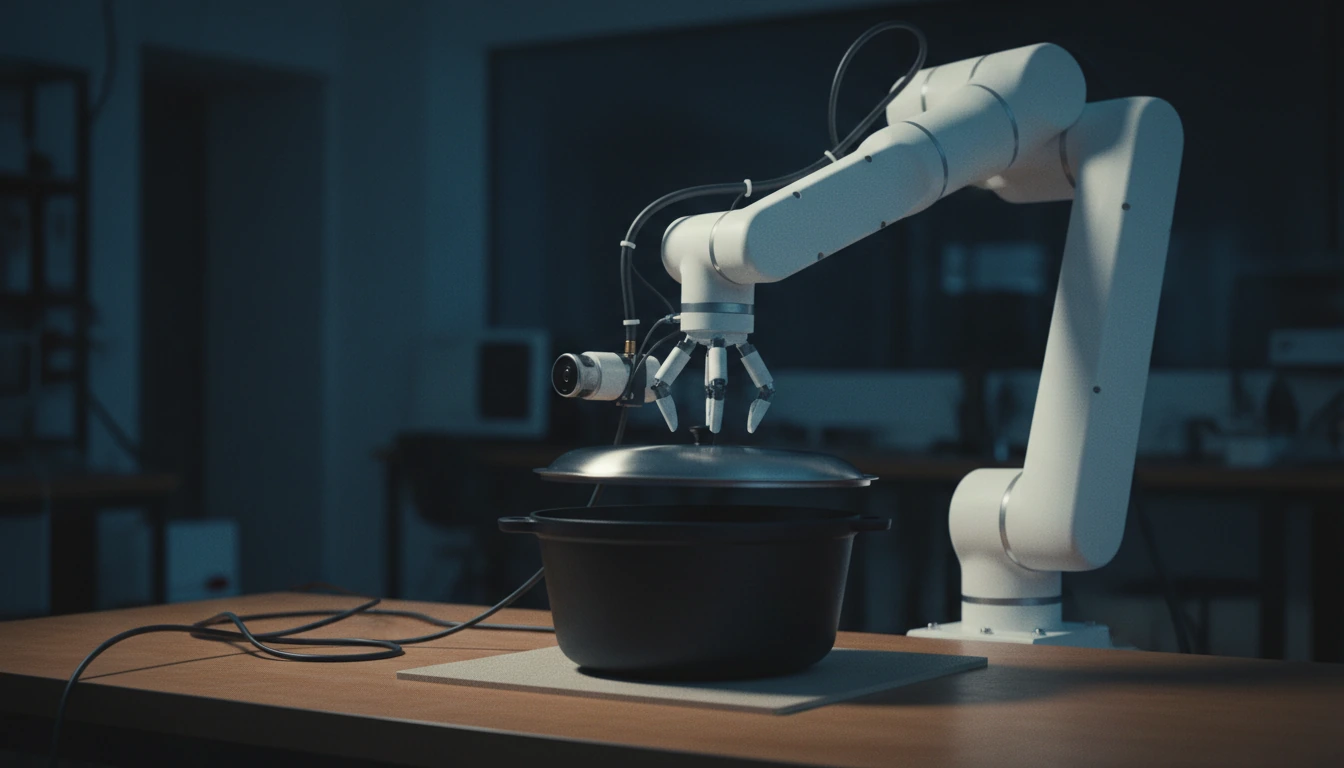
A new open benchmark puts numbers on a question robotics teams keep asking: can a general AI model control a robot arm just by writing code? In RoboUniverse-10K, Einsia and researchers from Tsinghua and Peking University among others built 10,807 simulated manipulation tasks automatically from real robot videos. On 500 held-out tasks, GPT-6.2 Astra succeeded 85.8% of the time and Claude Opus 5.5 76.8%, while no open model got past 10%. The environments and a fine-tuned 35B model are public on GitHub, with the paper under CC BY 4.0.
The scoreboard
Every model gets one attempt per task, cannot reset the scene and never sees its score until an independent verifier checks the final physical state. The test set holds 200 single-arm Franka tasks and 300 dual-arm AgileX tasks.
| Model | Open weights | Harness | Overall success |
|---|---|---|---|
| GPT-6.2 Astra | No | Codex | 85.8% |
| Claude Opus 5.5 | No | Claude Code | 76.8% |
| GPT-6 Astra | No | Codex | 54.6% |
| GPT-6.1 Sol | No | Codex | 49.4% |
| RoboUniverse-35B-A3B (fine-tuned by Einsia) | Yes | Claude Code | 21.2% |
| DeepSeek V4.1 Flash | Yes | Claude Code | 10.0% |
| Tencent Hy4 | Yes | Claude Code | 9.2% |
| Qwen4-Max | No | Claude Code | 8.6% |
| GPT-6 Luna | No | Codex | 5.6% |
| Kimi K3.1 Pro | Yes | Claude Code | 5.0% |
| Doubao Seed Evolving | No | Claude Code | 4.0% |
| GLM-5.3-Flash | Yes | Claude Code | 2.6% |
| Qwen3.6-35B-A3B (base) | Yes | Claude Code | 0.8% |
RoboUniverse-Verified, 500 held-out tasks, one attempt each. Figures from the RoboUniverse-10K paper (arXiv 2611.31002, November 23, 2026); the fine-tuned and base Qwen rows come from its post-training section.
One caveat matters for reading the gaps between neighbours. The GPT models ran in OpenAI’s Codex harness and all others in Claude Code, and our look at 13 coding agent harnesses showed that the wrapper alone can move results. A gap from 85.8% to 10% is far too large to be a harness effect, but a few points between the top two should not be over-read.
Where even the best models fail
The paper’s failure analysis is the most useful part for anyone running real robots.
- Grasping is the dividing line. On tasks that only require pushing or pressing, the weaker models still reach 32.1%. As soon as an object has to be grasped, they fall to between 0% and 4%, against 57% to 77% for the four frontier models.
- Cloth is a shared ceiling. All four frontier models stay between 28% and 41% on cloth tasks. Moving from the mid tier to the top tier adds 35 to 38 points on assembly and pick and place, but only 3 points on cloth.
- Most frontier failures happen after contact. About 80% occur once the object is already touched: a lid placed 6 mm off center when 2 mm was allowed, or a button pushed past its 3.5 mm travel with 70 to 138 newtons of force.
That last point is the warning for practitioners. In the camera image, the failed and successful lid placements look almost identical. A model that judges the world only through vision cannot tell, and on a real arm, 138 newtons on a small switch can break hardware. If you test code-writing agents on physical robots, enforce force and torque limits below the agent, not in the prompt.
What fine-tuning bought the open model
Einsia trained Qwen3.6-35B-A3B on about 17,000 trajectories (0.79 billion tokens) generated by GPT-6 Astra, using roughly 1,500 H100 GPU hours. The result, RoboUniverse-35B-A3B, rose from 0.8% to 21.2% overall. By our calculation that is 2.1 times the best open baseline (DeepSeek V4.1 Flash at 10.0%), but still only about a quarter of GPT-6.2 Astra’s score. The gain is lopsided: single-arm tasks went from 2.0% to 40.5%, dual-arm tasks only from 0.0% to 8.3%.
Two practical notes. The training data is distilled from a closed model, a practice OpenAI is actively working to block, as we reported in our story on its distillation defenses; anyone repeating the recipe with commercial outputs should check the provider’s terms first. And running the benchmark is not cheap: the README asks for a GPU that holds 67 GB of bf16 weights for the model server, plus one RTX-class GPU with 18 to 44 GiB and at least 8 CPU cores per simulation, and an NVIDIA Isaac Sim license review.
Why it matters beyond the leaderboard
The results support the bet OpenAI made when it folded its stand-alone robotics team into its main research group on the grounds that general models can drive robots directly. They also sharpen the contrast with the vision-language-action models in our Robot AI Model Comparison, such as X Square’s WALL-OSS-1.0, which learn motor control end to end. The authors list the limits themselves: simplified scenes, poorly modeled hinges and latches, short atomic tasks rather than long workflows, and only one real-robot demonstration, a Franka arm drawing a logo on a whiteboard.
i10x Perspective
RoboUniverse-10K is valuable less for its top score than for its failure map. Frontier models now plan manipulation well in simulation, yet they still crush buttons and misplace lids because they cannot feel. The next real gain will come from adding touch and force signals to the agent loop, not from more reasoning tokens: the base model’s median output was 14 times longer than the fine-tuned model’s, and it did far worse. For open models, a jump from 0.8% to 21.2% on 1,500 GPU hours shows the path is cheap enough for university labs, so we expect the open gap to narrow quickly on single-arm tasks and much more slowly on two-arm coordination.