
In Codex and Claude Code, one sentence is enough to let an agent hand work to parallel subagents, and the token bill grows with every helper it starts. A preprint from the University of Illinois Urbana-Champaign tested whether that spending buys a better program. On randomly drawn tasks in which an agent builds a whole program from scratch, subagents lifted the share of hidden tests passed by only about 1 to 5 points, while the run cost 2.6 to 3.8 times as much as a single agent. On hard tasks the gap was larger, but a good part of it came from habits a lone agent can be pushed into: checking its work for longer, restarting with a clean context and splitting code into files. That makes the paper a useful guide for anyone deciding when the subagent switch pays off.
Small gains, multiplied bills
Zhiheng Lyu, Chengyu Yin and Lingming Zhang ran OpenAI’s Codex CLI with its built-in subagents on 30 random tasks from each of two benchmarks. NL2Repo asks for a Python library described only in writing. ProgramBench asks the agent to rebuild a command-line tool and hands it the original executable, which the agent may run on any input to compare behaviour. In both, the grading tests stay hidden, so the agent has to decide for itself when it is finished. In the multi-agent setup, the main agent was only allowed to delegate, not told to, and it did so in every run, starting a median of 7 to 10 subagents.
- ProgramBench, GPT-5.6 Sol: A single agent passed 76.2% of hidden tests for an average of $5.69 per task at list prices. With subagents: 77.4% for $18.32.
- NL2Repo, GPT-5.6 Sol: 67.7% for $3.02 against 70.6% for $11.56. Subagents led early (47.2% against 16.9% after five minutes), but the final gap was small.
- Three model generations: On ProgramBench, the gain ranged from 1.2 to 4.7 points with GPT-5.6 Sol, GPT-6 Sol and GPT-6.1 Sol. With GPT-6.1 Sol, 2.5 of the 4.7 points came from a single task, and the median per-task gain was 1.5 points.
- Equal budgets: When both setups were stopped at the same spend, the single agent matched or beat the subagents on both benchmarks. Cheaper GPT-5.6 Luna subagents ended below the single agent.
- Noise: Two runs of the same setup on the same task differed by about 7 points on average, more than the typical gap between the setups. On 10 of 30 tasks, the sign of the subagent effect flipped between repetitions.
Our own arithmetic from the paper’s Table 3 puts a price on that: on ProgramBench with GPT-5.6 Sol, every extra point from subagents cost about $10.50 more per task ($12.63 for 1.2 points). On NL2Repo it was about $2.90 per point.
The one sentence that did most of the work
The authors then turned to 16 hard ProgramBench tasks, where subagents helped most. Reading the single agent’s runs by hand, they saw the same pattern again and again: it declared victory as soon as its own checks passed. On one database tool, its tests never connected to a database. On a typing trainer, it compared outputs with the error messages mixed into normal output, so mismatches went unnoticed.
So they added one instruction to a lone agent: before writing code, explore every command and option of the reference program, record the exact outputs and exit codes, and verify each recorded behaviour before finishing. With GPT-5.6 Sol, subagents raised the score by 8.8 points at 275% extra cost, and the probe sentence raised it by 6.7 points at 50% extra cost. By our calculation, the sentence recovered about three quarters of the subagent gain for less than a fifth of the extra spending.
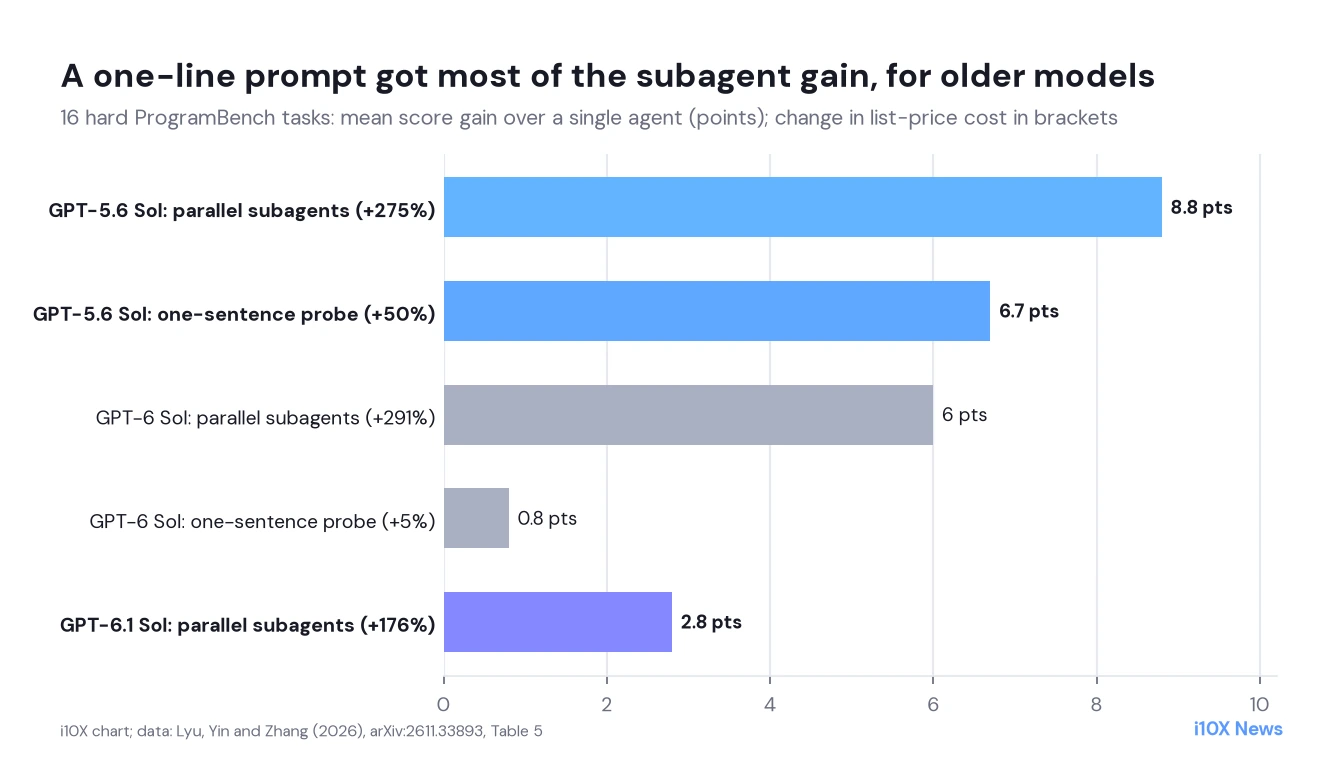
The trick faded with newer models, and so did the case for subagents. GPT-6 Sol barely reacted to the sentence, and GPT-6.1 Sol scored slightly lower with it. A single GPT-6.1 Sol agent already worked for 67 minutes on average before stopping, against 32 for GPT-5.6 Sol, and the subagent advantage on hard tasks shrank from 8.8 to 6.0 to 2.8 points across the three generations. The sentence also did not carry over everywhere: it did not lift GPT-5.6 Sol in DeepSeek’s open-source dsh harness, and on NL2Repo, which has no reference program, telling the agent to test every example in the specification made it worse on all four tasks tried.
Long runs: fresh sessions and smaller files
In a third experiment, both setups had to keep working until a budget of up to 20 hours ran out. That is expensive: a single multi-agent run of this kind with GPT-5.6 Sol cost about $500 at list price on average, against under $20 for a run that ends when the agent says it is done. Here two more mechanisms showed up.
- Fresh context: Restarting a stalled single agent every three hours with an empty conversation, but on the same code, produced faster early progress than letting one session continue in all six comparisons. In one resumed GPT-6.1 Sol session, the agent spent its first hour on syntax highlighting alone and six hours later still passed the same tests. A fresh multi-agent session from the same code moved sooner, but at equal cost it ended level with the chain of fresh single-agent sessions or slightly below it.
- Modularity: On a diff viewer task, a single GPT-5.6 Sol agent wrote all 7,728 lines into one file, while the subagent team spread its code over 22 files. That was the only task where subagents stayed clearly ahead at equal cost. Newer single agents split code more on their own, from one file with GPT-5.6 Sol to 21 with GPT-6.1 Sol.
- Breakage: Parallel work has a price beyond tokens. Most of the breaks the authors could trace came from an edit to shared code that every input passes through, such as a new error check that then rejected valid input elsewhere. The multi-agent runs broke their programs more often and more severely.
Method in brief
- Products and models: Codex CLI with GPT-5.6 Sol, GPT-6 Sol and GPT-6.1 Sol (reasoning level xhigh in the main runs); a smaller replication in Claude Code with Claude Opus 5.5, Grok 4.6 and MiniMax-M3; DeepSeek’s dsh harness with GPT-5.6 Sol.
- Scoring: Every five minutes the workspace was saved and scored against the hidden tests, so the authors could compare setups at equal time and at equal cost. Cost uses list prices; GPT-6 and GPT-6.1 Sol runs were priced at GPT-5.6 Sol rates, so those cost figures compare token use.
- Claude Code check: With Opus 5.5 on ten random ProgramBench tasks, subagents ended 4.7 points higher (95.5% against 90.7%) at 3.1 times the cost; on NL2Repo they did not help. Grok 4.6 and MiniMax-M3 never delegated on the two long tasks tested, even when allowed.
- Status: Preprint on arXiv (submitted November 25, 2026, CC BY 4.0), not peer-reviewed. The paper has no funding or conflict of interest statement. The authors say run data and scripts will be published on GitHub; the repository was not yet public when we checked.
What remains open
- Few runs: Most cells rest on one to three runs, and run-to-run noise is larger than many of the gaps. The clearest long-run win for subagents comes from a single task and the authors treat it as a case study.
- A reference is rare: The probe sentence relies on a working program to compare against. Real projects seldom have one, and the sentence did not help where it was missing.
- Mixed interventions: The probe also made runs longer, and the long-run subagent prompt also told the team to work module by module. On one task, that instruction alone explained at most a quarter of the lead.
- Scope: Only whole-program builds, mostly with closed OpenAI models whose outputs cannot be reproduced exactly. Bug fixes in existing code, where there is little to parallelise, were not tested, and reasoning effort was fixed rather than varied.
Context: the third warning about agent teams in a month
The result lines up with two earlier signals. In October, Anthropic advised builders to fold many subagent setups back into one agent loop, reporting lower cost and latency in its customer work. Last week, Bespoke Labs’ MAC Bench found that a team of eight agents cost 8.8 times as much as one, and a single agent gave the best score per dollar in every pairing. The UIUC paper adds what both lacked: controlled runs on coding with cost tracked every few minutes, plus experiments that point to why subagents help when they do. It also fits a theme across our agent research coverage: a precise instruction often beats more machinery.
Before you switch on subagents
- Start with one agent: Compare setups by score per dollar, not by final score, and repeat runs before trusting a few points of difference.
- Tell it how to check: If you have something to compare against (an old version, a live API, recorded outputs), instruct the agent to test against it before it declares the job done. Effective with GPT-5.6 Sol in this study, less so with newer models.
- Restart stalled sessions: When a long run stops improving, start a new session on the same code with short handoff notes instead of letting the old one grind on.
- Ask for modules: If a single agent keeps piling code into one file, ask it to split the work. The authors expect this to close part of the gap but did not test it.
- Save subagents for hard, long builds: That is where they helped. Use the same model for helpers; a cheaper subagent model cost more and scored lower than going alone.
About the analysis
Based on the full text of arXiv:2611.33893v1, including Tables 1 to 7, the threats to validity and the appendix. All figures come from the paper. The cost per extra point, the share of the gain recovered by the probe sentence and the comparison with Anthropic’s guidance and MAC Bench are our own. The chart is redrawn from Table 5; no original figure is reused.
i10x Perspective
Subagents are sold as the next step in agentic coding, and for very long, hard builds this paper shows they can help. For everyday work the bill matters more than the demo: a few points of hidden-test score at three times the price is a poor deal, especially when run-to-run noise is larger. The more interesting finding is that the benefit shrinks as single agents learn to check their own work. We expect vendors to fold self-checking and context resets into their default agent loop, and to keep subagents as an option for the rare jobs that justify the spend.