Coding agents now write pull requests faster than people can read them, so many teams let a second model review each change before it merges. Reasoning models come with an effort dial, and a preregistered study by researchers at Trust My Bot measured what turning it up buys with Claude Opus 5.5, Sonnet 5.5 and Haiku 5.5. More effort caught more broken patches in every model. Yet no setting worked as a reliable gate: even the best one approved 45% of patches that passed a benchmark’s tests but were in fact wrong. The authors build an agent harness with exactly such a review gate, which is worth keeping in mind. For engineering leads the study answers two practical questions: which settings are worth the money, and how much trust a green AI review deserves.
What the reviewers caught
The test set was 90 patches that coding agents had written for real Django issues in SWE-bench Verified. All of them pass that benchmark’s tests. 55 fail the stricter tests of SWE-ABS, a follow-up project that hardens those tests, so the benchmark would count them as solved although they are wrong. The other 35 pass both. Each model reviewed every patch at low, medium and high effort in sealed containers without internet access, with tools to read the code and run tests: 810 reviews in total.
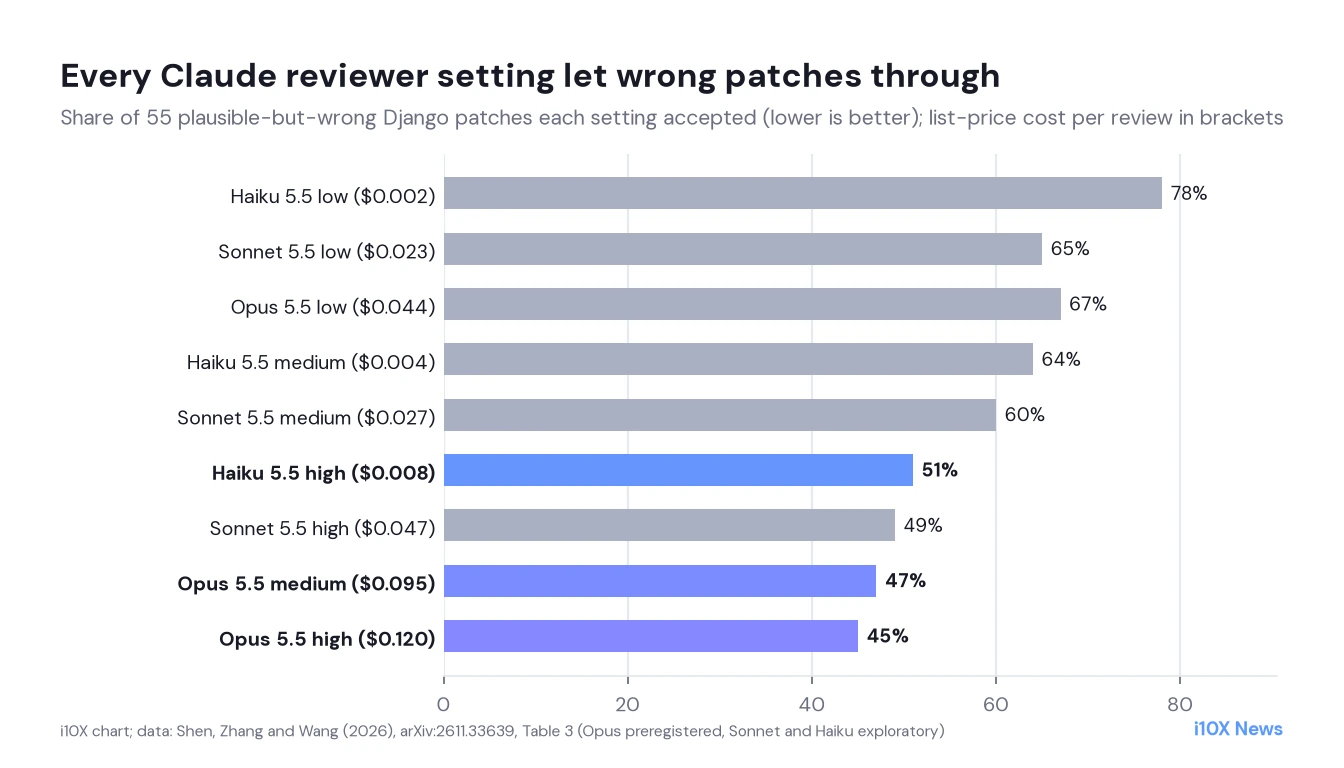
- More effort, fewer misses: Going from low to high cut the share of wrong patches approved from 67% to 45% for Opus, from 65% to 49% for Sonnet and from 78% to 51% for Haiku. The drop held up statistically for Opus and Haiku.
- False alarms stayed rare: Opus rejected 2 of the 35 correct patches at every level. Haiku at medium was the outlier with 7.
- Opus: medium is nearly as good as high: Opus at medium approved 47% of wrong patches against 45% at high, within the preregistered margin of 15 points, at about 20% lower cost. The authors had set 30% as the saving that would count as material, so that test failed.
- Smaller models need the high setting: For Sonnet and Haiku, medium was 39% and 51% cheaper than high, but it let through clearly more wrong patches and could not be shown to be as good.
- Haiku at high is the bargain: At under a cent per review, about 8% of the cost of Opus at medium, Haiku at high came within a margin the study could not resolve. It beat Sonnet at low and medium and Opus at low on both cost and agreement with the labels.
What a review gate costs
We converted the paper’s per-review costs into a budget: 1,000 reviews at list price come to about $120 with Opus at high, $95 with Opus at medium, $47 with Sonnet at high and under $8 with Haiku at high. For Opus, moving from low to medium caught 11 more of the 55 wrong patches for about 5 cents extra per review; moving on to high caught only one more. That matches Anthropic’s own advice to start on Opus 5.5 at medium effort. Anthropic’s Claude Ship code review and GitHub Copilot’s new adaptive review also let you choose or automate review depth. This study tested the Claude command-line tool with its effort flag, not those products, so it cannot rate them, but it shows why depth settings are worth checking against your own data.
Seeing the bug is not the same as rejecting the patch
Two exploratory results explain part of the misses. First, 111 of the 290 approvals of wrong patches mentioned the very defect that the failing test checks and still let the patch through, so the reviewer often found the problem but judged it unimportant. Second, Opus did worse on issues it seemed to remember: when it could reproduce the official fix from the issue text alone, it approved 64% of wrong patches at medium effort, against 27% on issues it recalled only in part. The authors suspect the model compares a patch with the fix it remembers instead of checking it against the code. Both findings are correlational and come from coding by language models, not people.
The big caveat: are the wrong patches really wrong?
The labels come from the stricter SWE-ABS tests, which are partly model-generated and derived from the official fix. For 32 of the 55 wrong patches, the failing test may check behaviour that the issue never asked for. Without those cases, neither accuracy hypothesis holds for any of the three models. Several labels were corrected after the reviews were in, using written rules applied by language-model agents and ruled on by the first author, with no independent human check. In other words, part of what looks like reviewer failure may be a strict test, and the true miss rate on clear bugs is uncertain.
Method in brief
- Design: Within-patch experiment: each of the 90 patches was reviewed once at each effort level by each model, so every patch is its own control.
- Preregistration: The Opus study, its hypotheses, margins and analyses were filed on OSF on November 2, 2026, before the main run. The Sonnet and Haiku runs reuse the design but are exploratory: their hypotheses were set after the data came in.
- Spend: $23.30 at list price for the 270 Opus reviews analysed, $8.77 for Sonnet and $1.23 for Haiku.
- Openness: Data, analysis code and the spend record are public in the authors’ GitHub repository.
- Status and interests: Preprint on arXiv (submitted November 25, 2026, CC BY 4.0), not peer-reviewed. No external funding. Zax Shen develops Trust My Bot, the harness whose review gate motivated the study, and Hanling Zhang is a member of the project; the third author declares no competing interests.
What remains open
- Small and narrow: 90 patches from a single Python project, one review per setting, and only Claude 5.5 models. Results for other codebases, languages or vendors may differ.
- No human ground truth: Labels and the coding of what reviewers said rest on language models; no person validated them.
- Pass or fail only: Reviewers gave a verdict but no confidence score, so the study cannot show whether a stricter threshold would have caught more. The authors suggest weighting missed bugs more heavily than false alarms in future work.
- Series to come: The team plans follow-ups on author notes, reviewer skills and voting among several reviewers.
What teams with an AI review gate should do
- Do not let it approve alone: Use AI review as an extra filter. In this study, every setting passed at least 45% of plausible but wrong patches, so stronger tests and human sign-off on risky changes stay necessary.
- Opus: medium, smaller models: high: High effort on Opus added one catch in 55 for 27% more cost. Sonnet and Haiku gained the most from the top setting, and Haiku at high still costs under a cent per review.
- Make findings count: Since many approvals named the defect anyway, consider a rule that any functional concern the reviewer raises blocks the merge or goes to a person. This is our suggestion; the study did not test it.
- Measure on your own repo: Before you hand merge rights to an AI reviewer, feed it changes you know to be broken and count how many it approves. Run it in observe-only mode first.
About the analysis
Based on the full text of arXiv:2611.33639v1, including Tables 1 to 8, the threats to validity and the competing interests statement. All figures come from the paper. The budget per 1,000 reviews and the comparison with Anthropic’s effort guidance are our own. The chart is redrawn from Table 3; no original figure is reused. More benchmark studies are in our Benchmarks & Evals section.
i10x Perspective
AI code review is becoming the default answer to the flood of agent-written code, and vendors now sell automatic approvals. This small but carefully preregistered study is a useful reality check: the effort dial is real, but it moves a reviewer from poor to mediocre, not to safe. The most valuable lesson is cheap: a small model at high effort can match much of what the flagship does at a fraction of the price, and the money saved is better spent on stronger tests. We would like to see vendors publish miss rates on known-bad patches for their review products, the way this team did for a raw model.