Quick Take
- Summary: AI agents are moving fast from simple chat tools into independent players that handle real economic decisions. This shift is fueling an intense race among blockchain and fintech teams to build the core payment rails for machine-to-machine transactions.
- What happened: Networks and tooling providers, including Solana with USDC, Ripple through RLUSD and XRP, and Lightning Labs with its L402 work inside LangChain, have begun rolling out protocols that let Large Language Models settle payments directly. The goal is to skip traditional banks and enable instant, code-driven transfers.
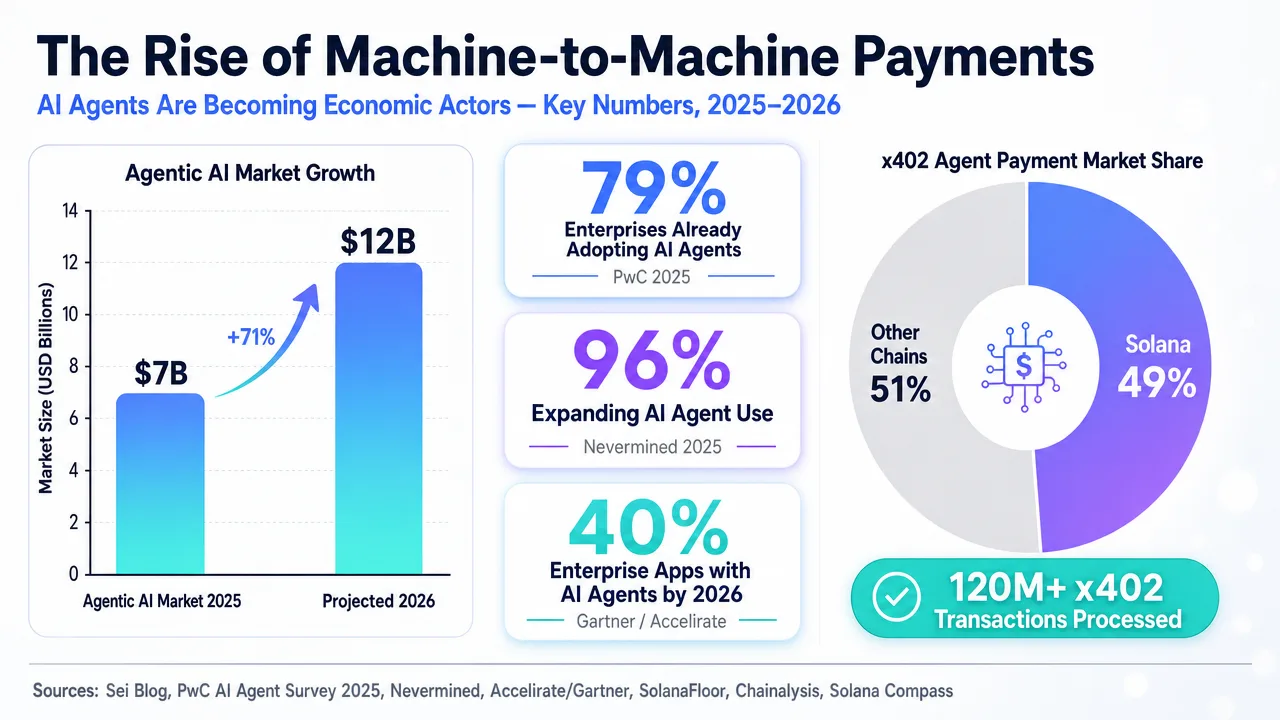
Why it matters now: Once AI workflows involve multiple agents, they quickly run into paywalled APIs or extra compute. Sub-cent payments that clear in real time become essential, otherwise the whole process stalls. The ability to pay for inference or data on the fly removes that ceiling.
Who is most affected: AI developers, enterprise CTOs, and FinOps groups now face a practical question: how to give autonomous systems spending power without putting the main treasury at risk.
The under-reported angle: Speed and token choice get most of the attention, yet custody and compliance remain the real choke point. An agent that can hallucinate and also hold an open wallet creates serious exposure. That makes tools like Multi-Party Computation, programmable spend rules, and Account Abstraction the parts worth watching most closely.
Deep Dive
The push to commercialize AI is running straight into decentralized finance for a straightforward reason: these agents need to make purchases on their own. As teams link LLMs through frameworks like LangChain, the models start needing outside data, APIs, or even help from other agents. Standard payment systems, with their fees, logins, and settlement delays, simply cannot keep up with software that finishes tasks in milliseconds.
That mismatch has set off a race to own the micropayments layer. Solana is positioning USDC as the go-to token for quick AI queries, banking on its speed. Ripple is responding with RLUSD and XRP, emphasizing enterprise-grade compliance and smoother cross-chain movement. Fetch.ai, for its part, is sketching out protocols that would let agents discover one another, negotiate, and settle on-chain with little human oversight.
On the practical side, Lightning Labs has folded the L402 approach into LangChain. It revives the old HTTP 402 code so developers can build endpoints that accept tiny Lightning payments automatically, cutting down on spam without API keys. Still, constant back-and-forth payments can become noisy. Streaming options such as Superfluid offer an alternative by sending value continuously, which helps FinOps teams track ongoing inference or monitoring costs without tracking thousands of separate receipts.
Yet handing capital to an LLM raises an obvious concern: how do you keep it from draining funds during a loop or an off-track response? The security side of custody has not received enough focus. Account Abstraction and smart-contract wallets look essential here. They let teams embed limits directly, for instance capping outlays at a set hourly rate or allowing payments only to approved endpoints.
The models that pull ahead will be the ones that can move money as smoothly as they process information. Intelligence is starting to include economic reach, the capacity to hire extra agents or rent compute mid-task when it helps solve a prompt.
Stakeholders & Impact
| Stakeholder / Aspect | Impact | Insight |
|---|---|---|
| AI / LLM Developers | High | Must integrate new SDKs (L402, XRPL, Solana) to monetize APIs via programmatic routing and per-request settlement. |
| FinOps & Enterprise CTOs | High | Requires entirely new operational playbooks for observability, idempotency, and programmable wallet limits (MPC) to secure agent spend. |
| Blockchain Networks | High | AI micropayments represent massive, sustainable blockspace demand. Capturing agentic volume is the new frontier for L1 utility. |
| Regulators & Policy | Significant | Autonomous software executing financial transactions triggers complex KYC/AML, “Know Your Bot,” and sanctions-screening challenges. |
About the analysis
Researched and written with AI assistance under the editorial responsibility of the i10X News team. The title image is an AI-generated illustration. Read our AI Use Policy. Spotted an error? Request a correction.
This independent analysis synthesizes cross-ecosystem documentation, spanning Ripple’s RLUSD infrastructure, Lightning Network’s L402 protocol designs, and streaming payment primitives, to map the emerging M2M economy. It is calibrated for AI engineers, product leaders, and infrastructure architects building the foundational layers of autonomous, multi-agent systems.
i10x Perspective
From what I have seen so far, giving AI native access to capital feels like the missing piece that turns automation from clever to truly independent. The last couple of years focused on making models smarter; the next stretch will be about letting them act on that intelligence with money attached. When transaction friction drops close to zero, the advantage shifts to whichever ecosystem builds wallet standards into its agents first. The boundaries between cloud providers, AI labs, and payment networks are already softening, and soon intelligence and capital will travel across the same rails.