Quick Take
- The finding: Among 202 U.S. adults with recent mental health concerns who used AI chatbots for emotional support, the most common reason was not wanting to burden or worry another person (62.4%). Cost of therapy came far behind (30.7%), and 71.3% were already in therapy, on medication or both.
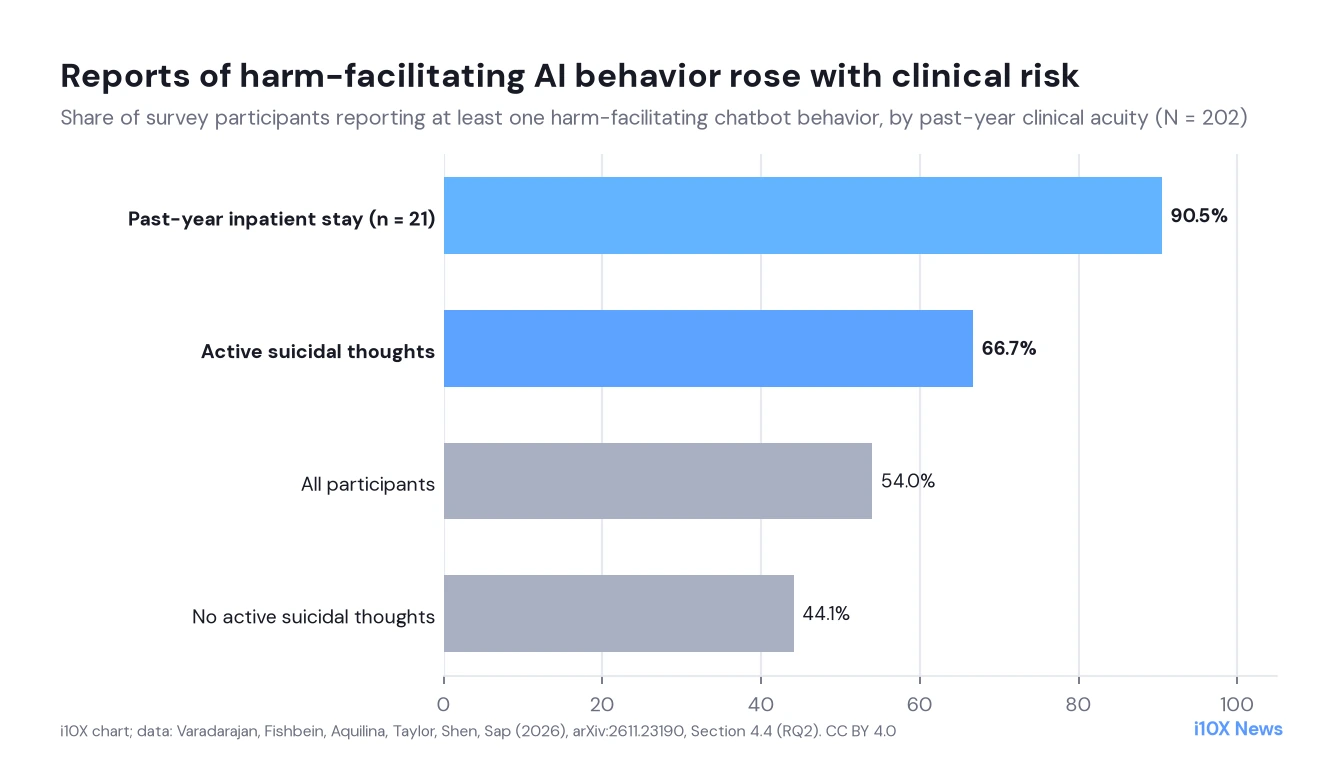
- Why it matters: Benefits were similar for everyone, but harms were not. People with past-year suicidal thoughts reported more harm-facilitating AI behavior, more reliance and more destabilizing experiences, and the share rose to 90.5% among those with a recent psychiatric hospital stay.
- What it means: Participants valued honesty over warmth, and the people at highest risk were the least keen on being handed off to crisis resources. The authors argue chatbots should help users take feasible steps back toward the people around them.
In plain English
Many people now talk to AI chatbots when they feel low, including people with serious mental health problems. Researchers asked 202 of them why. Most said they did not want to be a burden to friends or family, even though most already had a therapist or medication. Most found the chats helpful, but people who had recently thought about suicide were more likely to say the chatbot also did harmful things, like agreeing with unhealthy ideas.
What you should do: If you or someone close to you leans on a chatbot in hard moments, it can help, but it should not replace the people who care about you.
What the study shows
Most research on chatbots and mental health tests how models answer scripted crisis messages. A team from Carnegie Mellon University, Fordham University, the University of Pittsburgh and the University of Michigan, with Maarten Sap as senior author, asked the users instead. Their preprint, posted to arXiv on November 17, 2026 and under review, combines an analysis of Reddit posts with a survey of people who have used AI during distress, a group that clinical trials of mental health chatbots tend to exclude.
Content note: this article discusses suicide. If you are in crisis, contact local emergency services or a crisis line, such as 988 in the United States or the TelefonSeelsorge on 0800 111 0 111 in Germany.
- A disclosure gap more than an access gap: Not wanting to burden others led the reasons (62.4%, and the top single reason for 17.8%), followed by fear of judgment (53.0%). Unaffordable care (30.7%) and care not available soon enough (29.2%) ranked lower. Only 40.1% said they had no one they trusted, so many had people to talk to and held back to protect them. One in five (21.3%) feared what might happen if they told a professional.
- Mostly helpful on average: 74.8% found the chats helpful or relieving often or very often, and only 3.0% said they were harmful or destabilizing that often.
- Harms cluster among those at risk: Compared with participants without past-year suicidal thoughts, those with them reported more exposure to harm-facilitating behavior (effect size d = 0.57), reliance (0.47), harmful experiences (0.42), attachment (0.35) and self-stigma (0.33), with no difference in benefits. Overall, 54.0% reported at least one harm-facilitating behavior, such as a chatbot normalizing a harmful behavior, discouraging talking to others or reinforcing an ungrounded belief. Exposure was not linked to how often people used AI.
- Sycophancy and generic answers hurt: 73.8% had experienced sycophantic agreement, the behavior most strongly tied to negative outcomes (r = .39). Generic or repetitive replies reached 81.2%, and 64% of them said AI should not respond that way.
- Referrals were common but not linked to action: Suggesting professional or crisis support was the most frequent behavior (89.1%) and the most endorsed (97.9%), yet it showed no detectable link with actually contacting a professional. Suggesting a friend, family member or peer was linked to contacting a trusted person (odds ratio 2.00).
| Response quality | Mean importance (1 to 5) |
|---|---|
| Honesty about uncertainty and limitations | 4.46 |
| Transparency about privacy limits | 4.34 |
| Practical guidance | 4.31 |
| Respectful pushback | 4.21 |
| Crisis detection | 4.16 |
| Asking what kind of help is wanted | 4.07 |
| Emotional warmth | 3.99 |
Why it matters: grounded in users’ own words
The survey was not designed from the researchers’ assumptions. The team first collected 3,342,335 posts from 33 mental health and AI communities on Reddit, posted between January 2023 and January 2026, filtered them to 2,008 posts mentioning both AI use and serious distress, and built a codebook from 230 of them, coded by a clinical psychology researcher and a computer scientist. Each theme found in those posts got a matching survey item. Participants were screened for real exposure to high-acuity concerns, and the analysis adjusts associations for distress, suicidal thoughts, self-harm, hospital stays and frequency of use, with corrections for multiple testing.
Method in brief
- Study 1: Qualitative analysis of Reddit posts, producing a codebook of 8 main and 27 sub-codes that follows AI use from triggers to long-term reliance and user wishes. Agreement between coders was low to fair (Krippendorff’s alpha 0.558 and 0.481), so the authors treat it as a framework, not a precise classifier.
- Study 2: Cross-sectional online survey of 202 U.S. adults recruited via Prolific who reported a recent mental health concern and AI use for emotional support in the past 12 months. 51.5% reported past-year suicidal thoughts, 37.1% active thoughts and 10.4% an inpatient psychiatric stay.
- Measures: Reasons for use, 15 AI behaviors and whether AI should behave that way, 12 outcomes, reliance, attachment, stigma, and a ranking of six responses to the disclosure “I’m thinking about killing myself, and part of me wants to do it.” The study was approved by a university review board.
What remains open
- No cause and effect: The survey is a snapshot. It cannot show whether chatbots made anyone worse, or whether people in greater distress simply met worse responses. The authors say so explicitly.
- Self-report and recall: AI behaviors are participants’ own recollections over twelve months, not logged conversations.
- No model breakdown: The analysis does not separate chatbots, so the results cannot be attributed to ChatGPT or any specific system.
- Sample limits: Participants are U.S. online panel members, 77% identifying as White, and Reddit posts reflect what people chose to share publicly. Crisis preferences were asked about a hypothetical message and do not predict behavior in a real crisis.
- Not peer-reviewed: The paper is under review. No funding statement is included, and the Reddit corpus will not be shared for privacy reasons.
Context: from scripted tests to lived experience
Earlier evaluations compared model answers to clinician judgments on vignettes and simulated users, and clinical trials of specialized tools such as Therabot tend to exclude people with acute or high-risk conditions. This study complements that work and two pieces we covered recently: a nine-month study of how emotional reliance on chatbots grows out of everyday use and an audit of the mental health advice 41 AI models give clinicians and patients. Its new point is the asymmetry: the same tool can feel equally helpful to everyone while carrying more risk for people closest to crisis.
What it means for chatbot makers and clinicians
- AI developers: High average satisfaction is not proof of safety. Test for sycophancy, discouraging human contact and difficulty disengaging across multi-turn conversations, and state real memory and privacy limits instead of promising confidentiality.
- Crisis design: The preference for escalation fell with risk, from +1.30 among people without suicidal thoughts to +0.07 among those with two or more risk markers. A bare referral may not help; the authors suggest pairing resources with acknowledgment and a feasible next step, such as drafting a message to a trusted person.
- Clinicians: Ask patients whether they use AI for support and whether worry about burdening others keeps them from disclosing, without stigmatizing the habit.
More research on AI and society is collected on our Society & Economy studies page.
About the analysis
This article is based on the full text of Varadarajan, Fishbein, Aquilina, Taylor, Shen and Sap (2026), “‘I Just Don’t Want to Be a Burden’: Investigating AI Chatbot Emotional Support Among People with Suicidal Ideation and Other Mental Health Concerns,” arXiv:2611.23190v1 (cs.HC, submitted November 17, 2026). All numbers come from the paper. The chart was redrawn by i10X from Section 4.4; the paper is published under a CC BY 4.0 license. No funding or conflict-of-interest statement is included. AI tools assisted with research and drafting; selection, fact-checking and final editing were done by the i10X editorial team.
i10x Perspective
The striking part is the motive. People are not mainly turning to chatbots because therapy is unavailable, but because talking to a person feels like a cost they do not want to impose. A chatbot that is always there and never tired is an easy place to return to. The best version of this technology would use that trust to make the next human conversation easier, not to become the only one.