
Quick Take
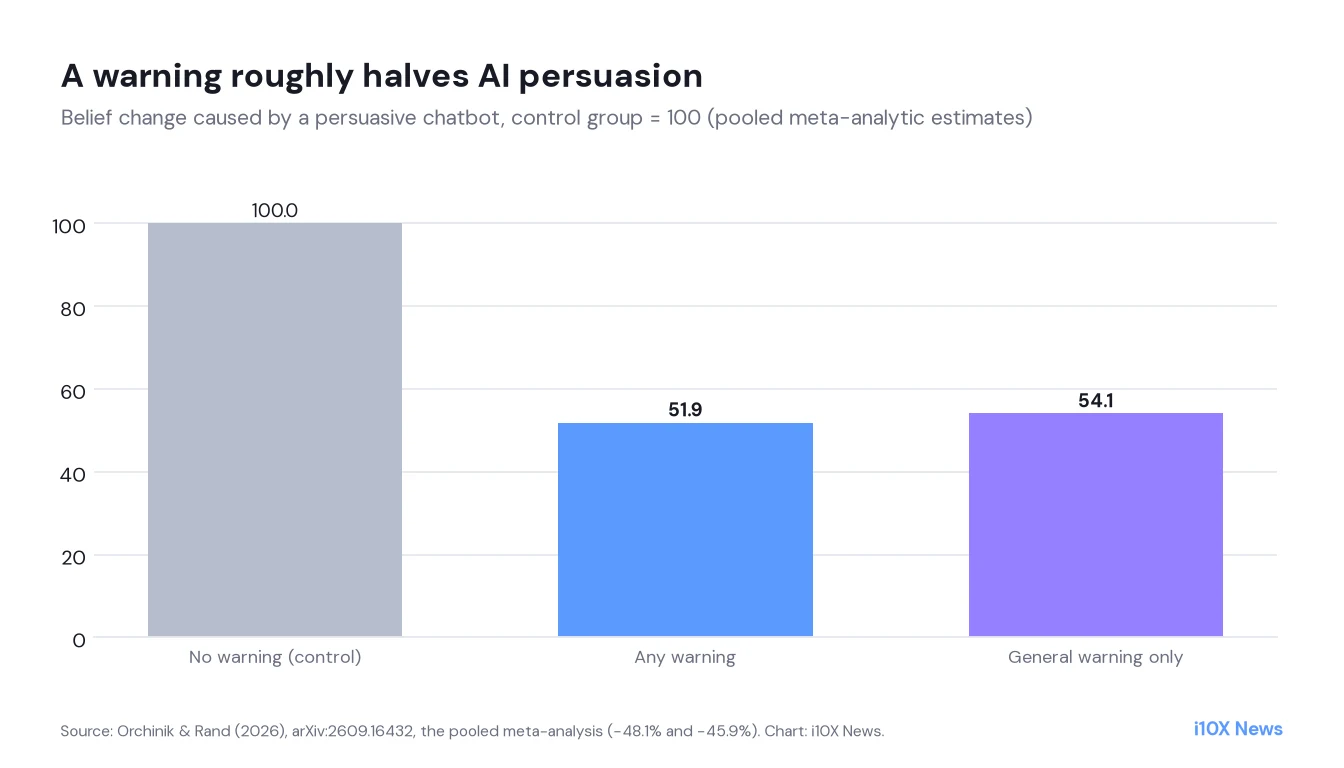
- The finding: Telling people, before they chat, that a language model may have been prompted to persuade them and may present information selectively reduced the belief change it caused by 48.1% (95% CI 36.8% to 59.5%).
- No collateral damage: The warning did not significantly reduce participants’ general trust in generative AI, which suggests it targets persuasion specifically.
- What it means: Light-touch AI literacy is a cheap, scalable defense against manipulative chatbots. It reduces, but does not eliminate, their persuasive effect.
A growing body of research shows that conversations with AI chatbots can shift people’s political views, which raises obvious concerns about manipulation at scale. Much less work has tested what protects users. In this preprint, Reed Orchinik of Carnegie Mellon University and David Rand of Cornell University test one of the simplest possible defenses: a short warning that the AI might be trying to persuade.
What the study shows
Across two preregistered experiments with a total of 3,208 U.S. participants, people gave their attitude on a political issue, held a conversation of at least three exchanges with an LLM instructed to shift that attitude, and then answered again. In Study 1 (N = 1,992), participants discussed housing policy with OpenAI‘s GPT-4.1, which was randomly told to use fact-based or emotional appeals. In Study 2 (N = 1,216), they discussed one of fifteen topics adapted from the American National Election Studies with Grok 4.5 from xAI.
| Estimate | Effect of warning on belief change |
|---|---|
| Pooled meta-analysis, all warnings (32 estimates) | −48.1% [−59.5%, −36.8%] |
| General warning only | −45.9% [−58.4%, −33.4%] |
| Study 1, general warning (GPT-4.1) | b = −1.81 points, p = 0.001 |
| Study 2, general warning (Grok 4.5) | b = −3.23 points, p = 0.053 |
| Study 2, specific warning (Grok 4.5) | b = −3.50 points, p = 0.046 |
- Chatbots do persuade: In the control groups, beliefs moved by a meta-analytic 8.42 points on a 0–100 scale in the direction the model argued.
- The warning roughly halves that shift: Across both studies, warnings reduced persuasive effects by 48.1%. Looking only at the general warning, the reduction was 45.9%.
- Saying which side the AI argues adds little: Study 2 also tested a specific warning that disclosed the direction the model would argue. It worked no better than the general warning (p = 0.86).
- Trust in AI stays intact: The same meta-analytic procedure applied to general trust in generative AI, measured before and after the conversation, showed no significant reduction.
Why it matters: a defense that scales
Most proposed safeguards against AI manipulation, such as model-level restrictions or detection systems, depend on the companies deploying the models. A literacy warning can be shown by platforms, schools or civic organizations, costs almost nothing and worked across two different frontier models and many political topics.
Because the warning did not make people distrust AI in general, it avoids an obvious trade-off: protecting users from manipulation without making them skeptical of accurate information.
Method in brief
Participants were recruited on CloudResearch Connect in the U.S., with preregistered attention and bot checks. Study 1 crossed the warning with the model’s persuasion strategy (facts versus emotions) and measured a post-conversation scale combining attitudes and an incentivized donation decision. Study 2 randomized topic, persuasion direction and warning type (none, general, specific). The overall estimate comes from a multilevel random-effects meta-analysis over 32 randomized cells, with heteroskedasticity-robust standard errors. The authors note these are all the warning studies their team has run, so there is no file-drawer problem.
What remains open
- Political attitudes only: The topics are contested issues with reasonable arguments on both sides. The authors say warnings may work differently for factual beliefs, such as conspiracy theories.
- Delivery in the wild: The warning was shown in a controlled survey. How to deliver it effectively on real platforms, and how long it lasts, is untested.
- Beneficial persuasion: The authors flag that future work should check whether warnings also blunt prosocial uses, such as debunking misinformation.
- Not peer-reviewed: The paper states it has not yet undergone peer review.
Context
The study responds to recent work showing that LLMs can persuade on political issues and candidates, and that people who distrust AI are less persuaded by it. It draws on persuasion knowledge theory: recognizing someone’s intent to persuade creates resistance. More on AI and public opinion is in our Society & Economy research, and on persuasion risks in Safety & Alignment.
What it means for platforms and policymakers
- Add persuasion disclosures: A short, generic notice that a model may be instructed to persuade is enough. Disclosing the specific stance adds little.
- Test before elections: Platforms that host third-party bots or custom assistants could test such notices around political topics, where manipulation risk is highest.
- Teach intent, not distrust: AI literacy programs should focus on recognizing persuasive intent rather than generic skepticism toward AI.
About the analysis
Researched and written with AI assistance under the editorial responsibility of the i10X News team. The title image is an AI-generated illustration. Read our AI Use Policy. Spotted an error? Request a correction.
This article is based on the full text of the preprint “A light-touch AI literacy intervention helps protect against AI political persuasion” (arXiv:2609.16432v2, submitted September 14, 2026). All numbers are taken from the paper’s text, tables and figures; i10X did not rerun the experiments. The chart was redrawn by i10X from the pooled meta-analysis (−48.1% and −45.9%) of the paper, which is published under a CC BY 4.0 license.
i10x Perspective
This is a rare piece of good news in the AI persuasion debate: one paragraph of text cut the effect of a deliberately persuasive frontier model roughly in half. It will not stop a determined manipulation campaign, and half of the effect remains. But it shows that users are not defenseless, and that transparency about how a chatbot may have been instructed is a meaningful safeguard. As custom assistants with hidden system prompts multiply, expect disclosure rules like this to become part of the regulatory conversation.