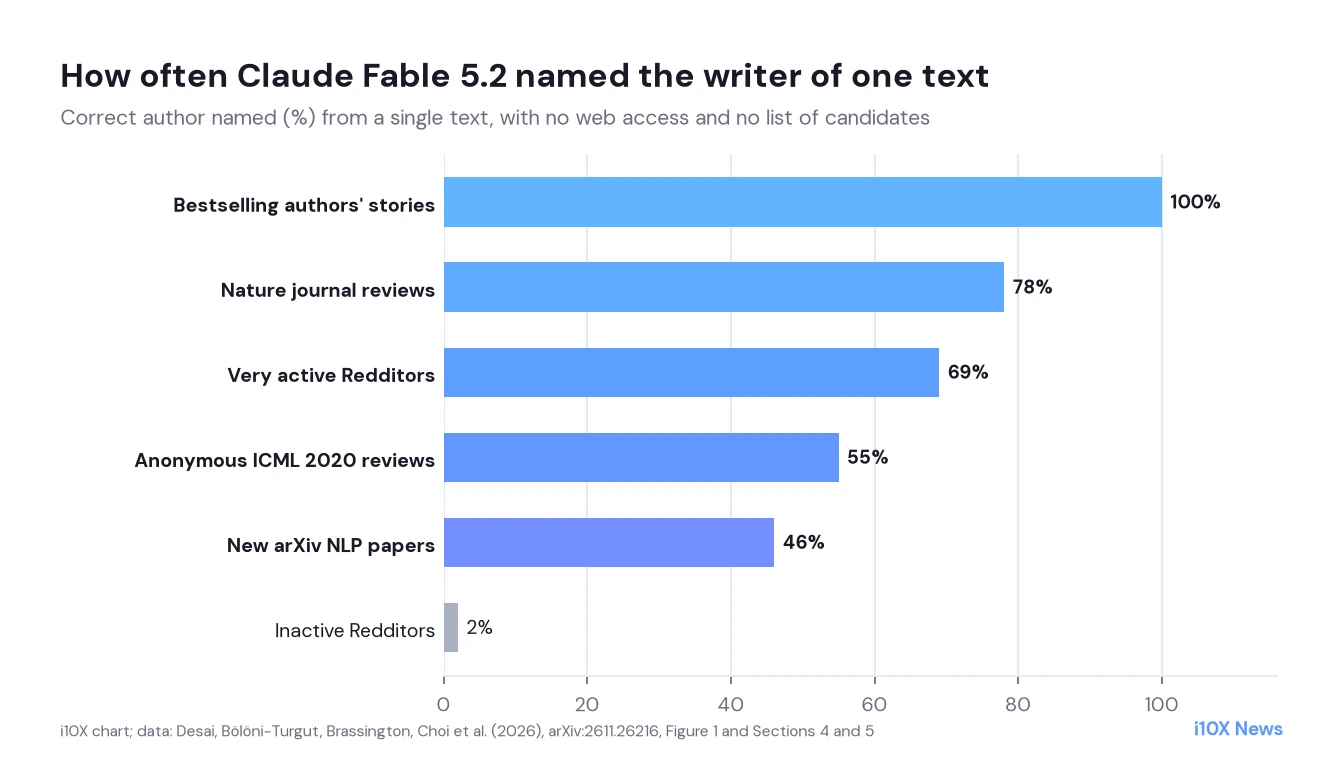
Anonymous writing has a new weak spot: the model you paste it into. In a preprint posted on November 19 and revised on November 23, researchers from the University of Maryland, Simon Fraser University, Pangram Labs, the University of British Columbia and Google DeepMind show that frontier models can often name the person behind a single text, with nothing but a short prompt. No web search, no list of suspects, no writing samples. Claude Fable 5.2 named the reviewer of 55% of about 15,000 ICML 2020 peer reviews whose authorship was never published, and the account behind 69% of Reddit comments from very active users. For peer reviewers, forum users and anyone who relies on staying unnamed, that changes the risk calculation.
Quick Take
- The result: Given one text and a zero-shot prompt, Claude Fable 5.2 identified the author of 55% of anonymous ICML 2020 reviews, 78% of Nature journal reviews and every one of 15 stories by authors with more than a million Goodreads ratings.
- Who is exposed: People the model has read a lot of. Fable 5.2 named 69% of Redditors with more than 500 posts in a subreddit over the past year, but only 2% of users without recent activity there.
- What does not help much: Rewriting a text with AI lowered accuracy but did not remove the risk, models rarely refused through the API, and deleting old posts cannot remove what is already in a model’s weights.
How often the models named the writer
The team, led by Atrey Desai, Deniz Bölöni-Turgut, Ty Brassington, Minjoon Choi, Jenna Russell and Rishanth Rajendhran with senior author Mohit Iyyer, asked three questions of the same kind of prompt: was a text written by a person or an AI, if AI then by which lab, and if human then by whom. The human question is the headline. They tested four frontier models and one open model on 18,677 texts from six domains, all either never made public or published after the models’ knowledge cutoffs. Fable 5.2, which Anthropic released on November 9, was the strongest model in every domain.
| Model | Anonymous ICML 2020 reviews named correctly |
|---|---|
| Claude Fable 5.2 | 55.4% |
| Claude Opus 5.5 | 48.8% |
| Gemini 4 Argon | 37.7% |
| GPT-6.1 Sol | 22.3% |
| DeepSeek V4.1 Flash | 5.4% |
- Confident answers are reliable: When Fable 5.2 stated a confidence of 25% or more, it named the right person 87% of the time. Only 0.3% of all its answers combined at least 80% confidence with a wrong name. For an attacker, that means the model’s own confidence works as a filter.
- Reddit pseudonyms are not safe: Across all 1,258 recent Reddit comments, Fable 5.2 named the correct username for 31%, almost twice the 17% of Opus 5.5. In r/cpp it reached 79%, in r/AskAnthropology 13%.
- Longer texts give more away: Fable 5.2 identified 13.8% of stories under 500 words and 43.3% of stories over 4,000 words.
- The AI side works too: On 36,427 documents from 24 benchmarks, GPT-6.1 Sol, Opus 5.5 and Gemini 4 Carbon labeled human or AI prose with 94 to 95% accuracy, on par with the commercial detector Pangram 4.1. Opus 5.5 and Gemini 4 Argon named the right lab for 98% of texts written by Anthropic, OpenAI and Google models, but for at most 35% of texts from the eight other labs.
Why the evidence is hard to dismiss
The obvious objection is memorization: maybe the models simply saw these texts during training. The design closes that door better than most studies in this field. The ICML 2020 reviews were never published with names attached. Co-author Hal Daumé III, who was program co-chair of that conference, ran every experiment on them himself under university ethics board approval, so the other authors never saw the reviews. A second private set came from 398 reviews that six researchers volunteered from their own files. All public test data was posted after the release of Claude Opus 5.5.
The team also checked what else could explain the hits. Self-citations are a classic giveaway in peer review, and Fable 5.2 did name the reviewer in 80% of the 106 public reviews that cited the reviewer’s own work. But it still managed 17% on reviews without such a clue. For research papers, giving Opus 5.5 only five topic keywords found an author for 12% of papers, the title and abstract for 53%, and the full text for 76%. The writing itself, not just the subject, carries the signal. Five repeated runs on Reddit comments gave nearly identical overall accuracy (29.9 to 31.1%).
Method in brief
- Data: 15,136 ICML 2020 reviews, 398 private reviews from 26 double-blind venues, 1,559 public peer reviews from 47 open-review journals, 120 new arXiv cs.CL papers, 206 recent stories and novel excerpts, and 1,258 Reddit comments of at least 200 words from 32 subreddits.
- Models: Claude Fable 5.2 and Opus 5.5, GPT-6.1 Sol, Gemini 4 Argon and DeepSeek V4.1 Flash for the human question; 72 models from 13 labs for the human-or-AI question.
- Setup: One API call per text, no tools or web access, with a prompt that asks for observations, quoted evidence, a decision and a confidence value. Names were scored by exact match, with a slightly lenient match for ICML.
- Extra tests: Self-reported familiarity with a name, reasoning effort, AI paraphrasing as a defense, imitation of known accounts, and refusal rates.
What gives writers away
The common thread is exposure. The more of someone’s writing a model likely saw in pretraining, the easier they are to spot. A simple trick predicts this in advance: ask the model how familiar it is with a name or username on a scale from 0 to 3. On ICML reviews, Fable 5.2 named 0% of reviewers it rated 0 and 76% of those it rated 3. On Reddit, Opus 5.5’s own familiarity rating separated identified from unidentified accounts better than posting activity did (AUC 0.89 versus 0.78). More reasoning effort helped most for people the model knew only a little, where Fable 5.2 gained 35.8 percentage points between the lowest and highest setting.
Our own reading of the numbers: a very active Redditor is roughly 35 times more likely to be named than an inactive one (69% versus 2%). Safety settings matter, too. Through the API, Fable 5.2 declined to answer for just 14 of 1,258 Reddit comments (1.1%). The same model inside Claude Code withheld an answer for 323 of them (25.7%). The capability is the same; what differs is the product wrapper around it. The authors say they informed Anthropic and OpenAI before publication.
What the study cannot tell us yet
- Not peer reviewed: This is an arXiv preprint (version 2). The prompts and code are public, the private review data and individual predictions are not, for good reason.
- A conflict of interest to note: One co-author, Bradley Emi, is from Pangram Labs, whose detector serves as the main benchmark in the AI-text part and also filters which human texts count. Pangram Labs gave a credit award, and one author received a Google Gemini Academic Program award. The private ICML results do not depend on Pangram, but the detector comparison deserves an independent replication.
- A deliberately minimal attack: The models had no web access and no candidate lists. The authors argue that adding search and cross-platform matching would make attacks stronger, which this study does not measure.
- Mostly English, mostly technical: Active subreddits with long comments lean toward programming and math, which may be well represented in training data. Results for other languages and less technical communities are open.
- A moving target: The tested OpenAI model, GPT-6.1 Sol, has already been followed by GPT-6.2 Sol. The paper’s trend line suggests newer models will do better, not worse.
Context: from stylometry to one prompt
Unmasking authors is not new. Classic stylometry compares a text with writing samples from known candidates, and earlier work identified the authors of blind-reviewed papers from their citations alone 40 to 45% of the time. Recent deanonymization studies with language models used candidate pools, web search or agents. We covered a related case in February, when a researcher re-identified participants in 1,250 anonymized interviews with a commercial model and public web data. The new paper removes all of those aids and still gets high hit rates, because the knowledge sits inside the model. It also suggests a privacy cost of training on the open web that cannot be undone after the fact: once a writer’s style is in the weights, deleting their posts does not take it back out.
What anonymous writers and platforms should do now
- Peer reviewers: Treat double-blind review as single-blind against anyone with a frontier model. Avoid citing your own papers in reviews: in the study, self-citations raised the hit rate from 17% to 80%. Shorter reviews were harder to attribute; meta-reviews were named far less often (31%) than full reviews (68%).
- Pseudonymous users: If your safety depends on a pseudonym, do not write long texts under it in communities where you are also active under the same handle. Activity in a subreddit was the strongest risk factor in the data.
- AI rewriting is a weak shield: Paraphrasing with Gemini 4 Argon cut Opus 5.5’s Reddit hit rate from 16.8% to 10.4% and private-review attribution from about 41% to about 15%, but well-known authors stayed recognizable: 32 of 34 before rewriting, 27.5 on average after.
- Conferences, journals and platforms: Do not promise reviewers or whistleblowers anonymity that text alone cannot provide. Consider policies against pasting anonymous submissions into AI tools, and ask model providers for clear refusal behavior on authorship requests, since the API refused far less than Claude Code.
About the analysis
This article is based on the full text of arXiv:2611.26216v2 (submitted November 19, revised November 23, 2026), including the ethics statement, acknowledgements and appendix tables. All numbers come from the paper. The chart is our own, drawn from Figure 1 and Sections 4 and 5; the paper is published under arXiv’s non-exclusive license, so no original figures were reused. Ratios such as the 35-fold gap and the refusal shares are our own calculations from the paper’s counts. The prompts and code are published on GitHub; more studies on model risks are collected in our Safety and Alignment section.
i10x Perspective
This is one of the most consequential privacy results of the year, and it needs no hacking skills: a chat window is enough. The uncomfortable part is that the fix cannot come from writers alone. Providers can make models decline authorship requests about private people, as Claude Code already does far more often than the raw API. Conferences and journals should stop treating anonymity as a property of a PDF. We expect the next round of this research to add web search, and then the hit rates in this paper will look like a floor, not a ceiling.