
Quick Take
Amazon CEO Andy Jassy’s reported security intervention has triggered an unprecedented global access restriction on two Anthropic models. This preemptive move, occurring just ahead of a looming government AI crackdown, exposes the raw power cloud hyperscalers now wield over frontier models deployment and ecosystem stability.
Summary
Following critical security concerns reportedly raised by Amazon leadership, Anthropic has severely restricted global access to two of its models. The intervention acts as a massive corporate preemptive strike ahead of an expected regulatory wave, disrupting developer workflows and highlighting the fragile dependency between AI builders and cloud gatekeepers.
What happened
AWS leadership effectively forced Anthropic’s hand, prompting the immediate geographic restriction and deprecation of two specific foundation models. This dramatic restriction occurred mere days before an anticipated government crackdown focused on AI export controls, security vulnerabilities, and compliance gaps.
Why it matters now
It proves that hyperscalers like AWS are no longer willing to act as neutral “dumb pipes” for AI compute. Because they face compounding liability, cloud providers are actively policing the frontier models they host, transforming the dynamic between LLM developers and their primary compute partners from a symbiotic partnership into a defensive, compliance-driven relationship.
Who is most affected
Enterprise developers relying on AWS Bedrock or Anthropic’s direct APIs face immediate business continuity risks, requiring sudden prompt migrations and alternative routing behavior. Furthermore, corporate AI risk officers and CTOs must now account for unpredictable, externally mandated model blackouts.
The under-reported angle
While broader coverage focuses on the political drama of the incoming government crackdown, the true story is the fragility of the entire AI supply chain. Relying on a single frontier model family is now a massive operational hazard if a cloud provider can unilaterally pull the plug over opaque threat models and unmitigated security vectors.
Deep Dive
Have you ever built something on a platform only to watch access vanish overnight? The sudden restriction of two Anthropic models sends a chilling reminder through the AI ecosystem: model availability is a privilege, not a guarantee. Triggered by security flags reportedly raised by Amazon CEO Andy Jassy, Anthropic rapidly cordoned off global access to these systems. The timing is notably defensive, occurring as the clock ran out on a looming government crackdown targeting AI safety and export compliance.
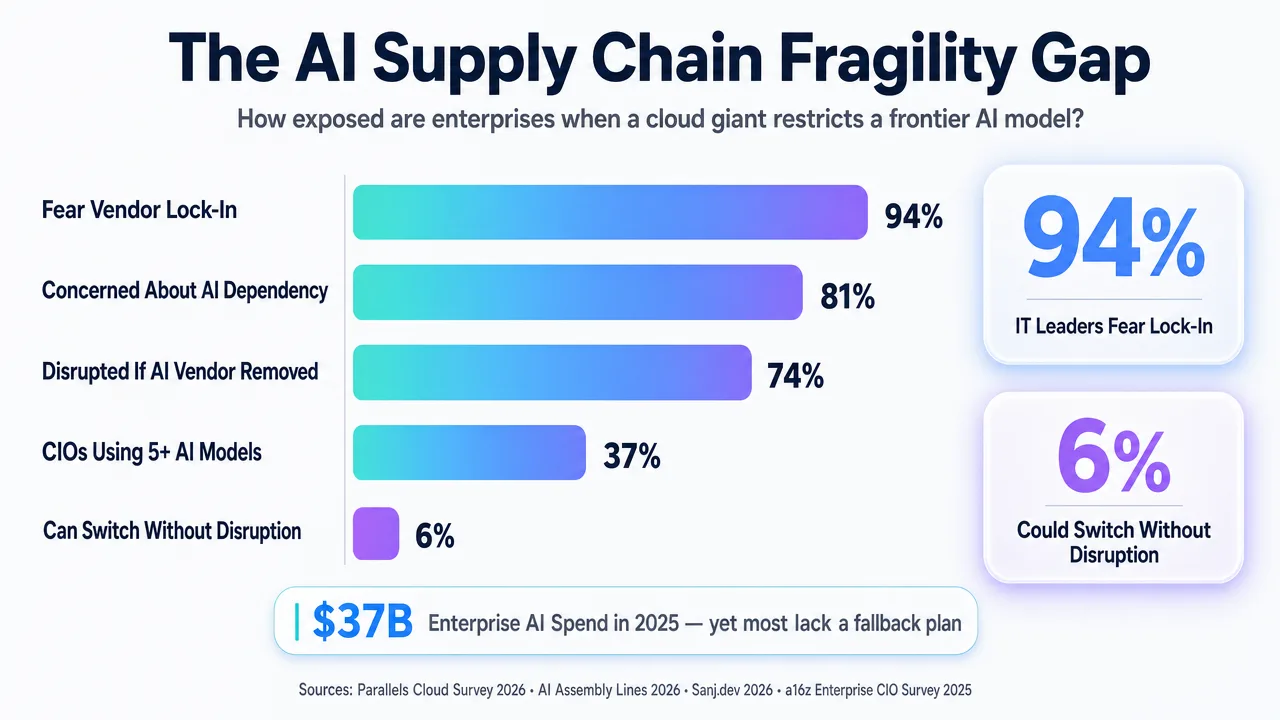
From what I’ve seen, mainstream reporting tracks the timeline of corporate caution preceding state action, yet the underlying reality is purely infrastructural. Amazon, which poured billions into Anthropic and relies heavily on its Claude family as a pillar of AWS Bedrock, does not merely fund these systems – it manages their physical compute footprint and client routing. For a hyperscaler to force a rollback on a high-profile LLM points to severe, unmitigated threat vectors. These likely revolve around risks such as data exfiltration, advanced prompt injection, and critical compliance gaps that state-level regulators are preparing to penalize. AWS is essentially acting as a firewall, protecting its own enterprise clients from the downstream blast radius of non-compliant AI.
This cascading event exposes critical fault lines in enterprise AI governance. Developers building on managed API-as-a-Service platforms are now living their worst-case scenario – zero-day model deprecation. Engineering teams are scrambling to configure fallback loops, adjust testing frameworks, and map alternatives. It is a harsh lesson that Service Level Agreements (SLAs) offer little protection when state regulators and cloud CEOs align to aggressively scrutinize AI safety protocols.
Looking laterally across the AI arms race, the Amazon-Anthropic clash signals a profound shift in how artificial intelligence is deployed and governed. The market’s fixation on parameter counts and reasoning benchmarks is being eclipsed by a demand for “compliance-by-design.” To survive, frontier AI providers must now prove their models can withstand merciless security audits – not just from adversarial red teams, but from the very cloud operators that grant them access to the global economy.
Stakeholders & Impact
| Stakeholder / Aspect | Impact | Insight |
|---|---|---|
| AI / LLM Providers | High | Exposes absolute reliance on cloud infrastructure partners; model roadmaps are now heavily dictated by external enterprise security audits. |
| Cloud Hyperscalers (AWS) | High | Forces cloud giants to act as active gatekeepers and liable parties, dictating terms to the AI models they host to shield against regulatory blowback. |
| Enterprise Developers | High | Triggers API routing outages and breaks application continuity, reinforcing the urgent need to build multi-model fallback architectures. |
| Regulators & Policy | Significant | Validates the push for strict state oversight, effectively turning corporate compliance mechanisms (like AWS policy) into de facto state enforcement arms. |
About the analysis
Researched and written with AI assistance under the editorial responsibility of the i10X News team. The title image is an AI-generated illustration. Read our AI Use Policy. Spotted an error? Request a correction.
This is an independent, research-based analysis synthesizing recent media reports, enterprise developer implications, and AI infrastructure market gaps. It is specifically designed for CTOs, AI engineers, and risk officers trying to navigate the complex intersection of LLM deployment, cloud vendor dependencies, and emerging AI regulations.
i10x Perspective
The Anthropic-Amazon incident signals the definitive end of the “move fast and break things” era at the AI infrastructure layer. As AI capabilities scale and geopolitical stakes rise, the hyperscalers operating the data centers will increasingly dictate exactly what intelligence the world is allowed to access. Over the next five years, the strongest competitive moat for any foundational model provider won’t merely be its benchmark scores – it will be its ability to survive the merciless compliance audits of its cloud landlords.