Quick Take
Have you ever wondered why data centers keep guzzling power despite all the fancy upgrades? The long-unspoken truth of data center efficiency is out: focusing only on Power Usage Effectiveness (PUE) is like tuning a car’s aerodynamics while ignoring a horribly inefficient engine. The next frontier for optimization isn’t in the cooling ducts; it’s inside the server rack, at the storage and workload layer. As AI demand pushes infrastructure to its breaking point, the industry is finally connecting the dots between inefficient software I/O and the facility’s power bill.
Summary:
The conversation around data center efficiency is pivoting from a singular focus on facilities-level metrics like PUE to a more holistic, software-defined approach. The new logic dictates that optimizing IT workloads, particularly flash storage performance, offers massive, untapped potential to reduce overall energy consumption by eliminating wasted compute cycles and heat generation at the source. And honestly, from what I’ve seen in recent reports, this shift feels like it’s long overdue.
What happened:
For over a decade, efficiency gains were driven by physical infrastructure improvements: hot/cold aisle containment, free cooling, and high-efficiency UPS systems. Now, hyperscalers like Google and Microsoft, along with academic research, are demonstrating that intelligent workload and storage management – reducing things like SSD write amplification and coordinating I/O scheduling – can cut the number of servers required, creating a cascading efficiency effect on power and cooling infrastructure. It’s one of those realizations that makes you rethink the whole setup.
Why it matters now:
The explosive growth of AI workloads is creating unprecedented power density and thermal challenges that cannot be solved by cooling alone. Making the IT workload itself more efficient is the only sustainable way to unlock capacity for more AI training and inference within existing power and space constraints. This shifts the efficiency burden from facilities managers to cloud architects and SREs – a change that’s bound to stir things up in boardrooms everywhere.
Who is most affected:
Enterprise data center operators, colocation providers, and the DevOps/SRE teams building and deploying applications. Operators can defer billions in capital expenditures by reclaiming “stranded” capacity, while developers now see their code’s I/O patterns directly linked to the company’s carbon footprint and bottom line. Plenty of reasons, really, for everyone involved to pay closer attention.
The under-reported angle:
Most analysis treats facilities (cooling, power) and IT (servers, storage) as separate domains. The critical insight being missed is the direct feedback loop: poor application I/O management creates unnecessary work for SSDs, which wastes CPU cycles, generates excess heat, and directly inflates the cooling load that metrics like PUE are designed to measure. Fixing the software first makes the entire physical plant more efficient – and that’s where the real game-changer lies, if you ask me.
Deep Dive
Ever felt like you’re squeezing every last drop from your data center’s setup, only to hit a wall? For years, the gold standard for data center efficiency has been Power Usage Effectiveness (PUE), a metric championed by the Uptime Institute that measures how much power is used by the facility for every watt delivered to the IT equipment. The race to a “perfect” PUE of 1.0 drove a wave of physical innovations, from sophisticated cooling controls to modular power systems. But for most modern data centers, this well is running dry. The era of easy PUE gains is over, forcing a search for a new efficiency frontier.
That new frontier is the IT workload itself. The industry is awakening to a simple but powerful idea: the most efficient watt is the one never consumed. Instead of merely cooling a server more efficiently, the next leap in performance comes from optimizing the software so profoundly that the server’s workload can be done with less hardware, or even eliminated entirely. This moves the focus from the facilities team to the DevOps and SRE teams, turning code efficiency into a direct driver of infrastructure sustainability and cost. But here’s the thing – it’s not just about tweaking lines of code; it’s about rethinking how everything interconnects.
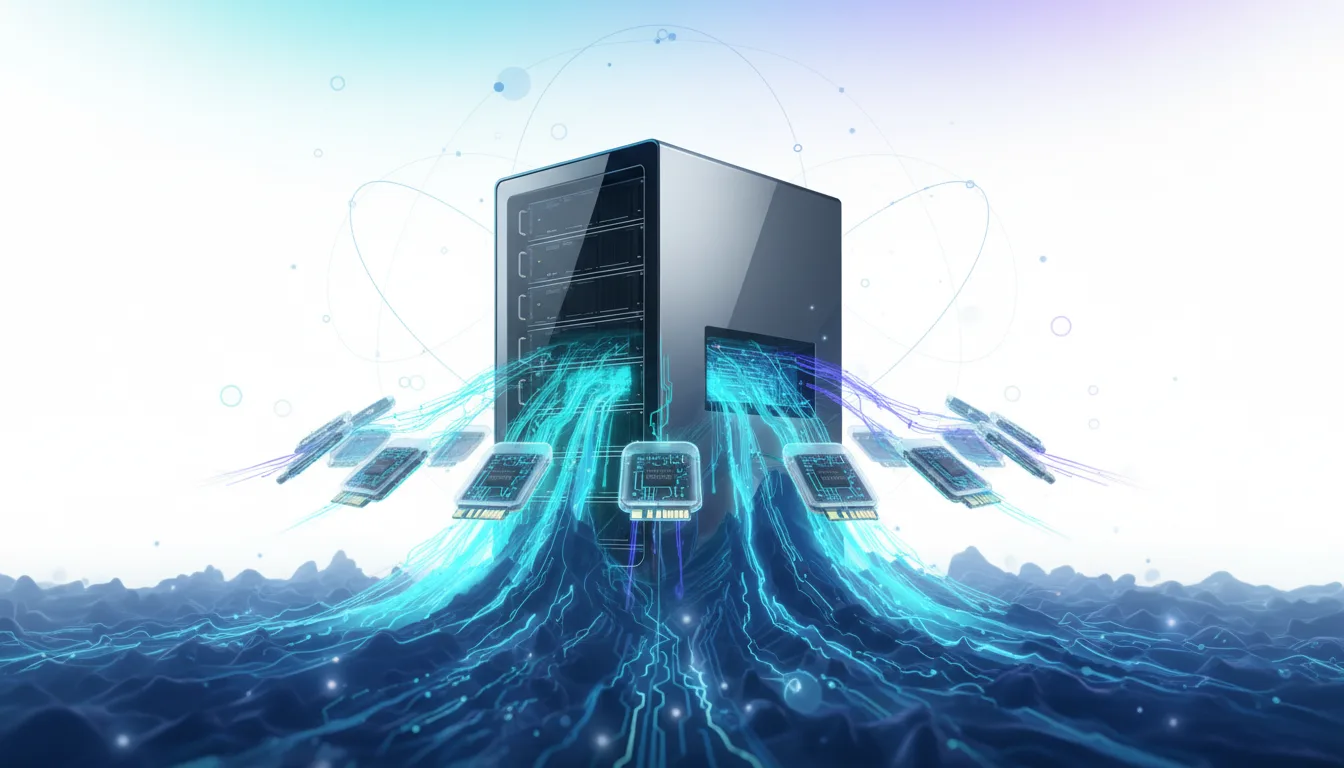
The most potent and overlooked lever in this shift is flash storage. Modern data centers run on NVMe SSDs, but few operators connect the performance of these drives to the facility’s electric bill. Inefficient I/O patterns, rampant write amplification (where the drive writes more data than the application requested), and uncoordinated “garbage collection” cycles cause a storm of wasted activity. This hidden I/O tax burns CPU cycles, generates significant heat, and ultimately forces operators to provision more servers and more cooling to deliver the required application performance. It’s a vicious cycle of waste, starting at the software layer – one that I’ve noticed creeps up in so many audits.
The AI boom acts as a massive catalyst for this new paradigm. The intense, often unpredictable compute and I/O demands of training and inference models render static efficiency plans obsolete. Hyperscalers like Google and Microsoft are already responding with AI-assisted cooling and custom liquid-cooled hardware, but their real secret weapon is the deep, software-led integration between workload scheduling and physical infrastructure. By co-optimizing workload placement with real-time thermal headroom and storage I/O, they ensure that every watt is used for productive work. For everyone else, this means the pressure is on to break down the silos between IT and Facilities and adopt a unified view of efficiency, where an I/O scheduler is as critical to energy savings as a chiller. That said, the bigger picture here is how this could level the playing field, or maybe not – depending on who adapts first.
Stakeholders & Impact
| Stakeholder / Aspect | Impact | Insight |
|---|---|---|
| AI / LLM Providers | High | Workload-aware efficiency allows more models to be trained and served within the same power envelope, directly lowering the Total Cost of Ownership (TCO) for intelligence. It turns infrastructure from a constraint into a competitive advantage – something that’s starting to show up in their earnings calls. |
| Data Center Operators (Enterprise & Colo) | High | Unlocks “stranded” power and cooling capacity, deferring multi-million dollar upgrades. This allows them to support high-density AI racks without a full facility rebuild and offers a new value proposition beyond a low PUE, especially as demands keep ramping up. |
| DevOps & SRE Teams | Significant | Code is now directly accountable for the facility’s P&L and ESG goals. I/O patterns, container orchestration, and QoS settings are no longer just performance tweaks; they are primary levers for corporate sustainability and cost control – a shift that’s got teams scrambling, from what I’ve heard. |
| Regulators & ESG Investors | Medium | As reporting requirements (like the EU’s EED) become more stringent, companies demonstrating this holistic, software-driven efficiency will have a more credible and defensible sustainability story that goes beyond simply buying renewable energy credits. It’s the kind of detail that could sway investor sentiment down the line. |
About the analysis
Researched and written with AI assistance under the editorial responsibility of the i10X News team. The title image is an AI-generated illustration. Read our AI Use Policy. Spotted an error? Request a correction.
This is an independent i10x analysis based on a synthesis of industry standards, hyperscaler sustainability reports, vendor best practices, and research into storage-layer performance. It is written for enterprise architects, infrastructure managers, and SRE leaders looking to move beyond conventional metrics and unlock the next wave of data center efficiency – or at least start the conversation in their own organizations.
i10x Perspective
What if the smartest data centers didn’t just react to demands but anticipated them? The future of intelligence infrastructure isn’t just about building more data centers; it’s about building autonomic ones. The locus of control is shifting from static physical assets to a dynamic, software-defined control plane that holistically manages resources from the application layer down to the liquid cooling pump.
The next competitive moat in the AI race won’t be defined solely by who has the most NVIDIA GPUs, but by who has the most sophisticated software to orchestrate their compute, storage, and thermal resources with maximum efficiency. The critical question for the next five years is whether this integrated, software-first approach can be democratized for enterprise and colocation use, or if it will remain an exclusive advantage of the hyperscalers, further concentrating the power to build and deploy AI. Either way, it’s a pivot worth watching closely – one that could redefine who’s really in the driver’s seat.