Quick Take
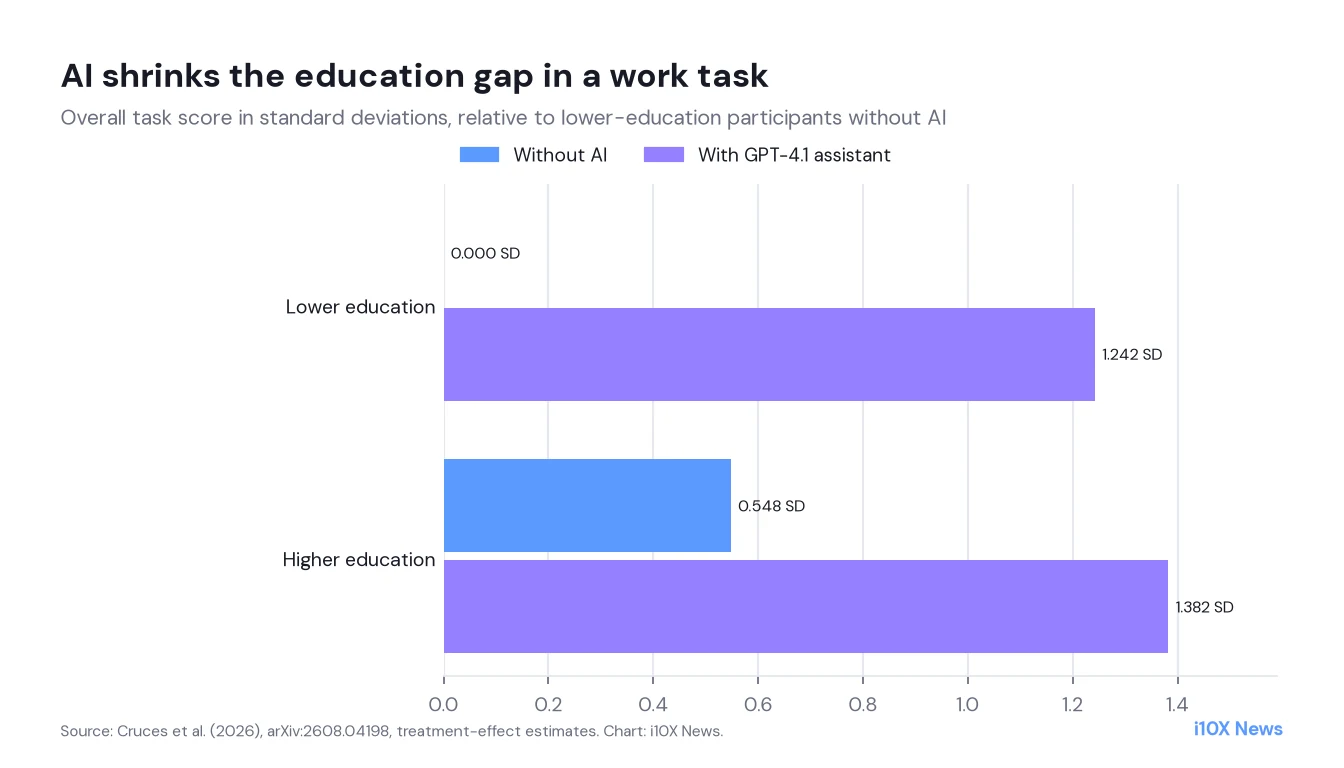
- The finding: With an AI assistant, adults with only a high-school-level education nearly caught up with university-educated peers on a business problem-solving task: the gap fell from 0.548 to 0.139 standard deviations, closing about 75% of it.
- Not just delegation: When the assistant was taken away for a follow-up task, treated participants did no worse than controls, and lower-education participants kept part of their gain (about 0.171 SD).
- What it means: AI raises the floor of task execution, but it does not erase human capital: a 0.200 SD education gap re-emerged without AI, and better-educated users still used the tool more effectively.
Does generative AI level the playing field between workers, or does it help the already advantaged most? Studies inside firms, such as call centers or consulting companies, tend to find bigger gains for weaker performers. But firms select whom they hire, which compresses the range of education levels being compared. This preregistered experiment by economists from Universidad de San Andrés, the University of Nottingham, the University of Maryland and Universidad Torcuato Di Tella looks outside firms, at adults with very different levels of formal education.
What the study shows
Between September and November 2025, 1,174 adults aged 25 to 45 in Argentina completed an incentivized, workplace-style task: diagnosing a business problem described in an email and proposing a solution. Half were randomly given access to an assistant based on OpenAI‘s GPT-4.1, embedded in the experiment page. Afterwards, everyone did a short follow-up module without AI. Scores are measured in standard deviations relative to the lower-education control group.
| Group | Without AI | With AI |
|---|---|---|
| Lower education (high school or partial tertiary) | 0 (reference) | +1.242 SD |
| Higher education | +0.548 SD | +1.382 SD* |
| Gap between groups | 0.548 SD | 0.139 SD |
- Bigger gains for the less educated: AI raised the overall score by 1.242 SD for lower-education participants and by 0.834 SD for higher-education participants. The difference in treatment effects, 0.408 SD, is statistically significant.
- Lower-educated with AI beat graduates without it: The average score of treated lower-education participants was more than twice the advantage of untreated higher-education participants (1.242 SD versus 0.548 SD).
- The gap narrows but does not vanish: Higher-education participants with AI still outperformed lower-education participants with AI by 0.139 SD, a difference the authors call economically meaningful, though marginally insignificant.
- Some learning carries over: Without the assistant in the follow-up, lower-education participants who had used AI scored about 0.171 SD higher; higher-education participants showed a small, non-significant gain.
- Effort still matters: Heavy use of the assistant produced strong main-task scores regardless of participants’ own effort, but follow-up performance was substantially higher only when intensive AI use was combined with sustained effort.
Why it matters: evidence beyond the firm
Most well-known results on AI and inequality between workers, such as studies of customer-support agents or consultants, come from inside a single company. This experiment compares people across a wide education range, which is closer to the question policymakers ask: can AI help people with less formal schooling compete for knowledge work?
The design also tests a common worry, that productivity gains are just the AI doing the work. Because performance did not fall once the tool was removed, the authors argue the gains are not purely delegation.
Method in brief
Participants were recruited through three panel providers and randomly assigned to treatment or control; 65% of eligible participants completed the experiment, with similar rates across arms. Responses were graded against preregistered rubrics for content (10 points) and writing (10 points) using an AI-assisted procedure based on GPT-5 mini. The authors validated the grading with alternative models (Claude Haiku 4.5, Gemini Flash 3.0), an independent researcher, and human graders on a 10% sample, all blind to treatment. Chat logs of all assistant interactions were analyzed to explain the results. The data are published on GitHub.
What remains open
- One task, one country: The study uses a single business problem-solving task with participants from Argentina. Whether the effect holds for other tasks, longer projects or other labor markets is not tested.
- Short-term learning only: The follow-up module comes right after the main task. It cannot show whether skills persist over weeks or months.
- AI grading: Scores come from an AI-assisted grader. The validation checks are extensive, but rubric-based grading of open-ended answers is never perfect.
- Selection into the sample: Participants needed a personal computer, which the authors say limited participation among lower-education adults (44% low versus 56% high education in the sample).
Context
The results fit the pattern seen in earlier work: AI assistance tends to help lower performers most, as in studies of customer-support agents and consultants. The new contribution is showing a similar compression across education levels outside firms, while also showing its limits once the tool disappears. More research on AI and work is collected in our Society & Economy section.
What it means for employers and educators
- Wider talent pools: For structured knowledge tasks, an AI assistant can make candidates without a degree much more productive. Hiring filters based only on formal education may miss them.
- Pair tools with practice: Gains carried over best when people used AI intensively and also put in sustained effort. Training should not let the assistant do all the thinking.
- Measure unassisted skill too: If assessments only test performance with AI, they will hide the human-capital gap that re-emerges without it.
About the analysis
Researched and written with AI assistance under the editorial responsibility of the i10X News team. The title image is an AI-generated illustration. Read our AI Use Policy. Spotted an error? Request a correction.
This article is based on the full text of the preprint “Does generative AI narrow education-based productivity gaps? Evidence from a randomized experiment” (arXiv:2608.04198v1, submitted August 4, 2026). All numbers are taken from the paper’s text, tables and figures; i10X did not rerun the experiments. The chart was redrawn by i10X from treatment-effect estimates of the paper, which is published under a CC BY 4.0 license.
i10x Perspective
This is one of the cleaner pieces of evidence that generative AI can act as an equalizer, at least for task execution. A lower-educated worker with a GPT-4.1 assistant outperformed a university graduate without one by a wide margin. But the follow-up is the more important part of the story: when the tool goes away, most of the gap returns. AI compresses differences in what people produce, not, so far, in what they know. For companies and education systems, the lesson is to treat AI as a powerful amplifier that still needs human effort behind it.