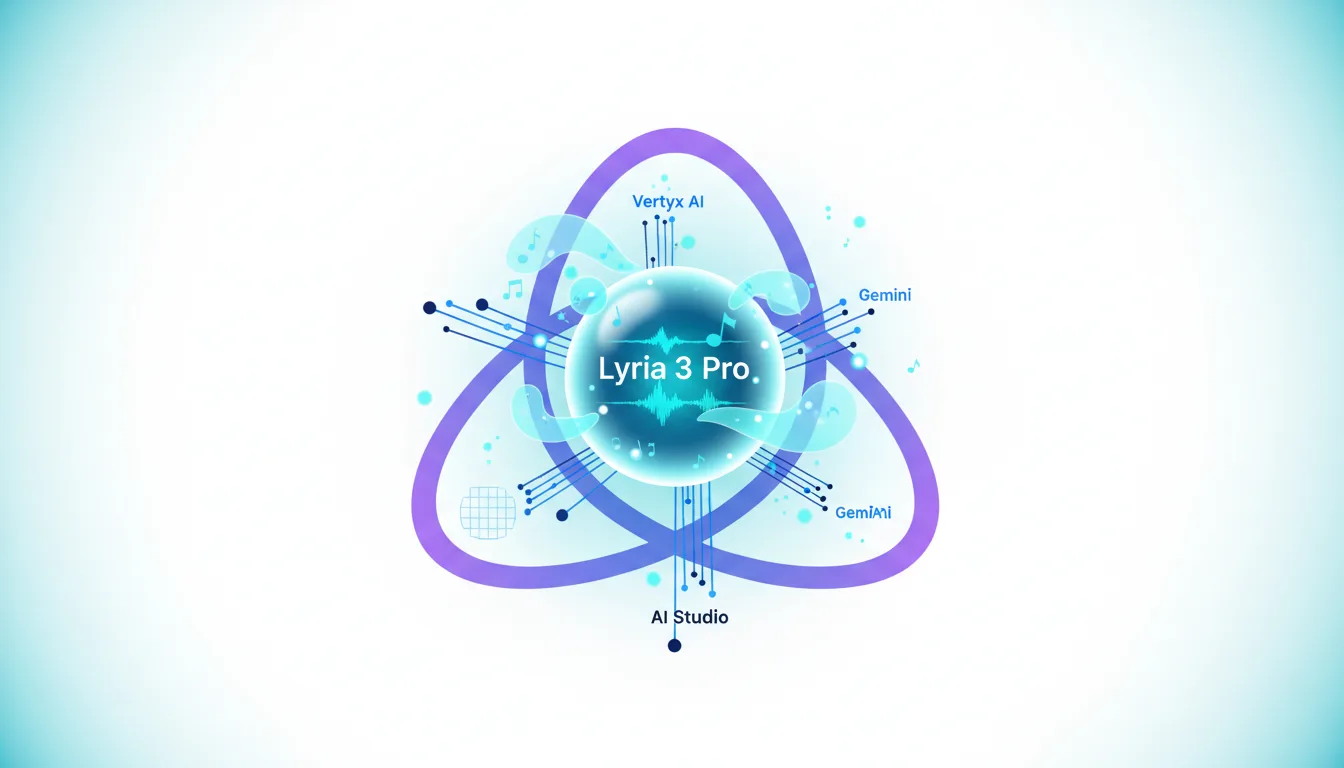
Have you ever wondered if the next big AI breakthrough would feel more like a quiet infrastructure upgrade than a flashy gadget? Google’s launch of Lyria 3 Pro isn’t just another AI model release; it’s a strategic move to turn generative music into a commoditized, enterprise-grade utility—one that’s woven right into the fabric of everyday development. By integrating it across Vertex AI, the Gemini API, and AI Studio, Google is signaling that the future of creative AI will be won through scalable infrastructure and developer access, not standalone apps.
Quick Take
- Summary: Google has launched Lyria 3 Pro, its latest-generation AI music model. Rather than being a consumer-facing tool, it is being distributed as a developer-first service through three key platforms: the enterprise-grade Vertex AI, the versatile Gemini API, and the rapid-prototyping environment of AI Studio. From what I’ve seen in similar rollouts, this kind of thoughtful layering really opens doors for builders at every level.
- What happened: Developers and businesses can now integrate high-quality, AI-driven music and audio generation directly into their applications and workflows. This triple-platform strategy caters to a wide spectrum of users, from solo developers testing ideas in AI Studio to large enterprises requiring monitored, scalable deployments on Vertex AI—it’s like handing out the right tools for the job, whatever the scale.
- Why it matters now: This marks a critical shift in the generative AI market, moving from novelties to utilities—the kind of pivot that changes how we think about building apps. By embedding Lyria 3 Pro within its core AI infrastructure, Google is betting that the real value lies in providing reliable, API-driven building blocks for others, placing immense pressure on specialized, standalone AI music startups. And honestly, it’s a smart bet in a world that’s growing more interconnected by the day.
- Who is most affected: Application developers in gaming, advertising, and social media now have a powerful, scalable tool to create dynamic audio—something that could spark fresh ideas in those fast-paced fields. Enterprise product teams can now consider generative audio a manageable part of their tech stack, while existing AI music startups face a new, deeply integrated competitor. The ripple effects here really could reshape team priorities overnight.
- The under-reported angle: The story isn’t the model’s capabilities alone, but its distribution strategy—that’s the part that keeps me coming back to these announcements. While an official announcement focuses on the “what,” the real insight is in the “how.” Providing simultaneous access via Vertex AI, the Gemini API, and AI Studio reveals a deliberate plan to make sophisticated AI music generation a boring, predictable, and scalable cloud service—the unglamorous stuff that actually gets things built.
Deep Dive
What if the real game-changer in AI music wasn’t the flashiest output, but how seamlessly it slots into your workflow? Google’s Lyria 3 Pro release is less about a single creative tool and more about the industrialization of AI-generated music—a shift I’ve noticed picking up steam across the board. By making the model accessible through its core developer and enterprise platforms, Google is productizing generative sound as a scalable utility. This isn’t a competitor to a consumer app; it’s a foundational service for building the next wave of audio-aware applications. The three access points—Vertex AI for enterprise governance, the Gemini API for broad developer integration, and AI Studio for instant prototyping—are a clear signal that Google is targeting the entire development lifecycle, from ideation to production, without skipping a beat.
This API-first approach directly addresses a major market gap: the difficulty of moving AI music from a cool demo to a reliable in-app feature—and boy, does that resonate with the teams I’ve talked to. Current web coverage focuses on the launch announcement, but the real developer pain points revolve around integration, scaling, and governance. The content_gap_opportunities in the market highlight a hunger for practical details: code samples, clear pricing, rate limits, and latency benchmarks. Google’s strategy bypasses the novelty factor and moves straight to solving these unglamorous but critical implementation challenges, promising that developers can go from an idea to a working prototype with minimal friction—or at least, far less than before.
The true differentiator for Lyria 3 Pro is its native home within Google’s infrastructure, which gives it an edge that’s hard to overlook. While smaller competitors may offer models with unique creative capabilities, they cannot easily match the enterprise-grade controls offered by Vertex AI, such as monitoring, security, and predictable performance at scale. This transforms the conversation from “Which model sounds best?” to “Which platform can I trust with my production workload?” For businesses building features for gaming soundtracks, personalized ad jingles, or podcast background audio, the reliability and scalability of the underlying platform are paramount—and that’s where the real decisions get made, day in and day out.
Furthermore, this multi-platform release strategy serves as a blueprint for how Google likely plans to commoditize other generative AI modalities in the future—it’s almost like they’re laying out the roadmap right in front of us. By leveraging its existing developer ecosystem and cloud infrastructure, Google erects a significant competitive moat. The battle for generative AI is quickly expanding beyond model leaderboards to include the plumbing: API performance, developer experience, and enterprise-readiness. Lyria 3 Pro is an infra play disguised as a model release, aimed squarely at making Google Cloud the default choice for building with generative media—a move that could echo through the industry for years.
Finally, embedding Lyria 3 Pro within managed services forces a conversation around the practicalities of governance, copyright, and safety—issues that, from my vantage, often trip up even the most prepared projects. While an independent model must grapple with these issues alone, a platform-based offering can inherit policies and safeguards from the parent ecosystem. For enterprises, this is a crucial advantage, as it provides a clearer path to deploying AI-generated content in a compliant manner, addressing key questions around usage rights and content filtering that often paralyze development. It’s a reminder that innovation, at its best, comes with guardrails built in.
Stakeholders & Impact
| Stakeholder / Aspect | Impact | Insight |
|---|---|---|
| AI / LLM Providers | High | Google is using its infrastructure strength to commoditize a creative modality—something that’s bound to influence how others play the game. This sets a precedent for competing on distribution and platform integration, not just model quality, and it raises the bar for everyone else in the space. |
| Developers & Enterprises | High | Access to a scalable, enterprise-ready music generation API reduces integration friction and enables new product features in gaming, advertising, and content creation—finally, a tool that feels purpose-built for real-world use. The focus shifts to implementation, letting teams spend more time creating than troubleshooting. |
| Creative Industries | Medium | Musicians and producers gain a powerful new tool, but one that is framed as a developer component rather than a standalone creative suite—it’s integrated, not isolated. The impact will be felt in workflows needing scalable, programmatic audio, opening up possibilities that were once out of reach. |
| AI Music Startups | High | The competitive landscape has shifted, no question about it. Startups must now differentiate not only on their model’s unique creative output but also on their ability to compete with the scale, price, and integration of Google’s cloud services—a tall order, but one that could spark some clever adaptations. |
About the analysis
Researched and written with AI assistance under the editorial responsibility of the i10X News team. The title image is an AI-generated illustration. Read our AI Use Policy. Spotted an error? Request a correction.
This analysis is an independent interpretation of Google’s Lyria 3 Pro launch, developed by i10x based on market signals, competitor coverage, and identified developer needs—drawing from patterns we’ve observed over time. It is written for engineering managers, product leaders, and CTOs who are evaluating the strategic implications of new AI models and their underlying infrastructure, with an eye toward what it means for their own roadmaps.
i10x Perspective
Ever feel like the AI landscape is tilting toward the builders who control the pipes, not just the ideas? The launch of Lyria 3 Pro via an API-first, multi-platform strategy is a watershed moment for creative AI—one that underscores how far we’ve come from those early, experimental days. It signals the end of the “magic demo” era and the beginning of generative media as a metered, industrial-grade utility, much like compute or storage ever since the cloud took off.
Google is demonstrating that the ultimate battle for AI dominance may not be won by the most advanced model, but by the most integrated and developer-friendly infrastructure—and that’s a perspective worth weighing carefully. Watch for this playbook to be repeated across video, 3D, and other complex modalities, as the AI race evolves from a contest of capabilities to a war of distribution. The unresolved question is whether this utility-based approach will accelerate creativity or simply homogenize it at scale—something we’ll likely see play out in the months ahead, with plenty of twists along the way.