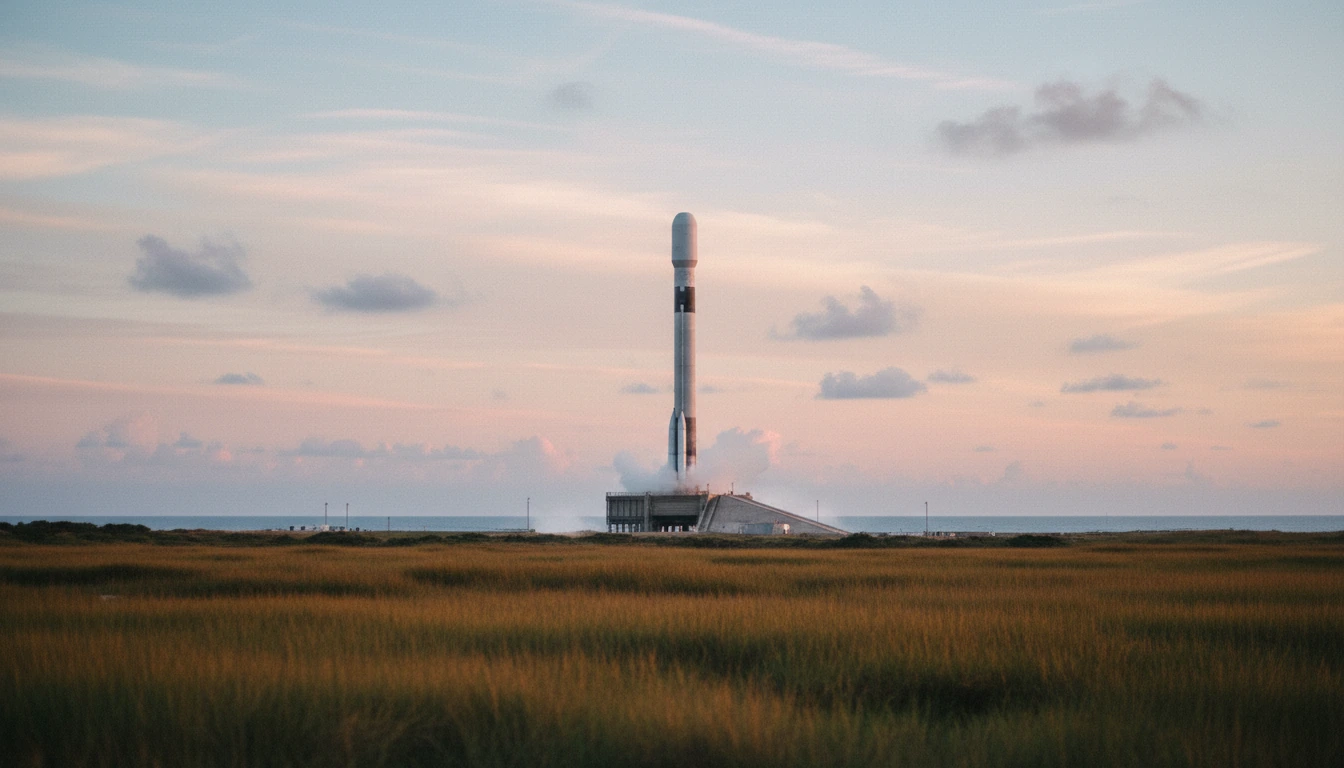
Google has booked a heavy-lift rocket for its plan to put AI data centers in orbit. Blue Origin said on 19 November 2026 that the two companies signed a launch services agreement for Project Suncatcher, Google’s research moonshot exploring whether networks of solar-powered satellites carrying its Tensor Processing Units (TPUs) can scale machine learning compute in space.
Quick Take
- The deal: Blue Origin’s New Glenn will carry Google’s first dedicated heavy-lift launch for Project Suncatcher.
- Timing: the launch is targeted for the first quarter of 2029.
- Payload: satellites, each with computing capacity “at roughly the scale of a data center rack,” headed for sun-synchronous orbit.
- Terms: no contract value was disclosed.
In plain English
AI needs huge amounts of electricity, and building power plants and grid connections on Earth is slow. In orbit, the sun shines almost constantly. Google wants to test whether it can put its AI chips on satellites powered by solar panels, link them together and run AI work up there. This deal books the rocket for that test.
What happened
Blue Origin announced the agreement in a news release. “Project Suncatcher is a long-term moonshot to scale AI infrastructure in space by tapping into the abundant solar power in orbit,” said Travis Beals, Senior Director of Project Suncatcher at Google. “This dedicated launch with Blue Origin represents a crucial milestone on our roadmap as we expand the boundaries of what’s possible for the future of compute.”
Jordan Charles, Senior Vice President of New Glenn at Blue Origin, said the rocket’s “heavy-lift capacity and large payload volume give customers the flexibility to bring new capabilities to orbit.”
How it works
- Interconnected satellites: Suncatcher envisions a network of satellites linked together, each carrying Google TPUs, the same family of AI chips Google uses in its data centers.
- Solar power: a sun-synchronous orbit keeps the satellites in near-constant sunlight.
- Scale of the test: each satellite on this mission carries roughly one data center rack’s worth of compute, according to Blue Origin.
Why it matters
For AI infrastructure, power is the bottleneck. Google has been signing deals for new energy on the ground, from superhot geothermal with Quaise Energy to large TPU capacity agreements. Orbit is the long-shot alternative.
For the space industry, a dedicated heavy-lift mission from Google signals that AI compute could become a new class of payload.
For everyone else, this is still research. A 2029 test of rack-scale satellites is far from replacing gigawatt-scale data centers.
What’s still open
- How many satellites the mission will carry and how they will be cooled and linked.
- What the launch costs and how the economics compare with data centers on Earth.
- How Google will handle latency, maintenance and radiation for chips in orbit.
Sources
- Blue Origin, “Google Selects Blue Origin’s New Glenn for Project Suncatcher,” 19 November 2026
i10x Perspective
Space data centers sound like science fiction, but the same power shortage that pushes AI labs toward nuclear and geothermal is pushing them toward orbit. A booked rocket makes Suncatcher a real program with a date. More on Google and AI spending in our AI Capex Tracker.