Quick Take
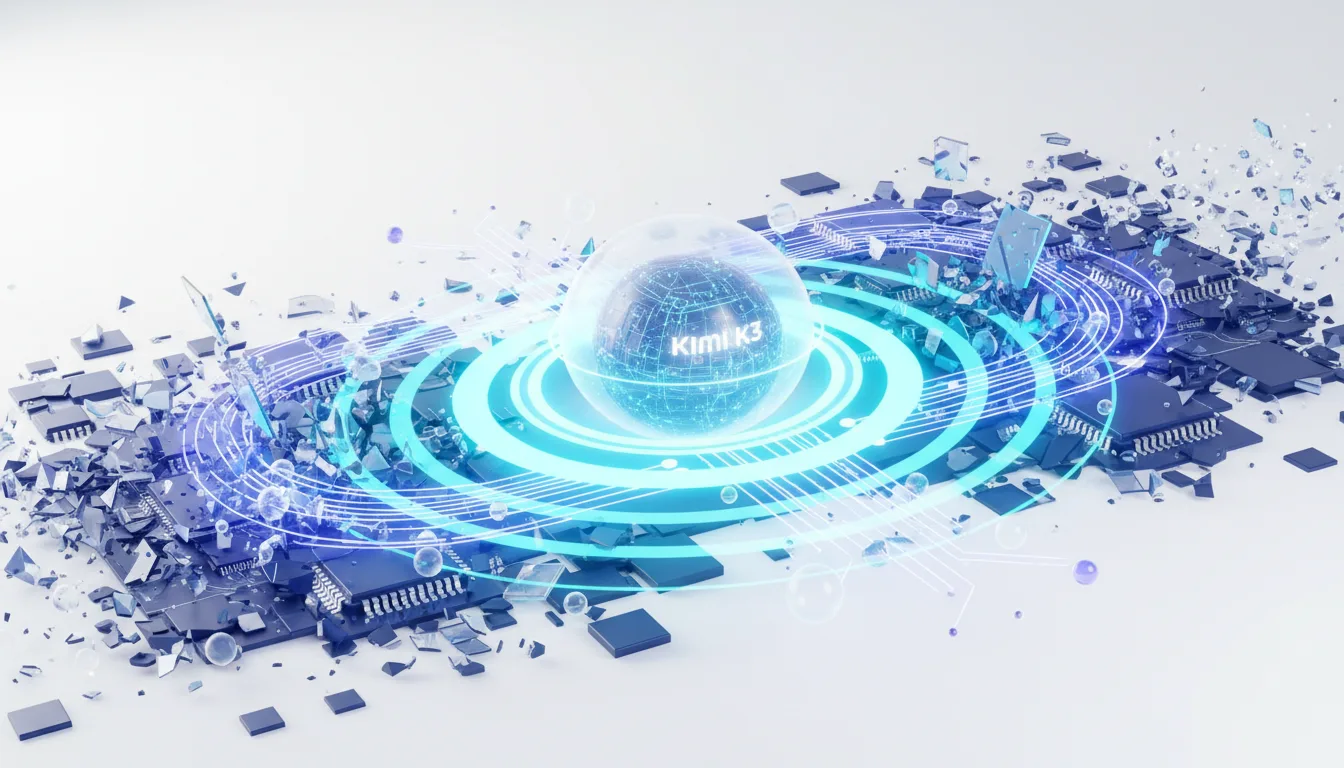
Moonshot AI’s Kimi K3 is sending shockwaves through global semiconductor markets, proving that hardware export controls haven’t halted the evolution of Chinese frontier models.
Summary:
Moonshot AI recently debuted its Kimi K3 model, and the ripple moved faster than most expected. It nudged investors to question whether U.S. labs still hold an unassailable edge, which showed up quickly as a dip in semiconductor stocks.
What happened:
The Chinese startup released Kimi K3, a model that sits comfortably alongside the strongest Western systems. Markets reacted in real time, with valuations for chipmakers and suppliers easing as traders recalculated the balance of power between software and hardware.
Why it matters now:
Export rules were meant to slow things down, yet Kimi K3 shows teams can still push frontier performance by tightening algorithms and inference instead of simply adding more chips.
Who is most affected:
Hardware makers and Western designers felt the first jolt. At the same time, policy teams and cloud providers have to adjust to a narrower gap they had counted on staying wide.
The under-reported angle:
Beyond the headline selloff sits a quieter shift in efficiency. Early signs point to training and inference paths that extract more from limited silicon, which could change what future hardware buyers actually need.
Deep Dive
Have you ever assumed export bans would simply freeze progress on one side of the Pacific? Moonshot AI’s Kimi K3 puts that idea to the test. For months the working premise in Western markets was that restricted GPU access would keep Chinese labs a step behind. Instead the new model shows hardware limits can push teams toward sharper code and leaner pipelines rather than outright surrender. Kimi already carried an advantage in long context and fast responses; stretching those strengths into territory held by GPT-4o, Gemini, and Claude compresses the distance between leaders and challengers.
The immediate selloff in chip stocks revealed how much pricing had baked in permanent Western dominance. That bet assumes an endless need for the newest, most expensive silicon. When a model reaches comparable multimodal and reasoning levels without unrestricted access to the latest NVIDIA parts, investors start asking whether peak compute is quite as decisive as once thought. Two concerns surface at once: a capable software rival now exists, and future training runs might succeed on more varied or heavily optimized hardware.
Right now details on parameter count, exact cluster size, and clean third-party benchmarks remain thin. Still, enterprises are already watching how Kimi K3 handles parameter-efficient inference and quantization. If it can run demanding workloads like code generation, large-scale document work, and agent-style tasks on tighter resources, the old link between more hardware and better models starts to loosen.
In short, the story moves from raw chip counts toward data quality, synthetic data, and training thrift. Regulators, planners, and API buyers now face a multipolar field where architectural edge matters at least as much as silicon access.
Stakeholders & Impact
| Stakeholder / Aspect | Impact | Insight |
|---|---|---|
| AI / LLM Providers | High | Western labs lose the “guaranteed lead” story and must now justify scaling beyond sheer parameter growth. |
| Infrastructure & Chip Vendors | High | Confidence dips once investors see algorithmic gains potentially trimming demand for top-tier GPUs. |
| Enterprise Developers | Medium–High | A strong global option adds pricing pressure and forces teams to weigh multi-model strategies more carefully. |
| Regulators & Policy | Significant | Export controls look more like speed bumps than permanent barriers. |
About the analysis
Researched and written with AI assistance under the editorial responsibility of the i10X News team. The title image is an AI-generated illustration. Read our AI Use Policy. Spotted an error? Request a correction.
This independent analysis pulls together market moves, competitor coverage, and infrastructure signals around Moonshot AI’s Kimi K3 launch. It is written for CTOs, strategists, and investors who want a clearer view of how model progress and semiconductor flows now interact.
i10x Perspective
Kimi K3 is a reminder that compute edges do not last when serious capital and talent line up on the other side. We are moving into a period of compute asymmetry, where constraints force fresh approaches to scaling. Over the next five years the durable advantages will likely sit in data pipelines, agent design, and relentless control of inference costs rather than in simply amassing the most GPUs.