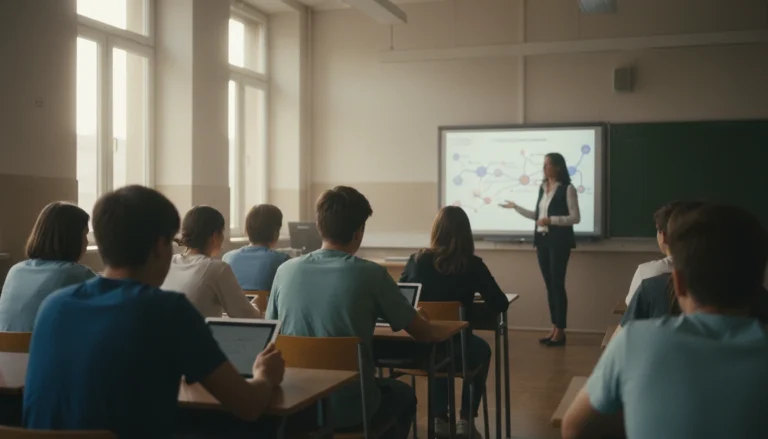
KQED, the public media station serving the San Francisco Bay Area, has released Finding First Person: Telling My Story in the Age of AI, a free AI literacy curriculum for high school students. The 15-lesson unit is built for English, ethnic studies and media arts classes and helps students decide if, when and how to use AI while they write personal narratives.
Quick Take
- What it is: A free, standards-aligned personal narrative media unit with 15 lessons, co-created with high school students.
- The core idea: “Narrative agency,” which KQED defines as the ability to recognize, value and keep ownership of one’s own voice.
- No stance: KQED says the unit does not assume a pro- or anti-AI position and instead opens classroom conversations about AI.
- The final project: Students create an audio essay or short video about their own experiences with AI and share it on the KQED Youth Media Showcase.
- Teacher support: Slides, daily lesson plans, rubrics and a free educator webinar on January 26, 2027. Twelve US teachers are being recruited to field test the unit.
In plain English
Many students now use chatbots to help them write, and many teachers worry about it. Instead of banning AI or encouraging it, this curriculum asks students to first figure out what they themselves want to say. Only then do they think about whether an AI tool helps or gets in the way. Along the way, they test chatbot outputs and compare them with their own writing.
What happened
KQED announced the curriculum on November 18. During the unit, students reflect on their personal values, read about AI’s evolving role in society and critically evaluate AI chatbot outputs.
“Narrative agency puts the student first and the AI tool later,” said Rachel Roberson, Senior Program Manager at KQED and co-developer of the program. “The concerns we as educators have about AI are valid, but blanket bans only drive the issue away from our classrooms.”
Shilynn BaFarlough, one of the students who helped write the unit, said: “AI should not replace my own voice. I should be the person deciding what I want to say, what experiences I want to share, and what my perspective is.”
Background
Schools and education organizations are publishing free AI materials at a fast pace, from the Hour of AI activities by CodeAI to national portals such as Armenia’s Teacher’s AI Guide. Most focus on how to use AI tools; KQED’s unit focuses on when not to.
Why it matters
AI literacy is often taught as a technical skill: how prompts work, how models make mistakes. KQED frames it as a writing and identity skill instead. That approach fits subjects like English and media arts, where the main worry is not cheating alone but students losing their own voice, and it gives teachers a ready-made alternative to outright bans.
What’s still open
- What the field test with twelve teachers shows about student outcomes.
- Whether districts with AI restrictions for students can use the chatbot evaluation lessons.
- How the unit will be adapted for other grades or subjects.
About the analysis
This independent i10x analysis is based on KQED’s press release. All quotes are taken from that source.
Sources (plain text, no links):
- KQED pressroom: “Public Media Station KQED Launches an AI Literacy Curriculum for High School Students” (November 18, 2026)
i10x Perspective
The most useful AI lesson for teenagers may be knowing what they think before they ask a chatbot. Expect more curricula that treat AI as a choice to reflect on, not a tool to master. More on our Education page.