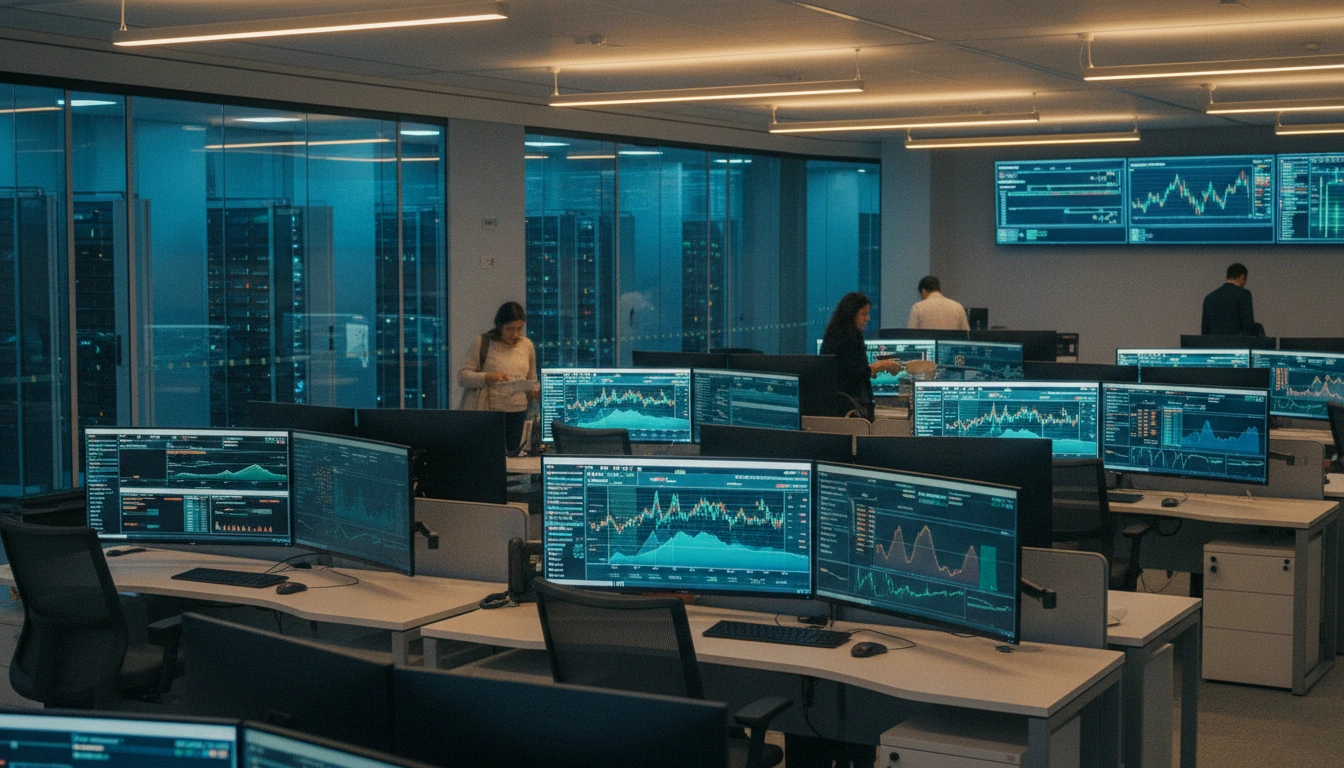
Nasdaq launched a governed environment for agentic AI inside its Calypso platform on 29 September 2026, marking a shift from experimental chatbots to production-ready automation across the trade lifecycle. The move positions Nasdaq Calypso as an orchestration layer for AI in capital markets, allowing banks, brokers, and asset managers to run and connect agents within a contained, governed space that enforces operational boundaries and live oversight.
The announcement comes as financial institutions face pressure to move beyond pilot projects. A Nasdaq and Acuiti survey found that 56 percent of respondents fear losing competitive ground if they do not integrate AI or machine learning into clearing operations, while nearly half cited manual intervention as a bottleneck in post-trade workflows.
Quick Take
- What happened: Nasdaq Calypso launched a governed agentic AI environment on 29 September 2026 for trade-lifecycle automation.
- The infrastructure: The platform uses the Model Context Protocol to connect agents, with sandboxing, no external data retention, and hosting on Amazon Bedrock.
- First capability: A natural language assistant queries platform data, documentation, and records to accelerate analysis and decision-making.
- Client control: Institutions retain full data ownership and must approve AI governance and control requirements before deployment.
- Competitive context: The launch follows Interactive Brokers’ autonomous AI trading and Goldman Sachs’ restrictions on AI in investment banking, showing divergent approaches to AI in finance.
In plain English
Nasdaq built a walled garden for AI agents inside its Calypso platform, which financial institutions already use to manage trading, risk, and collateral. Instead of letting agents roam freely or building chatbots that answer questions, Nasdaq created a governed space where agents can automate tasks like analyzing trade data, reviewing documents, and preparing recommendations. The system enforces strict boundaries so agents operate only within an institution’s perimeter and policies. Clients can plug in their own AI tools or use Nasdaq’s agents, and everything runs with oversight and sandboxing to prevent rogue behavior. The first agent is a natural language assistant that lets users query the platform’s records without writing code.
What happened
Nasdaq announced the agentic AI environment on 29 September 2026, describing it as a framework for integrating AI capabilities within capital market and treasury operations. Magnus Haglind, Head of Capital Markets Technology at Nasdaq, said the goal is to evolve Nasdaq Calypso from a system of record into an intelligent platform that automates activity at every stage of the trade lifecycle.
The environment allows clients to access Nasdaq Calypso’s agents and connect their own proprietary AI infrastructure through an integrated layer built on the Model Context Protocol, an emerging industry standard for linking AI agents to software. The system applies operational boundaries, live oversight, and strict sandboxing with no external data retention, designed to keep agents operating solely within an institution’s perimeter and policies.
Agents operate on core Nasdaq Calypso data, drawing on the platform’s system-of-record trading, risk, and collateral records, and can be extended with additional enterprise, market, and reference data sources. The agents are hosted by Nasdaq and delivered through Nasdaq Calypso’s cloud environment, which is built on Amazon Bedrock. On-premises clients can also connect to the same agents.
The first agentic capability is a natural language assistant that lets users query the platform’s data, documentation, and other information. Nasdaq said the functionality seeks to deepen how teams can use the platform, enhance productivity around data analysis and document review, and accelerate decision-making. The company plans to roll out a suite of governed agentic workers designed to address operational friction caused by manual processes across capital market workflows.
The infrastructure choice
Nasdaq chose the Model Context Protocol as the integration layer, betting on an emerging standard rather than proprietary connectors. The protocol allows clients to plug in agents from multiple sources, including their own AI infrastructure, without rewriting code for each connection. The decision reflects a broader industry pattern: enterprises are weighing security risks and production readiness as they move from experiments to scaled deployments.
The sandboxing and no-external-data-retention design addresses a core concern in regulated environments. Financial institutions cannot afford agents that leak data to third-party model providers or operate outside compliance boundaries. By hosting agents within the Calypso environment and enforcing strict perimeters, Nasdaq aims to give clients the automation benefits of agentic AI without the governance headaches that have slowed adoption elsewhere.
Amazon Bedrock provides the underlying cloud infrastructure, offering scalable services and governance controls. On-premises clients retain the option to connect to the same agents, a concession to institutions that prefer to keep sensitive workloads behind their own firewalls.
Why institutions are paying attention
The Nasdaq and Acuiti survey data underscores the urgency. Fifty-six percent of respondents said they risk losing ground to competitors if they do not integrate AI or machine learning into clearing operations, and nearly half highlighted challenges relating to manual intervention within post-trade operations. Those figures suggest that AI in capital markets is moving from a nice-to-have to a competitive necessity.
At FIA Expo in Chicago on 3 November 2026, executives from Bank of America, BNP Paribas, Nasdaq, and Société Générale discussed what is working and where the technology falls short. Sophie Marnhier-Foy, vice president of financial technology and head of digital asset solutions at Nasdaq, described a progression from chatbots that answer questions to more independent agents capable of investigating problems, accessing data, and preparing recommended actions. She said agents will stop at the point where they recommend an action to a user, never taking actions autonomously without human oversight.
That distinction between recommendation and execution is critical. Bank of America’s Ian Grubb, director of EMEA client solutions for futures and options and OTC clearing, said anything goes for activities such as reading, discovery, composition, and suggestion, but it stops at the point of execution. He said he is not aware of anything in the bank’s stack that allows autonomous taking of any sort of active risk decision that is not supervised by a human.
The catch
Nasdaq will partner with individual clients as they work through internal AI governance and control requirements to bring these capabilities online. That means deployment timelines depend on each institution’s readiness, not just the technology’s availability. Clients retain full control of their data, but they must approve the governance framework before agents go live.
The natural language assistant is the first capability, but Nasdaq has not disclosed a timeline for the suite of governed agentic workers it plans to roll out. The company said the launch builds on its extensive AI capabilities within its suite of Financial Technology platforms, including Nasdaq Verafin’s Agentic AI workforce leveraged by 800-plus clients and AI-powered regulatory reporting in Nasdaq AxiomSL. The patterns learned from those deployments are expected to help deliver greater levels of performance and client outcomes, but that remains a forward-looking statement.
The FIA Expo panel also highlighted where AI struggles. Marianne Maurel, head of markets operations, transversal services Americas at BNP Paribas, said AI had proved less satisfactory when asked to work with large sets of numerical data, such as profit-and-loss or independent price verification figures, to identify outliers or trends. The problem is not simply getting an answer but being able to explain and verify how the model reached it. Bank of America’s Grubb questioned what happens when AI is used to generate a full application or system, noting that firms could be approaching a point where AI produces so much code that humans do not have time to read the entire codebase.
What’s still open
- How quickly will institutions complete internal AI governance reviews and approve the Calypso agents for production use?
- What specific agentic workers will Nasdaq roll out beyond the natural language assistant, and on what timeline?
- Will the Model Context Protocol become the de facto standard for agent integration in finance, or will competing protocols fragment the market?
- How will Nasdaq measure and report the performance and safety of agents operating in client environments?
- Can the governed environment scale to handle the volume and complexity of trade-lifecycle workflows at the largest institutions?
About the analysis
Researched and written with AI assistance under the editorial responsibility of the i10X News team. The title image is an AI-generated image. Read our AI Use Policy. Spotted an error? Request a correction.
This independent i10x analysis is based on Nasdaq Calypso’s press release on agentic trade-lifecycle tools. Source names are given in the text; we do not link out to those pages.
i10x Perspective
Nasdaq’s move is a market-infrastructure play, not a feature race. By positioning Calypso as the orchestration layer for trade-lifecycle agents, Nasdaq is betting that institutions will prefer a governed environment inside a platform they already trust over stitching together point solutions from multiple vendors. The emphasis on sandboxing, no external data retention, and client-controlled governance addresses the compliance and risk concerns that have kept many financial institutions in pilot mode. The real test will be whether the governed environment can deliver enough automation value to justify the deployment friction, and whether clients trust Nasdaq to host agents that touch their most sensitive workflows. If the Model Context Protocol gains traction, Nasdaq could become the connective tissue for a multi-vendor agent ecosystem in finance. If it does not, the platform risks becoming a walled garden that limits interoperability.