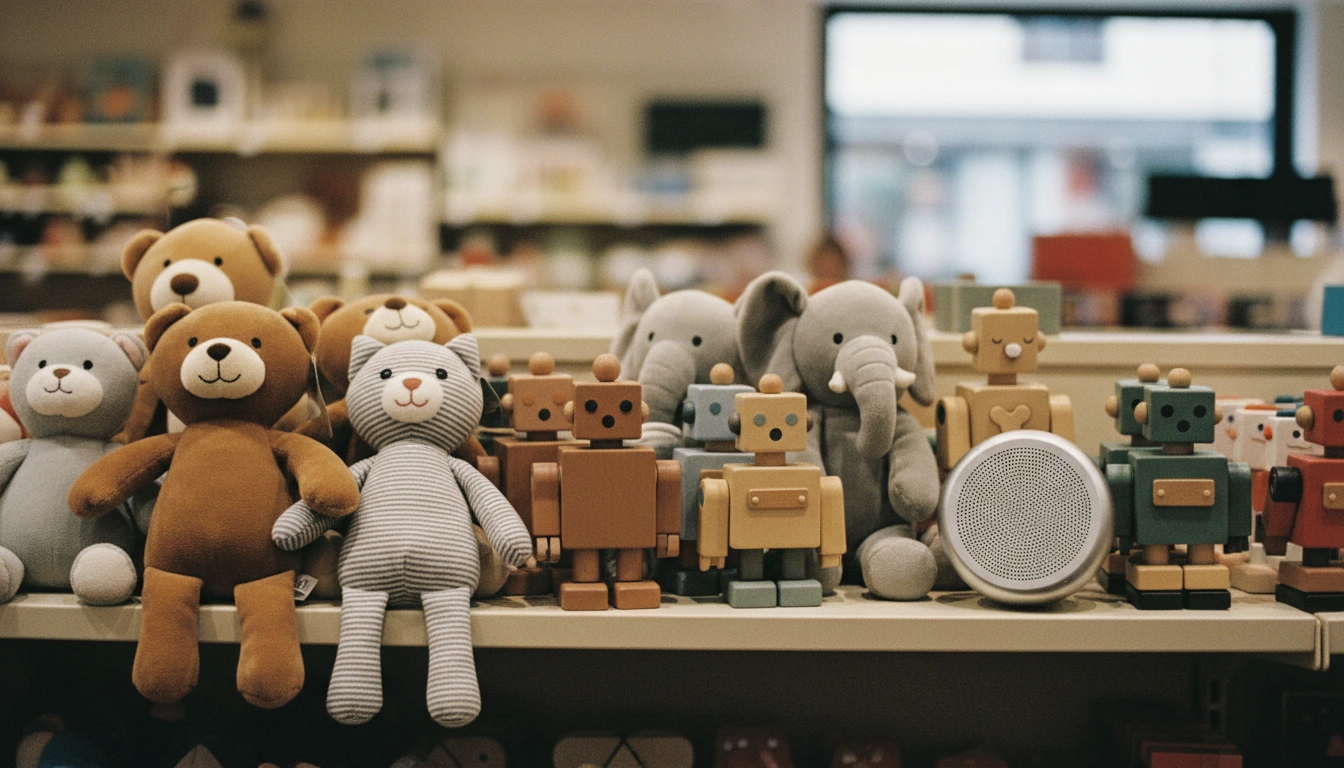
New York has enacted a five-year ban on toys with built-in AI chatbots. According to the governor’s announcement of November 24, bill S.9408A/A.11144B prohibits making, distributing and selling such toys in the state, for example talking stuffed animals, dolls and robots that hold internet-connected conversations with children. The ban does not apply this holiday season: it takes effect 90 days after signing. The more useful question for toy makers, AI providers and retailers is which products the law actually reaches, and the answer lies in two definitions the bill borrows from other laws.
What the law prohibits, and when
The bill text adds a new article to New York’s General Business Law. No business may manufacture, exchange, hold for sale, distribute or sell a “chatbot toy” in the state. On our count, the 90-day period ends on February 22, 2027, and the ban then runs for five years, until early 2032, unless lawmakers change it. The text also allows rules needed for implementation to be adopted before the start date.
Which toys count
A chatbot toy is defined as an “AI companion” embedded in or integrated with a children’s toy. Both parts come from existing law:
- Children’s toy follows the federal definition in the Consumer Product Safety Improvement Act: a consumer product designed or intended by the manufacturer for children aged 12 or younger to use when they play.
- AI companion comes from New York’s AI companion law, in force since November 2025. It covers systems that simulate a sustained human-like relationship by remembering earlier interactions and preferences, asking unprompted emotion-based questions and keeping up an ongoing dialogue about the user’s personal matters. That law excludes systems used only for customer service, internal productivity, research or technical assistance.
On our reading, that makes the relationship features the trigger, not the presence of AI as such. A plush toy that remembers a child’s name and asks how their day went is clearly covered. A toy that only answers factual questions or reads stories, without memory or emotional prompts, may fall outside the definition, although regulators and courts will have the final word on borderline products.
Who can be sued
Enforcement lies with the Attorney General, who can seek an injunction and civil penalties of up to $15,000 per day for each violation. No proof that a child was harmed is required, and preliminary relief is available. One detail stands out in the text: the ban applies to anyone selling such toys, but the enforcement clause is written against “operators”, meaning whoever runs or provides the AI companion inside the toy. That puts toy brands and their AI suppliers at the center of the risk, while the exposure of retailers is less clearly spelled out.
The announcement also cites tests by a consumer watchdog in which some chatbot toys for children aged 3 to 12 discussed sexual topics, explained where matches might be found at home and acted upset when a child wanted to leave, with few parental controls and safety limits that weakened over longer conversations.
What companies should do now
- Toy brands: check every connected product against the three companion features (memory, unprompted emotional questions, personal dialogue) and decide whether to redesign or stop New York sales before February 22, 2027.
- AI model providers that license voices or chat backends to toy makers: review those contracts, since the operator of the AI companion is the party the Attorney General can pursue.
- Retailers and marketplaces: flag affected products for New York delivery addresses, even if the text targets operators first.
- Parents: the state’s advice for this season is to check packaging for an AI companion, what data the toy collects and whether it allows open-ended conversation.
New York’s move adds to a wider push on children and chatbots, from age-based limits such as Google’s test of a daily Gemini time limit for children to research on how people use chatbots for company, such as our report on a study of ChatGPT and loneliness.
i10x Perspective
A time-limited sales ban on a whole category of AI consumer products is an unusual step, and the design is more precise than a blanket ban on “AI toys” would be: it targets companion behavior, not the technology. That gives manufacturers a clear path, which is to strip memory and emotional prompting from children’s products, and we expect several to ship New York-compliant versions rather than leave the market. The open point is the gap between who is banned from selling and who can be sued. Until the Attorney General or a court clarifies it, retailers will likely act cautiously and delist borderline products.