Summary
- What happened: Omen AI just raised $31M in Series A funding. The goal? Using machine learning plus continuous inline sensors to catch and stop bacterial outbreaks before they hit the liquid-cooled data centers powering today’s AI surge.
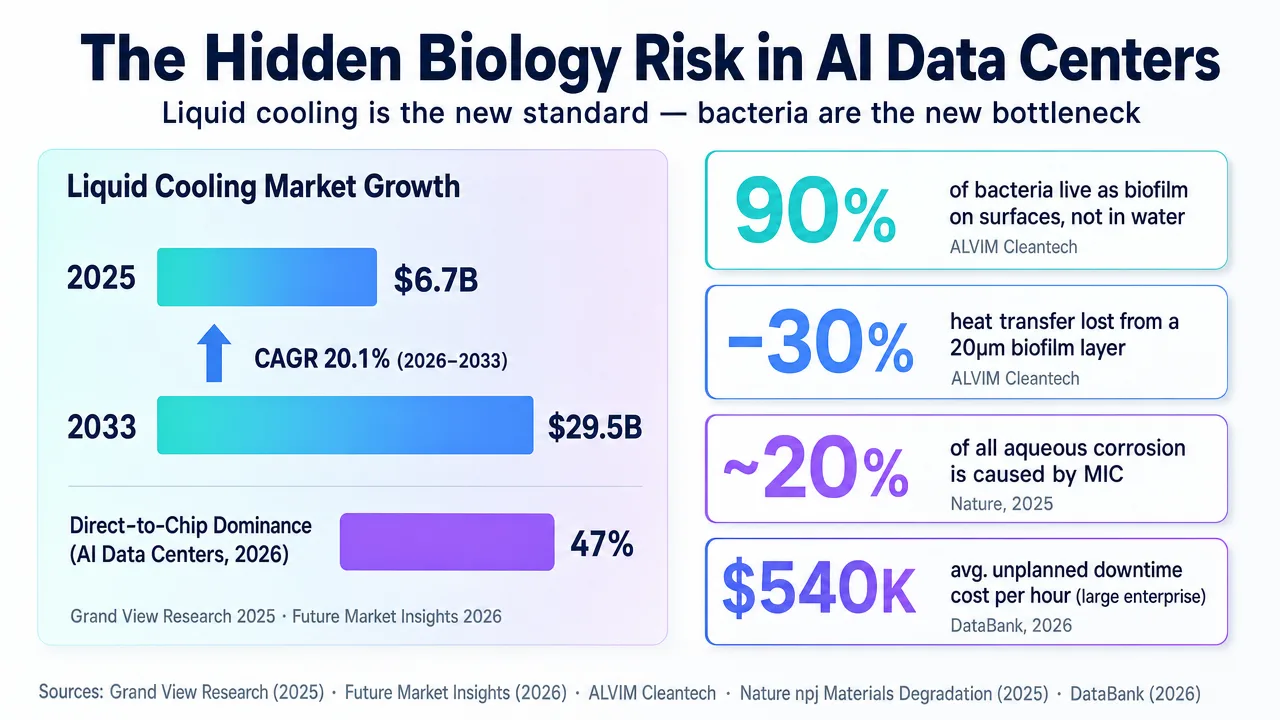
- Why it matters now: As AI hardware moves away from air cooling toward high-density direct-to-chip and immersion systems, operators are running into an unexpected problem—bacteria and biofilm clogging the loops. When microbes trigger microbiologically influenced corrosion (MIC) or block micro-channels, the result is sudden thermal throttling. That can take millions in hardware from full performance to outright failure.
Who is most affected
AI infrastructure engineers, hyperscale data center operators, and enterprise CTOs who have money tied up in multi-megawatt, GPU-dense clusters.
The under-reported angle
While everyone focuses on power grids and silicon supply, coolant hygiene has become a core Site Reliability Engineering (SRE) concern. Protecting these high-value AI pods now means treating biology like a preventable software issue instead of just another plumbing headache.
Deep Dive
The physical side of the AI boom is shifting fast. Handling the heat from chips like NVIDIA’s Blackwell has pushed data centers toward direct-to-chip liquid and immersion cooling. That switch, though, has surfaced a quiet problem: biology. Water-glycol mixes running through warm racks give bacteria the perfect conditions to grow and form biofilm.
I’ve noticed how quickly things can turn once those layers start building inside micro-channels—heat can’t escape properly. For a lab in the middle of a three-month LLM training run, a clogged line isn’t just another ticket; it means throttling, hardware wear, and lost compute time that costs real money.
Omen AI’s raise shows the industry is finally paying attention. In the past, teams checked water quality with periodic lab tests that simply couldn’t keep up. The new approach uses inline sensors feeding live data into an ML platform. Early signatures of trouble get flagged before biofilm takes hold, and it lines up with the tighter ASHRAE TC 9.9 liquid cooling standards.
Beyond the usual funding story, something more interesting is happening. Omen AI is turning coolant microbiology into an SRE problem. Instead of guessing when to flush or add chemicals, the system slots into existing DCIM and BMS tools. It sends alerts and suggests maintenance steps, creating a software layer that guards against microbiologically influenced corrosion (MIC).
There’s also a sustainability angle worth watching. Over-dosing biocides has been the quick fix for years, but it’s expensive and wasteful. Granular data lets operators dose more precisely, which helps cut chemical runoff. At this point, Total Cost of Ownership in AI infrastructure isn’t only about power and flops—it’s also about keeping hardware healthy longer and avoiding biology as a bottleneck.
Stakeholders & Impact
| Stakeholder / Aspect | Impact | Insight |
|---|---|---|
| AI / LLM Providers | High | Reliable cooling keeps GPU clusters running through long training jobs without thermal hiccups. |
| Data Center Operators | High | Moves teams away from slow lab checks toward automated telemetry that cuts downtime. |
| Sustainability & Regulators | Medium | Supports measured biocide use, helping meet local waste goals. |
| Hardware Vendors | Significant | Reduces MIC damage and blockages, which can lower warranty issues and stretch equipment life. |
About the analysis
Researched and written with AI assistance under the editorial responsibility of the i10X News team. The title image is an AI-generated illustration. Read our AI Use Policy. Spotted an error? Request a correction.
This independent look pulls together funding news, market reports, and thermal data to clarify how liquid cooling operations are evolving. It’s written for CTOs, AI leads, and operators dealing with high-density setups.
i10x Perspective
Omen AI’s work points to something basic about the current moment: even as AI grows more abstract in the cloud, its supporting hardware stays stubbornly physical—and now, partly biological. The heat from scaling has drawn data centers into fluid dynamics and microbiology.
Over the next decade, the winners won’t only be the ones with the most chips or power contracts. They’ll be the ones who handle these small-scale, messy realities with the right tools. This funding round shows that part of the ecosystem is expanding quickly, turning old facility risks into measurable, software-managed metrics.