
Quick Take
Dedicated AI hardware accelerates as intelligence moves to the edge, with Pocket securing an $11M funding round to challenge software-native transcription tools.
Summary:: Amid a booming market for ambient intelligence, Pocket has raised $11 million to commercialize a dedicated AI note-taking device. The startup is betting that professionals will prefer purpose-built physical hardware over smartphone apps or browser plugins for meeting capture, summarization, and task orchestration.
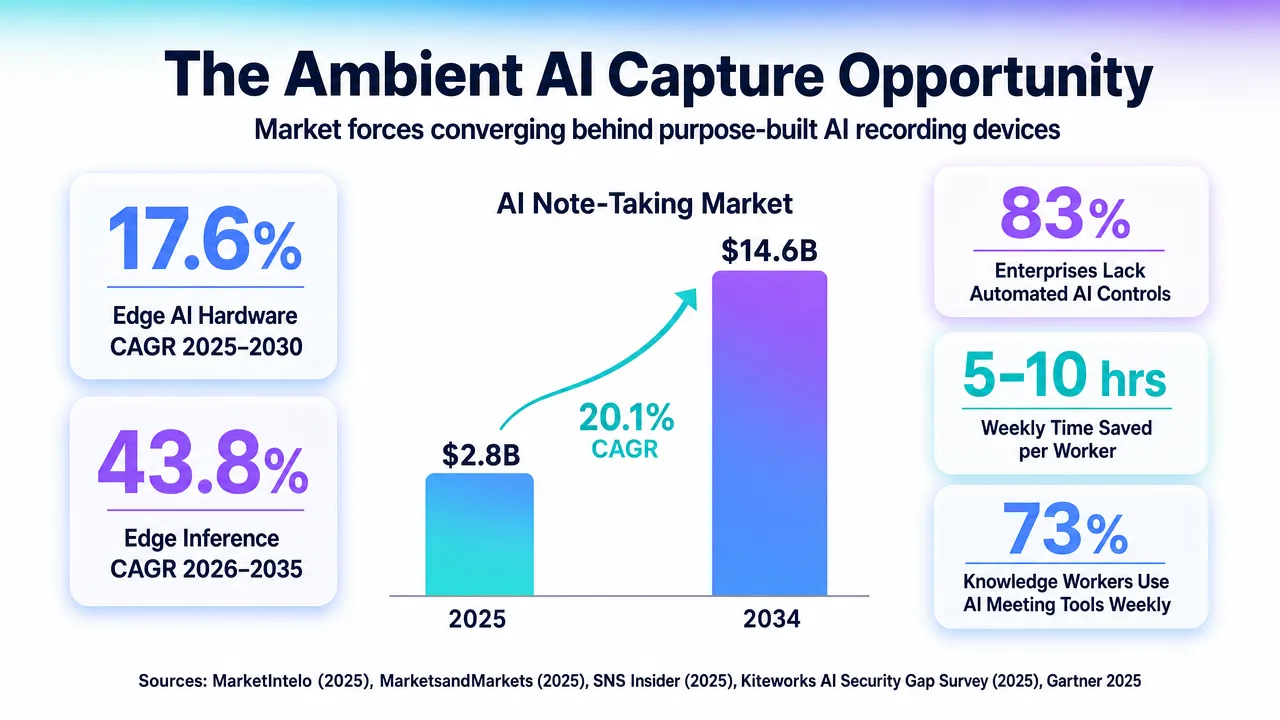
What happened:
Pocket successfully closed an $11M venture capital round to fund the development and rollout of its AI-first hardware. Features include one-touch recording, real-time transcription, and automated task extraction, aiming to bridge the gap between physical conversations and digital workflows.
Why it matters now:
As foundational LLMs (large language models) and speech-to-text models commoditize, the differentiation in AI is shifting to form factors and contextual data capture. Pocket’s entry signals an industry-wide pivot toward hybrid processing—balancing low-power on-device inference with cloud-based LLM heavy lifting—to counter the friction of app-switching.
Who is most affected:
Enterprise IT buyers weighing total cost of ownership (TCO), SaaS transcription incumbents like Otter and Fireflies, and edge AI hardware ecosystems competing for early-adopter market share.
The under-reported angle:
Most coverage focuses on the novelty of the device, ignoring the enterprise compliance nightmare of ambient hardware. The real barriers to mass adoption won’t be transcription accuracy or battery life, but robust SOC 2 compliance, MDM (Mobile Device Management) controls, and navigating granular consent/redaction workflows.
Deep Dive
Have you ever wondered why another gadget feels necessary when phones already do so much? Pocket’s recent $11M funding round highlights a real tension in today’s AI application layer: software is everywhere, yet hardware that feels intentional still has room to matter. While most tech coverage treats Pocket like a fresh productivity gadget squaring off against digital note-takers, the deeper story tests how edge intelligence actually gets built and scaled. The core speech-recognition and summarization problems have largely been solved by foundation models. What’s left to fight over is seamless workflow integration and constant, low-friction capture—a spot where a purpose-built device might edge out the general-purpose phones we already carry.
From an infrastructure view, devices like this make the on-device versus cloud trade-offs impossible to ignore. High-quality speaker separation and task mapping without draining the battery fast pushes developers toward specialized edge silicon. The feature lists focus on transcription and summaries, yet they skip past the practical engineering choices. Stream everything raw to the cloud and you hit latency walls; keep it local with smaller models and you need capable NPUs (neural processing units) that raise hardware costs and shift the TCO math against pure software subscriptions like Fireflies or Zoom’s built-in tools.
That said, the bigger scaling question sits with enterprise compliance, an area that still gets too little attention. Teams already juggling HIPAA, GDPR, and SOC 2 requirements see an always-on recorder as a fresh liability vector. To move beyond early adopters, Pocket (or any similar hardware) will need proper admin controls—SSO/SCIM rollout, offline fail-safes, automatic PII redaction, and clear retention rules. I’ve noticed how often these privacy layers decide whether pilots turn into fleet-wide deployments. Without them baked into the hardware logic from the start, broader adoption tends to stall.
In the end, the raise isn’t simply backing one device. It’s a bet on the scattered nature of modern knowledge work. Pocket wants to sit at the exact moment a conversation turns into something that can feed CRMs or task tools like Jira and Asana. By positioning the hardware as a focused, low-noise gateway to cloud models, the company is trying to claim the intake point before the big mobile platforms fold reliable ambient capture into the phones and earbuds most people already own.
Stakeholders & Impact
| Stakeholder / Aspect | Impact | Insight |
|---|---|---|
| AI Cloud & Edge Compute | High | Devices like Pocket augment demand for fast, specialized endpoint APIs (e.g., Whisper, Claude, Gemini) and edge-compatible SLMs (small language models). |
| Enterprise IT & SecOps | Critical | Introduces complex new vectors for data loss prevention (DLP); forces updates to bring-your-own-device (BYOD) and meeting consent protocols. |
| Software Competitors (SaaS) | Medium–High | Native Zoom/Teams plugins and apps like Otter face a new paradigm where the hardware itself bypasses software-layer competition. |
| End Users / Professionals | Medium | Significantly reduces context switching and workflow friction, but requires adopting (and charging) an additional piece of daily-carry hardware. |
About the analysis
Researched and written with AI assistance under the editorial responsibility of the i10X News team. The title image is an AI-generated illustration. Read our AI Use Policy. Spotted an error? Request a correction.
This independent analysis interprets early-stage VC funding reports, consumer AI hardware trends, and enterprise IT procurement gaps. Designed for AI product strategists, enterprise IT directors, and tech investors, it bridges the gap between hardware hype and the pragmatic realities of LLM deployment, edge computing, and data privacy.
i10x Perspective
Pocket’s hardware play is less about revolutionizing note-taking and more about capturing an exclusive data ingestion point before ambient intelligence becomes fully native to the dominant mobile operating systems. Moving forward, the survival of single-purpose AI hardware depends entirely on its ability to run hyper-efficient, on-device SLMs that bypass cloud latency and privacy risks altogether. Watch closely over the next three years: these standalone devices will either define a massive new enterprise hardware category or serve as temporary, heavily funded prototypes that eventually get subsumed into the next generation of smartwatches and earbuds.