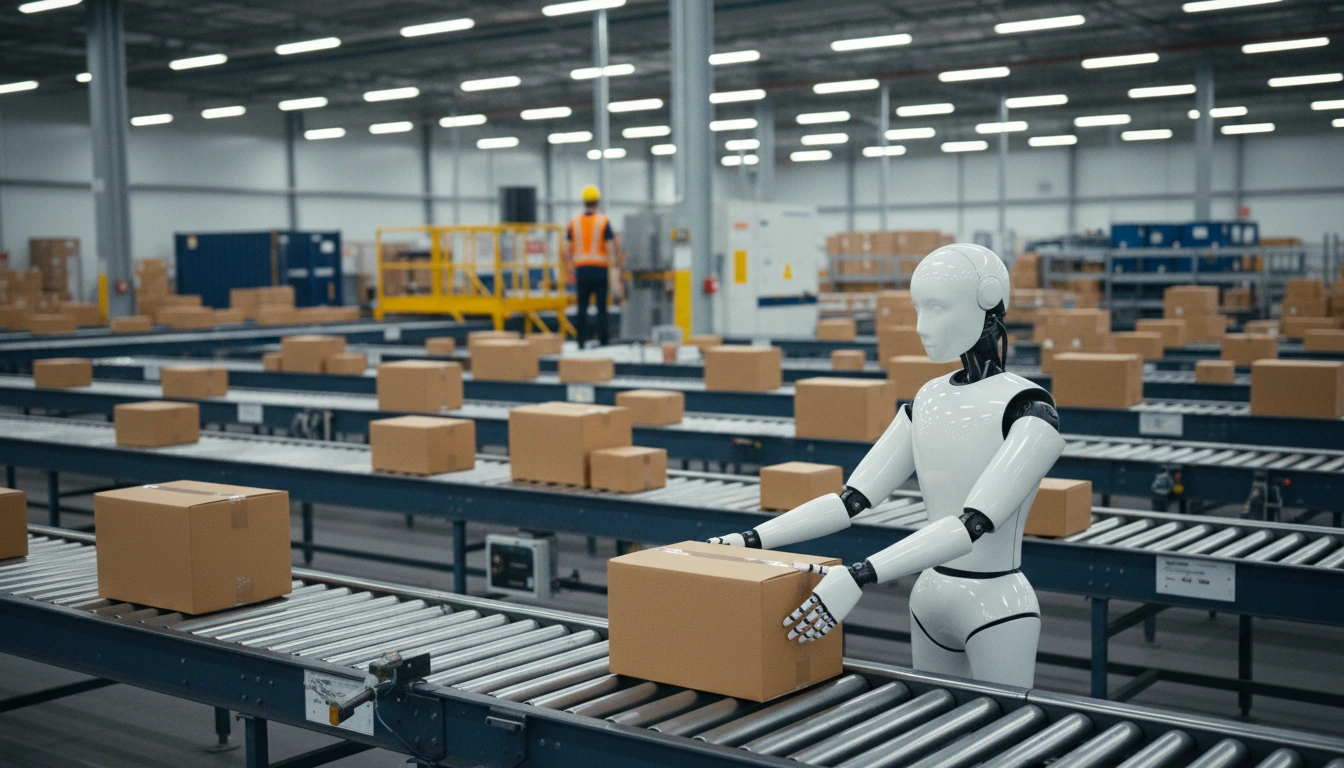
Chinese robotics company ROBOTERA says its humanoid robots now work at 11 postal hubs in eight cities across China Post’s Guangdong network, which it calls the largest and most geographically spread deployment of humanoid robots in logistics to date. Since a pilot began at the Guangzhou Postal District Center in March 2026, the robots have averaged an induction rate of more than 1,500 parcels per hour, a pace ROBOTERA compares to experienced human workers.
Quick Take
- The deployment: ROBOTERA humanoids at 11 China Post hubs in Guangzhou, Shenzhen, Dongguan, Jiangmen, Shantou, Shanwei, Jieyang and Heyuan.
- The task: Feeding parcels into sorting lines, including rejecting irregular items and adapting speed to reduce jams and missed items.
- The pace: More than 1,500 parcels per hour on average since the March 2026 pilot, according to the company.
- The hardware: ROBOTERA’s own five-finger dexterous hand, with multiple power options for continuous operation.
- Beyond Guangdong: The same solution also runs in postal operations in East China.
In plain English
In parcel centers, someone has to pick up packages and place them onto sorting conveyors, thousands of times per hour. It is repetitive, physically hard work with high staff turnover. ROBOTERA’s human-shaped robots are now doing that job across a whole province’s postal network, which is a step beyond the single-site pilots most humanoid makers announce.
What happened
ROBOTERA announced the expansion on November 17. The project is run jointly by China Post Group Guangdong Branch and ROBOTERA, whose legal name is Beijing Xingdongjiyuan Technology Co., Ltd. Guangdong is China’s largest province by express parcel volume, so the network includes high-volume sorting and cross-regional logistics. The company says the robots take on strenuous frontline tasks during demand peaks, while human workers move to robot maintenance, operations coordination and quality control.
ROBOTERA describes its approach as AI-native and full-stack, spanning data, motion control, foundation models, dexterous hands and humanoid systems, all developed in house.
Background
Logistics is one of the first places humanoid robots are moving from demos into daily work, alongside car and chip factories. Yesterday, we reported that Boston Dynamics’ Atlas will be tested in GlobalFoundries chip fabs. Our Humanoid Robot Price Tracker compares the main models on the market.
Why it matters
Most humanoid announcements are pilots at one site. A multi-city rollout inside a national postal operator tests reliability, maintenance and repeatability across many locations and parcel types. If the throughput numbers hold during peak shopping seasons, logistics could become the first large commercial market for humanoids.
What’s still open
- How many robots are deployed in total. ROBOTERA did not give a unit count.
- Costs per robot and per parcel compared with human labor or conventional automation.
- Independent data on uptime and error rates.
About the analysis
Researched and written with AI assistance under the editorial responsibility of the i10X News team. The title image is an AI-generated image. Read our AI Use Policy. Spotted an error? Request a correction.
This independent i10x analysis is based on ROBOTERA’s press release. Throughput and scale claims are company statements and were not independently verified.
Sources (plain text, no links):
- ROBOTERA press release: “ROBOTERA Expands Humanoid Robot Deployment Across China Post’s Guangdong Network, Reaching Eight Cities Province-Wide” (November 17, 2026)
i10x Perspective
Chinese humanoid makers are winning the race to real deployments by picking narrow, repetitive tasks in large state and industrial networks. Sorting parcels is not glamorous, but it generates the operating data that general-purpose robots need. More on our Engineering & Robotics page.