
Russia Opts Not to Ban Foreign Frontier AI Models
Summary
Russian regulators have officially confirmed they will not block foreign AI platforms, ending rumors of an impending state crackdown on Western and Chinese LLMs.
What happened
The government spelled out its position on generative AI without any hint of plans for a blanket ban on services like OpenAI’s ChatGPT, xAI’s Grok, or China’s DeepSeek.
Why it matters now
The move shows a deliberate nod to staying competitive in the wider AI race. It favors continued access to advanced models and developer tools over tighter data rules or content filters, at least for now.
Who is most affected
Russian developers, enterprise teams, and researchers who lean on global benchmarks for fresh ideas, plus local players like Yandex and Sberbank that must keep pace.
The under-reported angle
Even without new blocks from Moscow, Western sanctions plus geoblocking by US firms already limit direct access, pushing many to rely on VPNs and workarounds just to stay productive.
Deep Dive
Have you ever wondered why a country known for tightening its digital controls might leave the door open here? Recent chatter pointed to a possible wall around foreign LLMs under the “Sovereign Runet” rules, yet officials quickly shut that idea down. They are, in effect, giving tools like ChatGPT, Grok, and DeepSeek a pass. For a place that prizes information oversight, this reads as a hard-headed call that cutting off frontier models would simply stall progress.
Most coverage frames it as short-term breathing room. But the bigger picture points to a two-track approach. Russia is letting global models in rather than copying China’s more closed-off stance, all while pouring resources into homegrown options such as YandexGPT and Sber’s GigaChat.
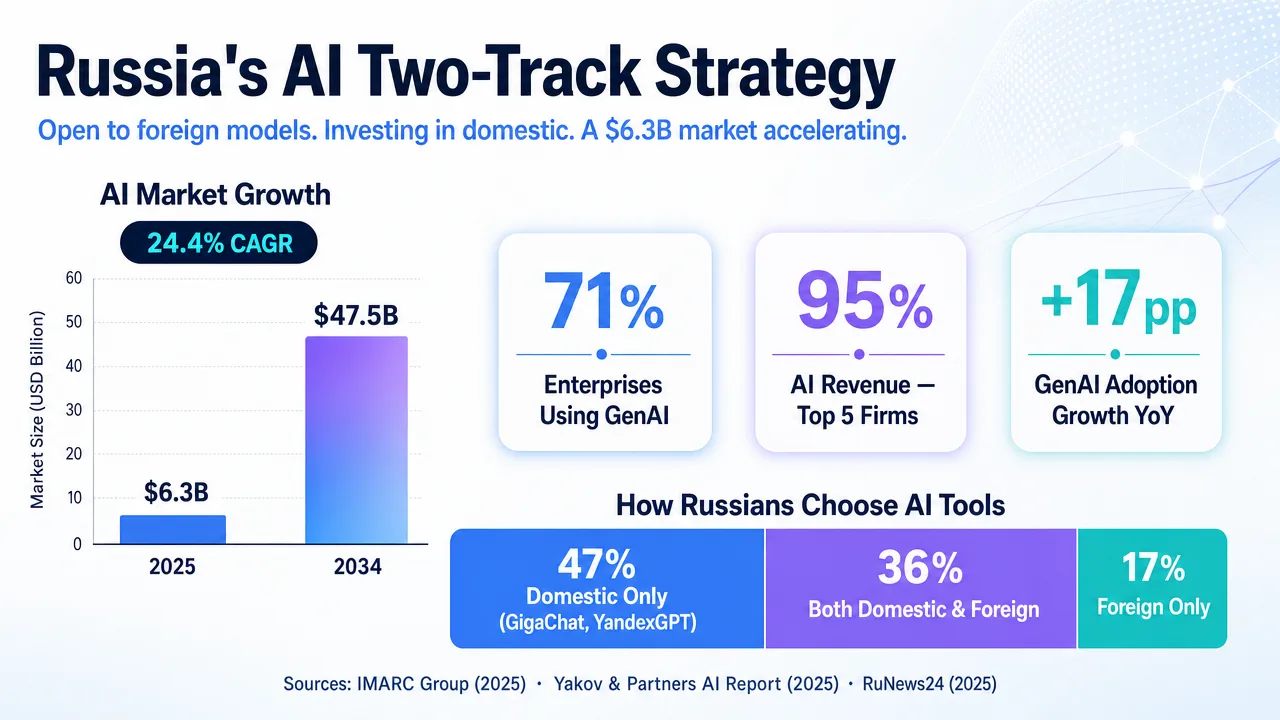
The real friction, though, sits outside official channels. US export rules and company policies already limit logins from Russian addresses. That gap leaves teams juggling proxies and VPNs to maintain any rhythm with worldwide development cycles.
Notice how DeepSeek and Grok get explicit mentions. Open weights models are easing some hardware pressures, and tolerating them shows Russia sees power shifting away from a handful of gatekeepers. Local fine-tuning on these releases can build edge capabilities without needing vast GPU clusters to start from zero.
Still, data-handling rules for deeper enterprise use will likely surface later. Until that point, the approach stays pragmatic: take what works globally to speed up what’s built locally.
Stakeholders & Impact
AI LLM Providers (Foreign)
Impact: Low
Insight: OpenAI and similar firms already restrict Russian IPs, so local policy tweaks change little on their end.
Domestic AI (Yandex, Sber)
Impact: Medium
Insight: The quality bar stays high, forcing home models to match global standards in reach and performance.
Developers & Enterprise IT
Impact: High
Insight: Workarounds preserve access to core tools like GitHub Copilot and ChatGPT, keeping teams effective.
Regulators & Policy
Impact: Significant
Insight: Signals a short-term easing of “Sovereign Internet” goals to hold onto technological ground.
About the analysis
Researched and written with AI assistance under the editorial responsibility of the i10X News team. The title image is an AI-generated illustration. Read our AI Use Policy. Spotted an error? Request a correction.
This independent, research-based analysis synthesizes global tech policy tracking and AI market dynamics, designed for engineering managers, policy strategists, and CTOs navigating AI deployment in fragmented geopolitical landscapes.
i10x Perspective
Keeping these digital borders somewhat open shows that total isolation rarely holds up when intelligence tools spread so quickly. Geopolitical barriers leak around open-source releases like DeepSeek and simple API routing. Over the next decade, expect formalized shadow pipelines to appear, with localized systems quietly drawing on outputs from restricted baselines—and that will further blur efforts to enforce hardware and model controls.