Quick Take
- The finding: Pre-trained LLMs with a light inference harness often beat their RL post-trained counterparts on solution coverage (pass@K) given enough test-time budget, despite much lower pass@1.
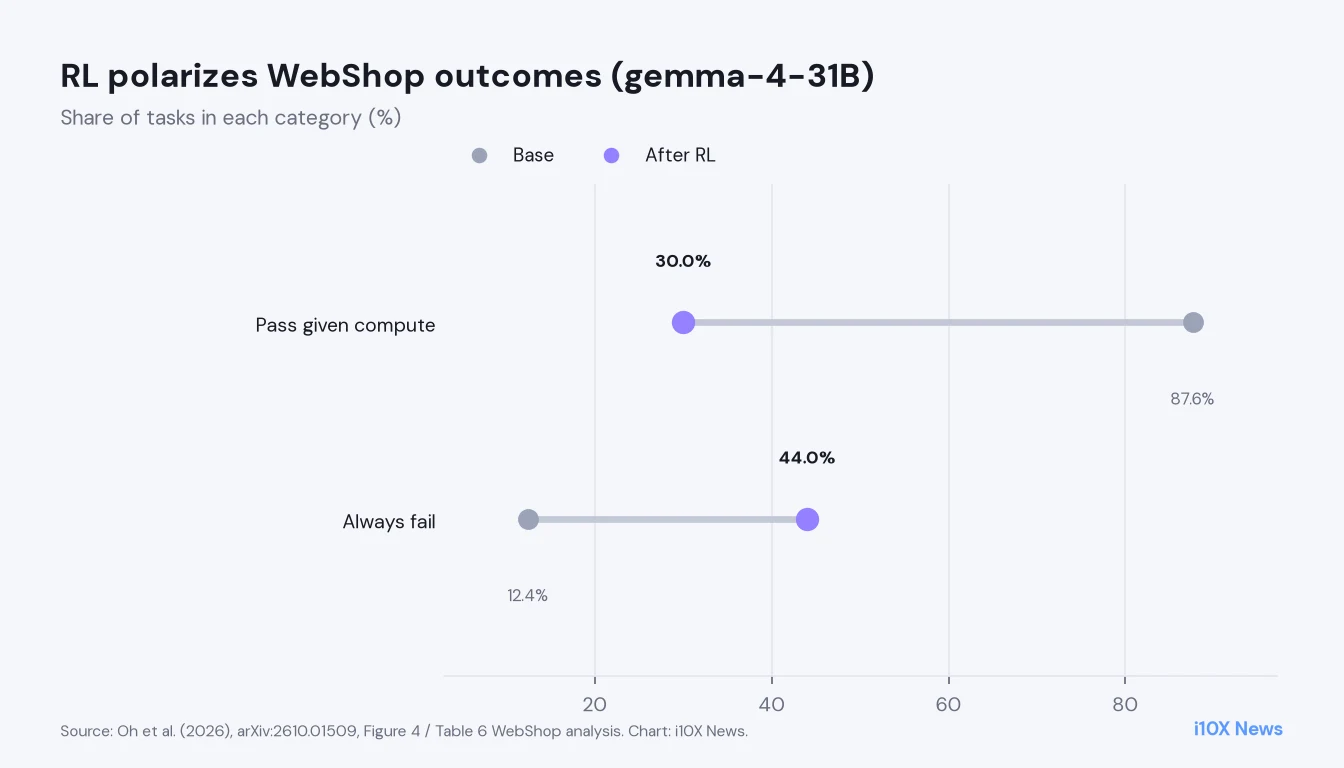
- Polarization: Post-training pushes tasks toward always-solved or never-solved. On WebShop with gemma-4-31B, “pass given compute” falls from 87.6% to 30.0%, while always-fail rises from 12.4% to 44.0%.
- What it means: The authors propose Sharpening Tax to quantify lost test-time scalability after post-training — prevalent across 42 cases.
A popular story about RL post-training is that it mainly sharpens what the base model already knew. Meta Superintelligence Labs, Wisconsin, NYU and Stanford researchers ask whether that story holds for agentic tasks with multi-turn tool use — and find that base models can still cover more solutions at high sampling budgets.
What the study shows
14 base/post-trained pairs from four families on three agentic benchmarks (42 cases). As budgets grow to 128 rollouts, base pass@K curves often cross and surpass post-trained ones (e.g., over 85% pass@128 on WebShop vs 56% for RL with gemma-4-31B).
- Sampling efficiency vs coverage: RL improves consistency and pass@1 by collapsing the middle.
- Incorrect modes amplify too: Always-fail grows alongside always-pass, matching recent work that RL amplifies preferred wrong modes.
- Cheap diagnostic: Sharpening Tax can be estimated from a few rollouts.
Why it matters: pass@1 is not the product
Products that sample multiple trajectories or search at test time may prefer a base policy’s broader coverage over an RL policy’s peak accuracy.
Method in brief
Pass@1 vs pass@K comparisons; task categorization into always pass / pass given compute / always fail; Sharpening Tax diagnostic.
What remains open
- Harness dependence: Light inference harnesses matter for base agents.
- Benchmark set: Three agentic benches; other domains may differ.
Context
Related RL reasoning work in Reasoning and Efficiency & Training.
What it means for post-training teams
- Report Sharpening Tax: Alongside pass@1.
- Keep a base checkpoint: For high-budget search.
- Watch always-fail growth: Polarization has a downside.
About the analysis
Researched and written with AI assistance under the editorial responsibility of the i10X News team. The title image is an AI-generated illustration. Read our AI Use Policy. Spotted an error? Request a correction.
This article is based on the full text of the preprint “Sharpening Tax in Post-Training” (arXiv:2610.01509v1, submitted October 1, 2026). All numbers are taken from the paper’s text, tables and figures; i10X did not rerun the experiments. The chart was redrawn by i10X from Figure 4 / Table 6 WebShop analysis of the paper, which is published under a CC BY 4.0 license.
i10x Perspective
Sharpening Tax gives a name to the hangover after RL: models become more decisive and less exploratory. For agents that can afford many rollouts, that can be the wrong bargain.