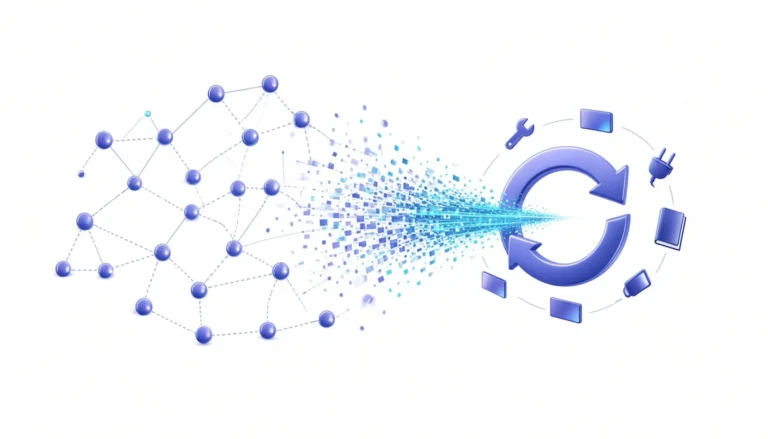
Strava has launched an official Model Context Protocol (MCP) connector. Now its more than 195 million users can feed their training data directly into advanced models like Claude and Gemini. The move opens the platform’s data to external AI agents, hinting at a broader change in consumer apps: shifting from locked internal chatbots to a “Bring Your Own Model” setup where people use top LLMs on their own information.
Quick Take
- What happened: Strava released a read-only MCP connector that enables paying subscribers to query their complete, live training history conversationally using Claude and Gemini.
- Why it matters now: It marks a high-profile consumer adoption of Anthropic’s open-source Model Context Protocol, proving that platforms can securely expose their data silos to external LLMs without building bespoke API middleware.
- The internal AI contrast: This integration bypasses Strava’s own in-app “Athlete Intelligence” feature, allowing power users to conduct multi-year, cross-workout analysis in the conversational UI of their choice.
- The privacy mechanism: The integration uses account-scoped OAuth to ensure models can read heart-rate streams, GPS data, and power metrics, but strictly prohibits write, edit, or delete actions to prevent agentic hallucination risks.
What happened
Strava has rolled out an official MCP server, granting subscribers the ability to link their fitness profiles directly to supported AI assistants—currently Anthropic’s Claude and Google’s Gemini. Once authenticated via OAuth, users can ask natural-language questions about their pace, heart-rate streams, cycling power data, and long-term fitness trends.
Crucially, the connector is engineered as a strict read-only pipeline. The AI assistant can fetch per-second activity streams and route data to ground its conversational responses in the user’s actual live data, but it cannot alter, upload, or delete activities. This sidesteps the security risks typically associated with granting autonomous AI agents write access to personal accounts.
Setting up the connection bypasses traditional API key generation. Users authorize the connection through Strava’s web or mobile app settings, instantly exposing years of structured workout data to the context window of their chosen frontier model.
Why it matters now
For the broader AI ecosystem, Strava’s adoption of MCP is a massive validator for the protocol. Originally introduced by Anthropic to standardize how AI models connect to data sources, MCP is now breaking out of developer-only enterprise use cases and entering the mainstream consumer application layer. It proves that platforms with highly valuable, proprietary data silos do not need to spend millions training or fine-tuning their own monolithic LLMs from scratch to offer advanced AI capabilities.
This release also highlights an emerging tension between internal AI wrappers and external frontier models. Strava already offers an in-app feature called “Athlete Intelligence” which summarizes individual workouts. However, the MCP connector acknowledges that users want to bring their own state-of-the-art models (like Claude 3.5 Sonnet or Gemini 1.5 Pro) to perform complex, multi-variable analyses across years of history—tasks that internal, lightweight LLM wrappers struggle to handle.
It sets a precedent for the “Bring Your Own Model” (BYOM) era. By adopting a standard protocol, Strava avoids the technical debt of maintaining separate, bespoke API integrations for OpenAI, Google, and Anthropic. As MCP gains traction, expect a cascade of consumer platforms—from finance to health—to adopt this architecture, transforming isolated apps into modular data nodes for AI agents.
Who is most affected
The immediate winners are data-heavy endurance athletes and AI power users who want deep, conversational analytics without having to export CSV files or write custom Python scripts. However, the broader implications affect developers and product leaders watching how consumer tech adopts AI architecture.
| Stakeholder | Impact | Why |
|---|---|---|
| Strava Subscribers | Enhanced analytics | Can query years of GPS, heart-rate, and power data conversationally via Claude or Gemini. |
| Anthropic & Google | Data enrichment | Their models get native access to highly structured, hyper-personal fitness data, driving sticky consumer usage. |
| Consumer App Devs | Architectural pivot | Validates MCP as a scalable, secure way to expose user data to AI without building in-house chatbots. |
| 3rd-Party Fitness Tools | Increased competition | Platforms relying on custom workout-analysis algorithms now compete with generalized frontier LLMs. |
About the analysis
Researched and written with AI assistance under the editorial responsibility of the i10X News team. The title image is an AI-generated illustration. Read our AI Use Policy. Spotted an error? Request a correction.
This is an independent, research-based i10x analysis intended for developers, founders, and AI infrastructure strategists navigating the rollout of the Model Context Protocol and the evolving consumer AI landscape.
- Strava Launches MCP Connector, Allowing Athletes to Sync Training History to Claude
- How do I connect Strava to an AI assistant?
- Strava launches an MCP server. Read yes, write no. – Tredict – Blog
- Strava’s newest subscriber perk lets Claude analyse years of your training data, offering a different kind of insight to Athlete Intelligence
- Strava MCP Connector: How to Connect Strava to Claude
i10x Perspective
Strava’s MCP connector is a quiet watershed moment. It proves that the future of consumer AI isn’t just bolting a proprietary chatbot onto every app, but letting users plug their preferred frontier models into their personal data. By embracing a read-only MCP architecture, Strava protects its data moat while outsourcing the heavy lifting of reasoning and conversational UI to Anthropic and Google. We’ve seen this pattern emerge before—watch closely, because this “data node” strategy is the blueprint for how walled gardens will survive and scale in the agentic era.