ReasoningDeepSeekGemini
Evidence check
  • Preprint
  • No code released
  • Not independently replicated

A 3B Model Hits 94.3 on AIME26 and 80.2 on LiveCodeBench

VibeThinker-3B from Weibo reaches frontier-band verifiable reasoning: 94.3 AIME26 (97.1 with claim-level TTS), 80.2 LiveCodeBench v6 Pass@1, 96.1% on recent LeetCode contests — without sacrificing IFEval (93.4).

Christopher Ort
By Christopher Ort · 2 min read
Share
Small AI model at the center of a complex network, demonstrating highly accurate and verifiable reasoning.
Illustration: i10X
On this page
  1. Quick Take
  2. What the study shows
  3. Why it matters: small can be elite on verifiable tasks
  4. Method in brief
  5. What remains open
  6. Context
  7. What it means for builders
  8. About the analysis
  9. i10x Perspective
i10X Quick Take

Quick Take

  1. The finding: The 3B dense VibeThinker-3B scores 94.3 on AIME26 and 80.2 Pass@1 on LiveCodeBench v6, matching or beating much larger flagships on verifiable tasks.
  2. Test-time boost: Claim-level test-time scaling lifts AIME26 to 97.1.
  3. Not just memorization: 96.1% acceptance on unseen LeetCode contests (Apr 25–May 31, 2026); IFEval stays at 93.4.

How far can verifiable reasoning go in a strictly small model? Sina Weibo Inc. reports VibeThinker-3B, extending their earlier 1.5B Spectrum-to-Signal work with curriculum SFT, multi-domain RL and offline self-distillation.
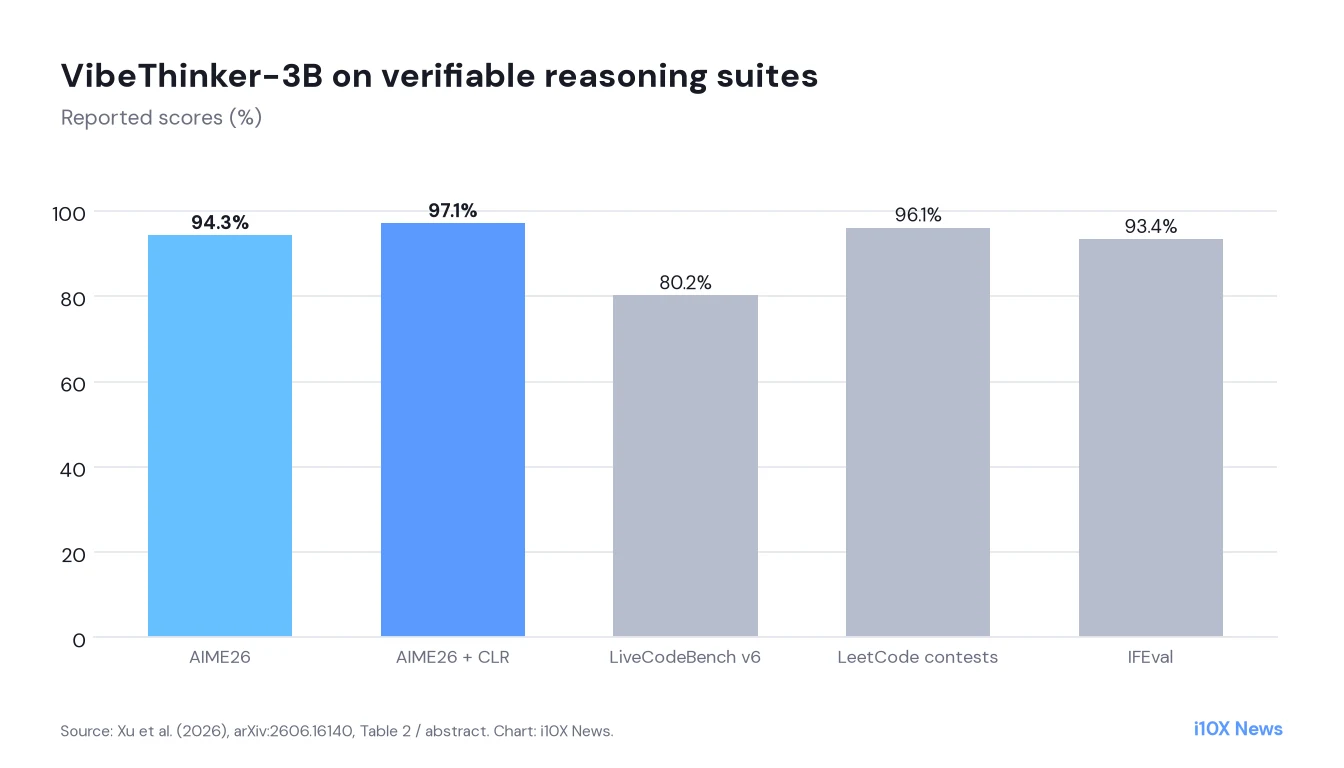
Column chart: AIME26 94.3, with CLR 97.1, LiveCodeBench 80.2, LeetCode 96.1, IFEval 93.4.
i10X chart based on data from Xu et al. (2026), arXiv:2606.16140, Table 2 / abstract (CC0 1.0).

What the study shows

Results place the model in a first-tier reasoning band versus systems such as DeepSeek V3.2, GLM-5 and Gemini 3 Pro on the reported verifiable suites, while preserving instruction following.

  • Parametric Compression-Coverage Hypothesis: Authors argue verifiable reasoning is compressible into small parameter budgets when post-training is carefully staged.
  • CLR averaging: Claim-level test-time scaling flow run 8 times; averaged Pass@1 reported as +CLR.

Why it matters: small can be elite on verifiable tasks

If a 3B model sits with frontier systems on math/code contests, deployment economics change for offline and edge reasoning.

Method in brief

Curriculum SFT, multi-domain RL, offline self-distillation; global batch 128, cosine LR from 5e-5 to 8e-8.

What remains open

  • Vendor report: All authors at Weibo; independent replication needed.
  • Task family: Focused on verifiable reasoning, not open-ended chat.

Context

Related small-model reasoning in Reasoning.

What it means for builders

  • Try staged post-training: Curriculum + RL + self-distill.
  • Keep IFEval in the loop: Reasoning need not kill controllability.
  • Budget test-time compute: CLR still helps a strong 3B.

About the analysis

Researched and written with AI assistance under the editorial responsibility of the i10X News team. The title image is an AI-generated illustration. Read our AI Use Policy. Spotted an error? Request a correction.

This article is based on the full text of the preprint “VibeThinker-3B: Exploring the Frontier of Verifiable Reasoning in Small Language Models” (arXiv:2606.16140v1, submitted June 15, 2026). All numbers are taken from the paper’s text, tables and figures; i10X did not rerun the experiments. The chart was redrawn by i10X from Table 2 / abstract of the paper, which is published under a CC0 1.0 license.

i10x Perspective

VibeThinker-3B is a shot across the bow of “bigger is the only path” for contest-style reasoning. Treat it as a strong existence proof pending third-party evals — and as motivation to measure compression of verifiable skills, not just parameter counts.


Christopher Ort

Christopher Ort

Christopher Ort handles SEO, AI agent workflows and PR & partnerships at i10x.ai, the all-in-one AI workspace built by i10X Global Pte. Ltd. in Singapore. He is a graduate of Friedrich-Alexander-Universität Erlangen-Nürnberg (FAU). He is the author of “The Style Penalty”, a study published on SSRN that analyses 1,576 evaluation decisions by four frontier AI models to show how AI-written CVs fare in automated hiring screens; the research has been covered by heise online and t3n.

Timeline

What happened before

  1. Release

    Gemini 4 Argon

    1.05M context · $2 / $10 per 1M tokens

    Google's most capable model for complex coding, agentic, math and science tasks.

    ai.google.dev (source, opens in a new tab)
  2. Release

    Gemini 3.8 Flash

    1.05M context · $0.75 / $3.75 per 1M tokens

    ai.google.dev (source, opens in a new tab)
  3. Release

    Gemini 3.7 Flash

    1.05M context · $0.75 / $3.75 per 1M tokens

    ai.google.dev (source, opens in a new tab)
  4. Release

    Gemini 3.6 Flash & 3.5 Flash-Lite

    1.05M context · $0.75 / $3.75 per 1M tokens

    ai.google.dev (source, opens in a new tab)
  5. Release

    Gemini 3.5 Flash

    1.05M context · $1.5 / $9 per 1M tokens

    Launched at I/O 2026 as the first Gemini 3.5 model; Google later dropped the planned 3.5 Pro.

    blog.google (source, opens in a new tab)
Full Gemini timeline ›

Editor's picks

  1. Anthropic IPO Filing Reveals Extreme AI Safety Risks
  2. Grok Imagine Odyssey Pilot Exposes AI Video Limits
  3. Anthropic Files S-1 for Nasdaq IPO Under Ticker ANT
  4. Jakarta Agentic AI Milestone Delivers Standardized AI Agents for Java
  5. llm-deepseek Serialization Bug Replays Text After Tool Use