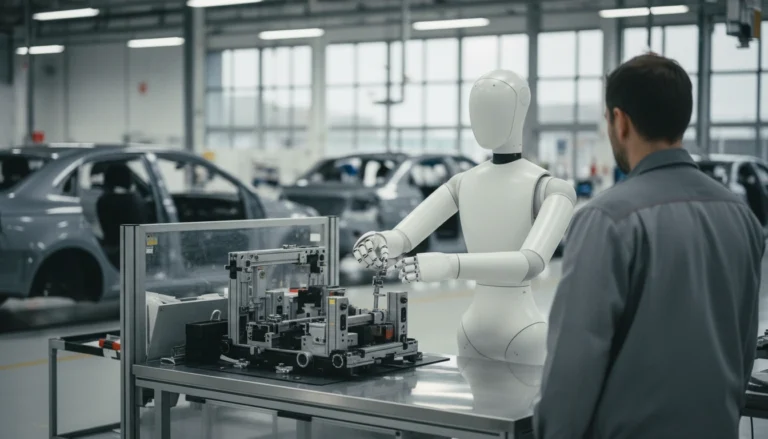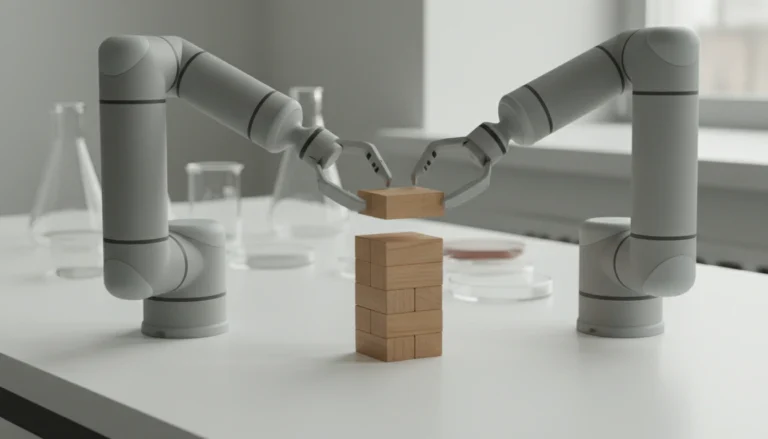
Robbyant, the embodied AI company inside Ant Group, has released two robot models it calls open source: LingBot-Map 2.0, which builds a 3D map from a moving camera, and LingBot-Navi, which uses that map to find objects and plan routes. The headline claim is a big cut in mapping drift over long distances. The detail that matters more for anyone planning to use it is the license: the new mapping weights are for non-commercial use only, while the navigation model ships under Apache 2.0.
What the mapping model fixes
Camera-only mapping models build a scene frame by frame, and small errors add up. Classic SLAM systems repair this afterwards with loop detection and pose-graph optimization. Robbyant’s approach, which it calls Geometric Context Reshaping, revises the model’s own spatial memory while it runs, so later frames are placed against a corrected map rather than a drifting one. The model takes plain RGB frames and returns camera poses, intrinsics, depth and a confidence value per frame.
Robbyant’s project page reports these trajectory errors on the VBR urban sequences, where a camera covers 5.2 km in close to 19,000 frames:
| Model | Trajectory error on VBR (m) |
|---|---|
| LingBot-Map 2.0 with memory correction | 4.72 |
| LingBot-Map 2.0, streaming only | 17.01 |
| ABot-Recon | 29.89 |
| LingBot-Map 1.0 | 31.12 |
| VGGT-Ω | 65.65 |
| π³ | 73.83 |
Source: Robbyant LingBot-Map 2.0 project page, checked November 27, 2026. Lower is better. Vendor-reported, not independently verified.
By our reading of that chart, the correction step alone takes the error from 17.01 to 4.72 metres, a drop of about 72 percent, and the full gain over version 1.0 is about 85 percent. On Oxford Spires the error falls from 8.25 metres with version 1.0 to 3.92 metres. Robbyant says the model runs at 27.51 frames per second on one RTX 5090. All of these are vendor numbers; we have not run the model ourselves.
The license split
This is where the release differs from Robbyant’s earlier ones. LingBot-Map 1.0, published in April, is Apache 2.0 on GitHub. The LingBot-Map 2.0 model card puts the new code and weights under CC BY-NC 4.0 and lists third-party parts under the DINOv3 license and a FAIR noncommercial research license. LingBot-Navi, by contrast, is Apache 2.0 and is built on Alibaba’s Qwen3.5-4B, which is also Apache 2.0.
- Research labs and hobby projects can use both models as released.
- A company shipping a robot can use LingBot-Navi and the older LingBot-Map 1.0, but not the 2.0 mapping weights without a separate agreement with Robbyant.
- Conveniently, the LingBot-Navi repository already pairs the navigation model with LingBot-Map 1.0 weights in its quick start, so the commercially usable stack is the documented one.
What the navigation benchmark actually shows
LingBot-Navi keeps a reusable 3D memory of places a robot has seen, so a second task in the same building does not start from zero. Robbyant also published a dataset of 511 reconstructed real-world scenes, mostly workplaces. The reference table in the repository is small, 36 episodes per setup, and it is worth reading closely. When the memory is built with LingBot-Map 1.0 rather than the default setup, success rate drops from 68.26 to 61.12 percent on a GOAT-Bench subset and from 48.75 to 41.94 percent on Robbyant’s own workplace benchmark. That gap of roughly seven points shows how much the quality of a self-built map decides the outcome, which is exactly where version 2.0 claims its gains, under the license commercial users cannot use.
Before you try it
- Hardware: both models need an NVIDIA GPU. The mapping model asks for a BF16-capable card and PyTorch 2.8 or newer; the navigation code expects Linux, Python 3.10 and CUDA 12.8.
- Access: when we checked on November 27, the Hugging Face listing for the 2.0 weights was public, but the GitHub readme still says the repositories are private and asks for a login. Expect some rough edges in the first days.
- Licenses elsewhere: of the 18 robot foundation models in our Robot AI Model Comparison, 8 have open weights, with terms ranging from Apache 2.0 (SmolVLA, π0.5) to NVIDIA’s own Open Model License for GR00T. Ant Group also published open weights for its LingSante medical models earlier this week.
What is still open
Robbyant has not said whether a commercial license for LingBot-Map 2.0 is available or what it would cost. The 85 percent figure comes from one long urban sequence, and there are no independent results yet. Nor does the release show how the combined stack performs on a real robot outside the benchmark scenes.
i10x Perspective
Robbyant has published most of its LingBot models under Apache 2.0 this year, which makes the non-commercial tag on LingBot-Map 2.0 a signal worth noting. Robbyant gives away the navigation layer, where it wants adoption, and keeps the best mapping model under a research license, where the value is. We expect more labs to copy that split: permissive licenses for the parts that build an ecosystem, restricted ones for the parts customers would otherwise not need to buy. Teams evaluating these models should check the license before the benchmark chart.