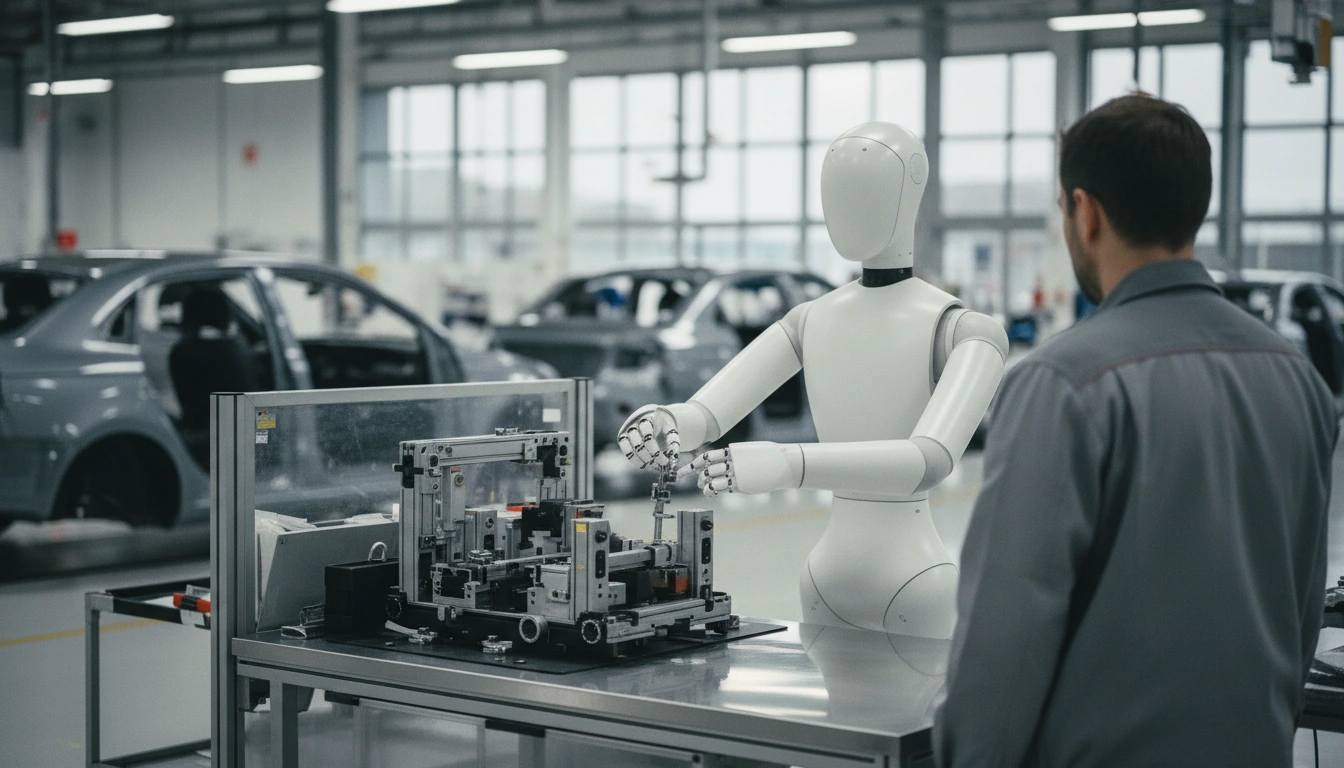
Volvo Cars has started training humanoid robots on real factory work. In a press release on November 26, the carmaker says Hexagon Robotics’ AEON humanoids are now learning tasks at its plant in Ghent, Belgium, the first Volvo factory to try them. Volvo’s own engineers are teaching the robots by imitation learning, and the first job is placing components into two fixtures with high precision. A larger pilot with more units follows in the first half of 2027, and Volvo wants the robots in live production from mid-2027. For other manufacturers the interesting part is not the demo but the limits Volvo published alongside it.
The spec sheet sets the job list
Volvo gives AEON’s numbers plainly: 1.65 metres tall, 60 kilograms, cameras and sensors for perception, wheels instead of legs with a top speed of 2.4 metres per second, and a payload of 10 kilograms. Those figures decide which stations a humanoid can take over. A 10 kilogram limit rules out most heavy assemblies and leaves small parts, kitting, machine loading and inspection. Wheels mean flat, clear floors. Fixtures with known positions, the very first task Volvo chose, are the easiest place to start because the robot always knows where the part has to go.
Volvo’s argument for the human shape is that fixed robot arms already cover stable, repetitive work in one spot, while some ergonomically hard tasks need a machine that can move between stations without rebuilding the line. The next training steps follow that logic: handling several parts, moving around the production area and working with the plant’s existing automation.
How Ghent compares with other factory humanoids
Our Humanoid Robot Price Tracker lists the industrial humanoids already in pilots, and the comparison puts Volvo’s plan in context.
| Robot | Maker | Factory status | Payload |
|---|---|---|---|
| AEON | Hexagon | Training at Volvo Ghent; Schaeffler fleet rollout after a 2025 pilot | 10 kg |
| Figure 02 | Figure AI | Retired after an 11-month BMW deployment that contributed to 30,000+ X3 vehicles | Not listed |
| Atlas (electric) | Boston Dynamics | Training center at Hyundai’s Metaplant in Georgia since September 21, 2026; all 2026 units committed | Not disclosed |
| Walker S2 | UBTech | Factory work at BYD, Zeekr, Geely and Audi-FAW; 5,000 units targeted for 2026 | Not listed |
| HMND 01 Alpha | Humanoid | Early access and industrial pilots, including Schaeffler and Siemens | 15 kg |
| G1 | Galbot | Instant-retail warehouses plus factory sorting and loading | 10 kg |
Source: i10X Humanoid Robot Price Tracker (entries checked November 3 to 16, 2026); AEON payload from Volvo Cars, November 26, 2026.
Two points stand out. AEON’s payload matches Galbot’s G1 and sits below the 15 kilograms that Humanoid lists for HMND 01, so Volvo is not buying an unusually strong machine. And AEON already has a scale customer: Hexagon and Schaeffler agreed in April to deploy at least 1,000 AEON units across Schaeffler’s factories by 2032, which works out to roughly 140 robots a year on average by our count. Volvo has not said how many units it will run in Ghent. Carmakers that build their own humanoids take a different route: XPENG’s IRON, for example, slipped to a 2027 release with trimmed specs.
What other plants can learn from the Ghent setup
- Start with fixtures. A task with fixed positions and parts under 10 kilograms is where imitation learning has the best chance of reaching factory reliability quickly.
- Budget for demonstrations. Imitation learning needs people to show the robot the task many times, so line staff time is part of the cost, not just the robot.
- Ask for the missing numbers before signing: cycle time per part, interventions per shift, battery runtime and price. Neither Volvo nor Hexagon published any of them.
- Measure against fixed automation. The case for a humanoid is flexibility across stations; if a task never moves, a conventional arm is usually the cheaper choice.
What is still open
The release leaves out the number of robots, the price, runtime and the success rate on the first task. It also does not say which jobs follow in 2027 beyond the general steps. We will add those figures here once Volvo or Hexagon report them.
i10x Perspective
Volvo is late to humanoids compared with BMW or Hyundai, and that may be an advantage. It picked a wheeled robot with modest specs, started with the easiest possible task and gave itself about seven months from training to production. That is a realistic plan rather than a showcase. The test of whether it worked is not a video from Ghent but whether Volvo can name a cost per station next summer. If it can, expect other European plants to copy the template quickly; if the pilot slips, it will say more about the state of factory humanoids than any trade show demo.