Genesis AI, a robotics company based in Paris and San Carlos, California, has raised $500 million in Series A funding at a $3.5 billion post-money valuation. The money is meant to scale data collection and training for its robot brain, push toward human-level hand dexterity and put its first general-purpose robot, Eno, to work with customers. The round lands on the same day that Boston Dynamics announced its first humanoid trial outside the car industry.
Quick Take
- The deal: $500 million Series A at a $3.5 billion post-money valuation, co-led by Premji Invest, Khosla Ventures and Eclipse.
- Who else is in: Durable Capital Partners, accounts advised by T. Rowe Price, Bpifrance, HSG, NVIDIA, AMD Ventures, Zoom, Samsung Next and Ericsson, plus individuals including Eric Schmidt, Eric Yuan, Jerry Yang, Xavier Niel and Zach Kirkhorn.
- The product: Eno, a general-purpose robot that the company says favors “human capability over human appearance,” powered by its GENE foundation model.
- First markets: Manufacturing, logistics and laboratories, then hospitality and healthcare, then consumer and outdoor use.
- The caveat: Genesis has not disclosed customers, unit numbers, prices or independent performance results.
In plain English
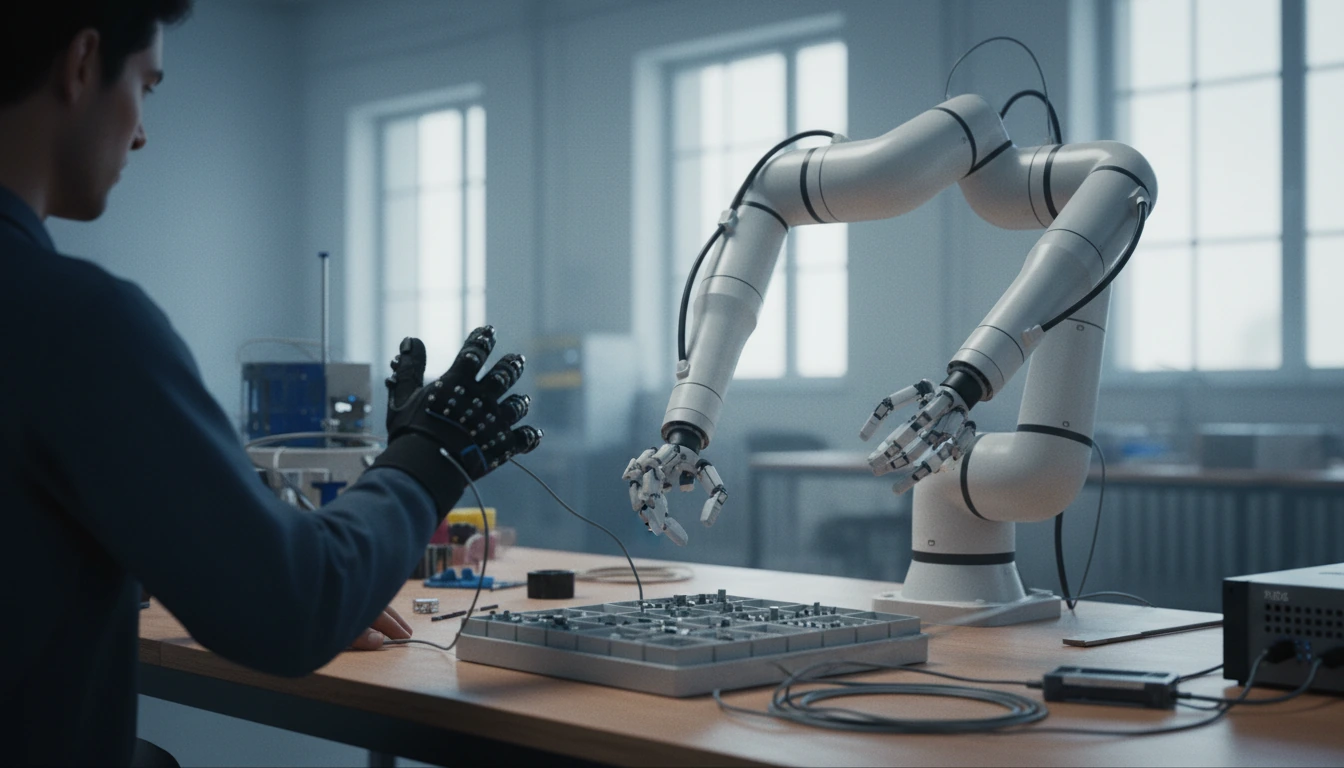
Most robots in factories today do one job over and over. Genesis wants to build a single robot that can learn many jobs, especially the fiddly ones that need human-like hands. To teach it, people wear a data glove while doing their normal work, and the robot hand copies those movements one to one. A simulator lets the robot practice in virtual worlds first. The new money pays for more training data, more engineers and the first real deployments.
What happened
Genesis announced the round on November 17. “Our mission is to remove the physical limits on human ambition,” said Zhou Xian, co-founder and CEO. “This funding will accelerate our efforts to deploy our robots in the real world at scale.” Zhou founded the company with Théophile Gervet.
According to the company, the capital will go to four areas:
- Data and training: expanding data acquisition and large-scale training to extend the range of tasks robots can perform.
- Dexterity: solving human-level physical manipulation across environments.
- Deployment: rolling out Eno at scale with customers, with production now ramping up.
- Hiring: more AI researchers, robotics experts and engineers.
“What stood out to us was watching Genesis robots complete long, multi-step tasks on their own at the same speed a person would, with smooth and natural movement,” said Vedant Agrawal, partner at Premji Invest.
The full-stack bet
Genesis builds every layer itself. GENE is its foundation model for robot control. A dexterous hand and a matching data glove create what the company calls a 1:1:1 mapping between human hand, glove and robot hand. Genesis World is its simulation platform, and Eno is the hardware. Deployment feedback flows back into the model, the simulator and the hardware. “The next generation of robotics won’t be built by improving hardware or AI models in isolation,” said Vinod Khosla, founder of Khosla Ventures.
Background: physical AI money keeps flowing
Investors are pouring money into robots that learn rather than follow scripts. On the morning of the same day, Agile Robots raised $500 million at an $8.5 billion valuation in a SoftBank-led round. With a $3.5 billion valuation at Series A, Genesis joins the companies we follow in the AI Unicorns List, a sign that investors are willing to pay for robotics platforms before revenue is visible. Our Engineering & Robotics section tracks who is building what.
Why it matters
Hands are the bottleneck of general-purpose robotics. Walking robots exist; robots that can reliably pick, insert, fold and assemble in messy real-world settings mostly do not. Genesis is betting that cheap, large-scale human demonstration data from gloves, plus simulation, can close that gap faster than teleoperation alone. If that works, it would lower the cost of teaching robots new jobs, which is the real barrier to deployment in factories and labs.
What’s still open
- Which customers are deploying Eno, in which facilities, and on what tasks.
- How reliable Eno is over long shifts, measured independently rather than in company demos.
- What Eno costs to buy or lease, and how many units Genesis can produce in 2027.
- How GENE compares with other robot foundation models on shared benchmarks.
About the analysis
Researched and written with AI assistance under the editorial responsibility of the i10X News team. The title image is an AI-generated image. Read our AI Use Policy. Spotted an error? Request a correction.
This independent i10x analysis is based on Genesis AI’s funding announcement. Performance claims are company statements and were not independently verified.
Sources (plain text, no links):
- Genesis AI press release: “Genesis AI Raises $500M Series A at $3.5B Valuation to Master Human-Level Dexterity in General-Purpose Robots and Deploy at Scale” (PR Newswire, November 17, 2026)
i10x Perspective
Two $500 million robotics rounds in one day is a signal that capital is no longer waiting for proof of revenue in physical AI. Genesis stands out for its data strategy: turning everyday human work into training data through gloves. The test now is boring but decisive: uptime, cost per task and whether customers keep the robots after the pilot.