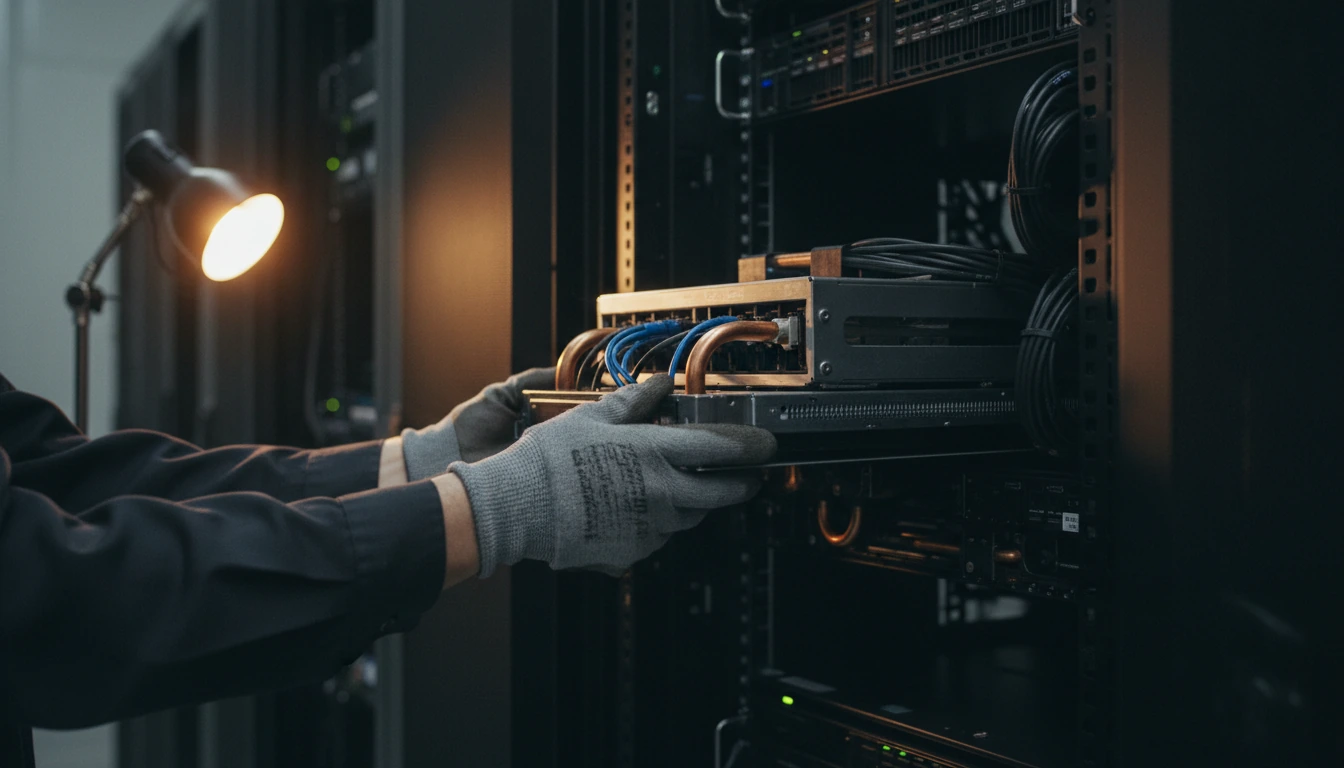
NVIDIA’s next-generation Vera Rubin platform made its benchmark debut on 16 November 2026, and it took first place across MLPerf Training v6.1. In NVIDIA’s submissions, a Vera Rubin NVL72 system delivered up to twice the per-GPU training performance of the current GB300 NVL72, and it trained the DeepSeek-V3 671B benchmark in 4.14 minutes on 1,024 GPUs.
Quick Take
- Sweep: NVIDIA says its platform was the only one with results on every MLPerf Training v6.1 benchmark. Vera Rubin NVL72 was fastest on six of seven.
- Per-GPU gains vs. GB300 NVL72: 2x on DeepSeek-V3 671B, 1.6x on gpt-oss 20B and Llama 3.1 8B, 1.5x on Llama 2 70B LoRA and FLUX.1, 1.4x on Qwen3.5 397B reinforcement learning and DLRMv4.
- Scaling: going from 256 to 1,024 GPUs on DeepSeek-V3 cut time to train from 16.12 to 4.14 minutes, about 97% scaling efficiency.
- Agentic inference: in a provisional MLPerf Endpoints result on Kimi K3, Vera Rubin NVL72 delivered more than 10x the throughput per watt of GB300 NVL72 at the same response speed. That result still awaits MLCommons verification.
- Ecosystem: 20 partners submitted on NVIDIA hardware, including Azure, CoreWeave, Google Cloud, Oracle, Lambda and Nebius.
In plain English
MLPerf is an industry benchmark run by the MLCommons group that measures how fast computers can train AI models to a fixed quality bar. NVIDIA’s newest system did the same training work in about half the time of its current flagship, per chip. For companies paying for AI training by the hour, that means more experiments per budget, or the same work on fewer machines.
What happened
MLCommons published MLPerf Training v6.1 results on 16 November 2026, and NVIDIA submitted its first Vera Rubin NVL72 numbers in the same round. In NVIDIA’s technical blog, the headline DeepSeek-V3 671B result came from 1,024 Vera Rubin GPUs across 16 racks, versus 8.03 minutes for an identically sized GB300 NVL72 setup.
On a new reinforcement learning benchmark (Qwen3.5 397B GRPO), Vera Rubin finished in 10.44 minutes at 1,024 GPUs compared with 13.78 minutes for GB300 NVL72. NVIDIA also submitted that result with two different inference backends, TensorRT-LLM and vLLM.
At the largest scale in the round, NVIDIA ran DeepSeek-V3 on 10,240 GB300 GPUs, and Microsoft Azure matched that scale with 10,240 GB200 GPUs.
How the numbers compare
Training. The comparison NVIDIA highlights is per GPU on the same model, which strips out the effect of simply buying more hardware. The 2x gain on DeepSeek-V3, a mixture-of-experts model, is the largest generational jump in the round. Dense models and image generation show smaller gains of 1.5x to 1.6x.
Inference. MLPerf Endpoints is a newer benchmark that tests systems on agentic coding and enterprise workflows. NVIDIA’s provisional Vera Rubin result on Kimi K3 used 32 accelerators at about 101 kW and served 41,414 tokens per second at 1,024 concurrent queries. The GB300 comparison point, which MLCommons has verified, used 48 accelerators at 60 kW. NVIDIA compares the two on throughput per kilowatt at a shared minimum of 50 tokens per second per user.
Why it matters
For AI labs, training speed is iteration speed. NVIDIA’s own framing is that halving time to train roughly doubles how many experiments a team can run in a quarter.
For data center planners, the throughput-per-watt claim is the more important one. Most new AI capacity is limited by power, not floor space, so serving more agent traffic per watt is what changes the economics of a site. That is why the Endpoints result matters, even though it is still provisional.
For buyers, these are vendor-run submissions on NVIDIA-tuned software. They show what the hardware can do in expert hands, not what a typical customer cluster will see on day one. NVIDIA says it expects further gains from software updates.
The results arrive the week of SC26 and ahead of NVIDIA’s quarterly earnings, as the company deals with board pressure over Jensen Huang’s departure.
What’s still open
- Final MLCommons verification of the Vera Rubin MLPerf Endpoints results.
- How competing accelerators from AMD and Google compare, since neither matched NVIDIA’s full benchmark coverage this round.
- When Vera Rubin capacity will be broadly available from cloud providers beyond the first multi-rack submissions.
Sources
- NVIDIA Blog, “NVIDIA Sweeps MLPerf Training and Endpoints as Vera Rubin Debuts With Leading Performance,” 16 November 2026
- NVIDIA Technical Blog, “NVIDIA Vera Rubin NVL72 Achieves up to 2x Blackwell Ultra Performance in MLPerf Training v6.1,” 16 November 2026
- MLCommons, MLPerf Training v6.1 results and NVIDIA supplemental discussion
i10x Perspective
A 2x per-GPU jump in one generation is big, but the number to watch is throughput per watt. The AI buildout is now a power story, and every claim of “more tokens per kilowatt” translates directly into how many agents a data center can run. If the provisional 10x inference figure holds up under verification, it will reshape capacity plans for 2027. Track the spending side in our AI Capex Tracker and the Infrastructure section.