Quick Take
- The finding: In a preregistered randomized experiment with 625 active ChatGPT users in the US, people who stayed away from AI assistants for two weeks became less lonely than a control group that paused for one day (effect of minus 0.10 standard deviations, p = 0.03).
- Why it matters: The participants mostly used AI for work and errands, not for companionship: 84.4% named productivity as their most frequent use. Even this practical use seems to crowd out small everyday contacts with other people.
- What it means: The drop in loneliness was still there two weeks after people went back to AI (minus 0.16 standard deviations, p = 0.02), and the abstainers reported more in-person contact without working less.
In plain English
Researchers paid hundreds of regular ChatGPT users to stop using AI chatbots, some for two weeks and some for just one day. The two-week group ended up feeling a little less lonely and saw more people face to face. Many said they asked friends, family or colleagues for help they would normally have asked a chatbot for. The effect was small but lasted after they started using AI again. It suggests that even using AI for simple tasks can quietly replace some of the little conversations that keep us connected.
What the study shows
Most worries about AI and loneliness focus on companion apps and people who chat with bots as friends. This study looks at the far more common case: people who use a general assistant like ChatGPT to look things up, plan purchases or draft emails. Dora Zhao and Diyi Yang at Stanford, with Grace Wang and Yutong Zhang (Stanford), Lujain Ibrahim (University of Oxford) and Robert E. Kraut (Carnegie Mellon University), ran what they describe as a randomized deactivation experiment, borrowing a design used earlier to measure the effects of quitting Facebook and Instagram. Their preprint was posted to arXiv on November 18, 2026.
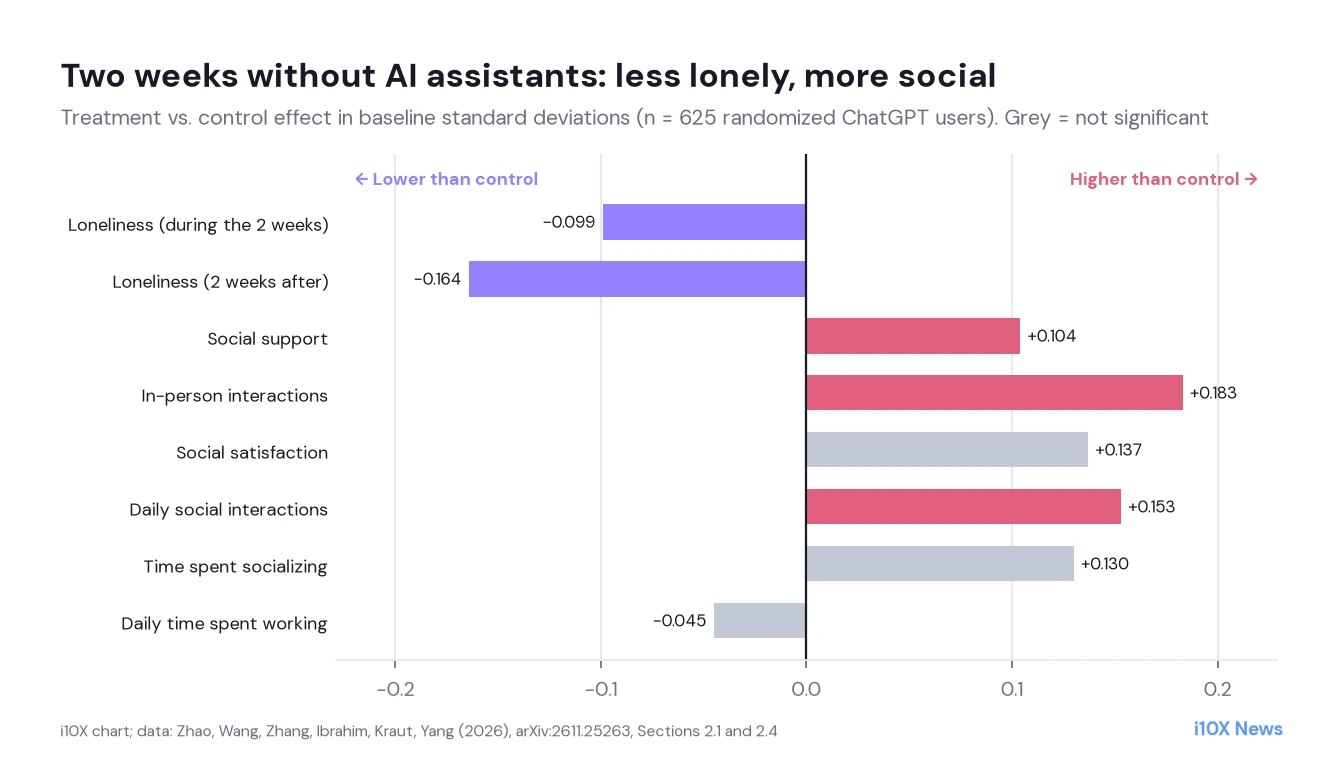
- Less loneliness: Two weeks without AI reduced loneliness relative to the one-day control group (beta = minus 0.099, p = 0.028, in baseline standard deviations).
- More social contact: Abstainers reported more social support (beta = 0.104, Q = 0.037) and more frequent in-person interactions (beta = 0.183, Q = 0.037). In daily surveys they also reported interacting with more people (beta = 0.153, p = 0.007), and that gap widened over the two weeks.
- No cost to work: Daily working time did not differ between the groups (beta = minus 0.045, p = 0.576). The extra socializing did not come at the expense of work, at least by self-report.
- Effects that last: At a follow-up two weeks after the break (442 participants), the former abstainers were still less lonely (beta = minus 0.164, p = 0.016) and reported greater feelings of competence and autonomy, which had not been significant at the end of the break. They also said they used AI less, although logged ChatGPT activity did not differ significantly between groups.
- Long-time users changed most: How long someone had held a ChatGPT account moderated the effect (beta = minus 0.109, p = 0.021): longer-tenured users saw larger drops in loneliness. Daily time spent with AI did not matter (p = 0.965).
| Outcome | Effect of two weeks without AI | Significance |
|---|---|---|
| Loneliness (during the break) | minus 0.099 SD | p = 0.028 |
| Loneliness (two weeks after) | minus 0.164 SD | p = 0.016 |
| Social support | plus 0.104 SD | Q = 0.037 |
| In-person interactions | plus 0.183 SD | Q = 0.037 |
| Social satisfaction | plus 0.137 SD | not significant (p = 0.053) |
| Daily time spent working | minus 0.045 SD | not significant (p = 0.576) |
| Emotional state and broader well-being | no significant change | not significant |
Why it matters: a real experiment, not a survey
Earlier work on AI and well-being mostly compared heavy and light users, which cannot tell whether AI makes people lonely or lonely people use more AI. Here, existing users were randomly assigned to a long or a short break, so the groups differ only in how long they went without AI. The one-day control group also had to give up AI and got paid at the same weekly rate, which reduces the risk that people simply reported what they thought the researchers wanted to hear.
The break was enforced, not just requested. A Chrome extension blocked 36 web addresses of common AI assistants, and the researchers checked participants’ ChatGPT conversation lists across all devices for messages sent during the break. The design was preregistered on the Open Science Framework and approved by Stanford’s ethics board, the sample size was planned in advance, and secondary outcomes were corrected for multiple tests. The authors report that alternative models accounting for dropouts gave similar results.
Method in brief
- Participants: 7,900 US ChatGPT users screened on Prolific; 625 enrolled. All used ChatGPT as their main assistant for at least 15 minutes a day, had an account for at least a month, used Chrome and accepted 40 dollars a week to abstain.
- Groups: 306 assigned to a 14-day break, 319 to a one-day break, block-randomized by usage intensity and account tenure. The study ran in two waves between May and July 2026.
- Measures: Five survey waves (loneliness, emotional state, well-being, psychological needs, social support and interaction), eleven daily experience-sampling surveys, open-ended reflections, and optional ChatGPT usage data.
- Analysis: Linear mixed-effects models comparing change from baseline between groups, plus exploratory mediation analyses and AI-assisted topic modeling of the open-ended answers.
What remains open
- Small effects: The changes are about a tenth to a fifth of a standard deviation. That is meaningful for a two-week change, but it is not a dramatic shift in anyone’s life. Emotional state and broader well-being did not change significantly.
- Uneven dropout and compliance: 80.0% finished the study, but completion was higher in the two-week group (85.9%) than in the control group (74.3%). Among finishers, 81.36% of the two-week group fully complied, against 91.56% of the control group. The authors use statistical corrections, but these rely on assumptions about who dropped out.
- Self-reported outcomes: Loneliness, social contact and working time are all self-reported, and participants knew they were not allowed to use AI. The blocker only covered the Chrome browser, and automatic violation checks only covered ChatGPT; other use relied on self-reports.
- A specific group: Participants were paid, US-based Prolific users who were willing to give up AI for money. Results may differ for people who rely on AI at work or cannot easily pause it.
- Changes from the plan: The authors list deviations from their preregistration, including a different main statistical model. They report that the preregistered-style analyses gave similar estimates.
- Funding and access: The paper is a preprint. Part of the funding came from an OpenAI Mental Health Grant used for participant payments; the authors state OpenAI had no role in the study. The paper says code and data are available, but the arXiv version contains no working link.
Context: from social media detox to AI detox
The design follows deactivation studies by Allcott and colleagues, which found that quitting Facebook and Instagram increased offline socializing and improved well-being. Research on AI companions, including earlier work by some of the same authors, found that heavy companion use is linked to lower well-being. This paper extends the question to everyday, practical AI use, where conversations about relationships or personal reflection made up only 3.2% of participants’ chats. It also sits in tension with workplace data: a log study of 12,000 employees found that Copilot adopters collaborated more, not less. The two results measure different things (work collaboration versus personal loneliness), but together they show that AI’s social effects depend heavily on context.
What it means for users and AI companies
- Notice what you skip: In open answers, 7.7% of abstainers said they turned to people for help they would otherwise have asked AI for, and 18.8% described actively seeking more contact. Asking a colleague or a friend now and then has value beyond the answer.
- Heavy use is not the only signal: Daily time spent with AI did not predict the effect, but account tenure did. Habits formed over months may matter more than hours per day.
- Design for connection: The authors argue that assistants should be judged not only by what they help individuals finish, but also by whether they create or remove opportunities for people to connect, for example by pointing users toward people who could help.
- A tool for future studies: As fewer people go without AI, temporary deactivation may become one of the few ways to measure its causal effects on existing users.
More research on how AI changes daily life is collected on our Society & Economy studies page. For a related angle, see our report on why people in mental health crises turn to AI to avoid burdening others.
About the analysis
This article is based on the full text of Zhao, Wang, Zhang, Ibrahim, Kraut and Yang (2026), “AI Deactivation Reduces Loneliness and Increases Social Interaction,” arXiv:2611.25263v1 (cs.HC, submitted November 18, 2026). All numbers come from the paper’s results and methods sections; where the arXiv abstract metadata and the paper differ slightly on the productivity share, we use the 84.4% given in the paper’s results. The paper is released under CC BY 4.0. The chart was drawn by i10X from Sections 2.1 and 2.4; no original figures were reused. AI tools assisted with research and drafting; selection, fact-checking and final editing were done by the i10X editorial team.
i10x Perspective
This is one of the cleanest causal tests yet of what everyday AI use does to social life, and the answer is subtle rather than alarming. Nobody became a hermit from asking ChatGPT for recipes. But the small favors we used to ask of each other are part of how relationships are maintained, and an assistant that answers everything can quietly take that away. AI companies measure engagement and task success; this study makes a good case that they should also measure what their products displace.