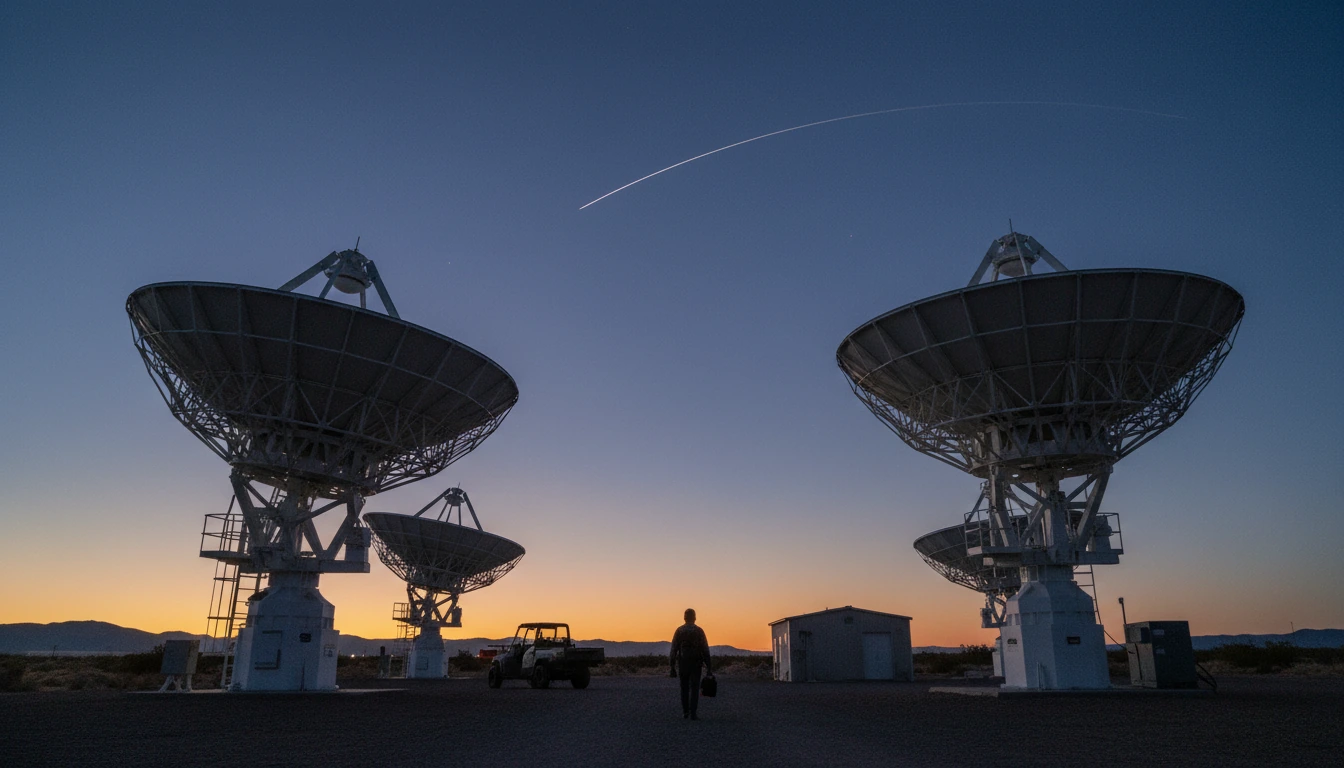
SpaceX now holds a US license for a constellation of up to one million satellites meant to work as data centers in orbit, but the grant is narrower than the headline number suggests. In a Memorandum Opinion and Order released on November 25, the FCC’s Space Bureau granted in part and deferred in part SpaceX’s application for the “SpaceX Orbital Data Center System”, called Starmind. What the agency actually authorized is radio spectrum for backup control links, a deployment schedule that runs to 2040, and several waivers. One of the hardest questions, how satellites above 600 km get rid of themselves at end of life, is still open.
What the FCC granted, line by line
The scope of the grant is spelled out on its cover page: authority for “backup and emergency” telemetry, tracking and command (TT&C) for 1,000,000 non-geostationary satellites operating as data centers in space. The frequencies are two Ka-band slices, 18.8 to 19.3 GHz down and 28.6 to 29.1 GHz up, and SpaceX may use them only on an unprotected, non-interference basis. If anyone documents harmful interference, SpaceX has to stop the offending transmission at once.
That is a small piece of spectrum for a very large system, and it is deliberate. According to the application cited in the order, Starmind will rely on optical links, including laser connections to SpaceX’s first and second generation Starlink satellites. Radio is the fallback when the lasers fail. SpaceX also has to coordinate with federal and national security users before it transmits in the 18.8 to 19.3 GHz band at all.
The Bureau further granted waivers of the processing round rules, the surety bond rules and the old deployment milestone rules, and it denied petitions to deny filed by Viasat, Amazon’s Kuiper Systems and the American Astronomical Society. It also declined to run an environmental review under NEPA, citing the Commission’s October 2026 finding that licensed activities in space are extraterritorial.
The milestone math
In place of the old rules, the order applies the new milestone schedule from the FCC’s Space Modernization proceeding. If SpaceX misses these dates, the order says the authorization becomes null and void.
| Deadline | Requirement | Satellites in service |
|---|---|---|
| November 25, 2033 | First satellite deployed and operating | 1 |
| November 25, 2035 | 10% of the authorized maximum | 100,000 |
| November 25, 2038 | 50% of the authorized maximum | 500,000 |
| November 25, 2040 | Full constellation | 1,000,000 |
Source: FCC Space Bureau, DA 26-1273, condition 10. Satellite counts: our calculation from the percentages.
Our reading of those dates: the first deadline is loose, one working satellite eight years from now. The pressure starts after 2035. Getting from 100,000 to 500,000 satellites in three years means about 133,000 deployments a year, roughly 365 a day. The final step to one million in two more years would need about 685 a day. The 15 year license term only starts when SpaceX certifies that its first Starmind satellite is in orbit and fully compliant.
The deferred part: disposal above 600 km
SpaceX asked to dispose of satellites operating above 600 km into “Earth disposal orbits or heliocentric orbits” instead of letting them re-enter the atmosphere, which FCC rules require for missions ending below 2,000 km. The Bureau deferred that request because SpaceX had not given it enough information to judge whether the alternatives comply. Before deploying any Starmind satellite that will not re-enter, SpaceX must file a modification application with a full justification.
That condition matters more than it looks. Of the six nominal operating shells listed in the grant, four sit above 600 km: 686 to 718 km, 707 to 744 km, 946 to 978 km and 967 to 1,002 km. By our count, most of the planned altitude range therefore depends on a disposal plan the FCC has not yet accepted. Only the two lowest shells, around 550 to 585 km, are covered by the standard re-entry rule.
SpaceX also has to report twice a year on conjunction events, maneuvers, failed or removed satellites, re-entries, the total number deployed and how many satellites used the Ka-band links.
Why SpaceX wants compute in orbit
The company’s AI business is already its largest. Its latest quarterly filing showed the SI segment, which rents compute to outside customers, at more than half of revenue, with one unnamed customer at 34.5 percent; we went through the numbers in our analysis of the SpaceX 10-Q. Orbital capacity is a bet that power and cooling in space will one day be cheaper than new grid connections on the ground.
SpaceX is not alone. Google has booked a dedicated New Glenn launch for Project Suncatcher, its orbital TPU experiment, targeted for early 2029, with satellites carrying about one data center rack of compute each. The difference is scale: Google is testing rack-sized units, while SpaceX now has a license framework sized for a million satellites.
What this changes for AI compute buyers
- Nothing in the next few years. The only binding deadline before 2035 is a single satellite by November 2033, so orbital capacity is not a factor in compute contracts signed today.
- SpaceX’s near-term capacity still comes from ground campuses such as Colossus in Memphis, which is where any new supply for model training and inference will originate this decade.
- For investors following xAI and SpaceX’s compute business, the real milestones to watch are the disposal modification filing and the first satellite certification, not the one million headline.
What is still open
SpaceX has 30 days from release to decline the grant as conditioned; otherwise it is accepted. The disposal waiver, any ITU filing changes and the reporting rules from the Space Modernization proceeding will all shape what the constellation can become. The order also says nothing about thermal design, launch cadence or cost per unit of compute in orbit, the questions that decide whether the business case works.
i10x Perspective
The FCC has treated Starmind mainly as a spectrum and space safety file, and on those terms the grant is modest: backup radio links, a long schedule and an unresolved disposal question for most of the planned altitudes. That is the right lens for a regulator, but it means the approval says little about whether orbital data centers make economic sense. We expect the first real signal in the disposal filing, because it will show how SpaceX plans to handle failed hardware at 1,000 km. Until then, treat orbital compute as a long dated option on SpaceX’s balance sheet, not as capacity.