
The era of clicking links is making way for conversational fulfillment-and the trillion-dollar advertising infrastructure is racing to inject itself into the payload.
Quick Take
- Summary: Amazon’s latest AI-driven ad format points to a massive paradigm shift in digital marketing: moving from static URL real estate to conversational, recommendation-based “agentic ads” embedded directly into AI outputs.
- What happened: Amazon introduced native sponsored placements embedded seamlessly within chatbot-style shopping recommendation flows, effectively merging generative AI shopping assistants with paid targeting.
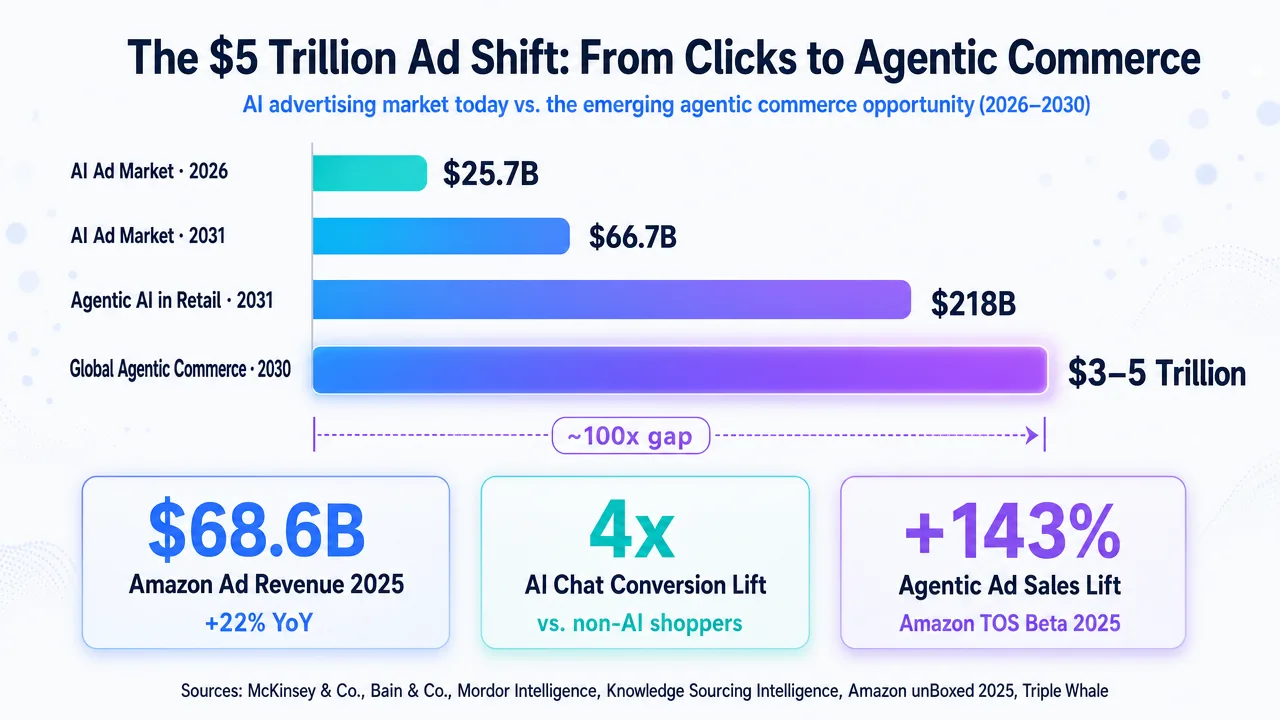
Why it matters now: As LLMs become the primary interface for search, commerce, and daily workflows, traditional ad models are breaking. Networks are being forced to figure out how to monetize multi-turn intent via real-time, context-aware agentic insertions without breaking the user experience.
Who is most affected: LLM infrastructure providers mapping new revenue models, ad-tech platforms building prompt-based bidding exchanges, brands forced to rethink their data structures, and the engineering teams managing latency and prompt safety at the ecosystem layer.
The under-reported angle: The true bottleneck isn’t user adoption, but technical architecture. Advertising in an LLM world requires mastering token efficiency, RAG-powered product schemas, and novel metrics like “Cost Per Resolution (CPR)” rather than simple click-through rates.
Deep Dive
To understand the shift toward “agentic ads,” you have to look beyond the user interface and into the technical architecture. An agentic ad isn’t a banner, and it isn’t a sponsored search link. It is a dynamically generated response, seamlessly integrated into a Retrieval-Augmented Generation (RAG) pipeline, designed to resolve multi-turn user intent on the fly.
When a user asks an AI assistant to “build a starter kit for podcasting under $300,” the resulting recommendations are no longer just scraped from organic data. They are mediated by real-time inventory signals, contextual decisioning models, and agent auctions. Early industry coverage has largely characterized Amazon’s move as a clever UI update for retail media—a chatbot format to hook uncertain buyers. But from an AI infrastructure perspective, this represents a fundamental rewiring of the web’s economic engine.
Static creative is functionally dead in this environment. To participate in an agentic auction, entities must provide highly structured knowledge graphs, product metadata, and real-time pricing feeds that the platform’s LLM can safely ingest, evaluate, and output as a coherent, conversational recommendation. This introduces immense complexity into how success is measured. Traditional Cost-Per-Click (CPC) logic shatters when a transaction happens inside a five-turn conversation without a solitary, defining “click.”
Ad tech infrastructure must now calculate attribution across agent-mediated journeys, where memory effects and intent drift play massive roles. We are looking at the birth of entirely new procurement models, like Cost Per Resolution (CPR), where advertisers bid on an LLM successfully concluding a user’s task using their product or service. From what I’ve seen, the real test lies in whether these systems can stay transparent enough to retain trust.
Furthermore, dynamic insertion into an LLM context window introduces severe governance and brand safety risks. What happens if an AI assistant hallucinates a product capability while delivering a paid placement? Or if it injects bias into a sponsored B2B recommendation? The tech stack required to serve an agentic ad relies heavily on latency budgets, token efficiency optimization, and stringent safeguard systems designed to prevent the model from misrepresenting the sponsor while retaining the natural, conversational flow.
The implications stretch far beyond retail. Today, we are seeing conversational commerce ads on Amazon; tomorrow, we will see agentic ads deployed inside enterprise productivity agents, OS-level assistants, and autonomous workflow bots. The battleground for AI supremacy—currently fought over raw compute and model benchmarks—is rapidly expanding to include who owns the RAG-native monetization layer.
Stakeholders & Impact
| Stakeholder / Aspect | Impact | Insight |
|---|---|---|
| AI / LLM Providers | High | Unlocks the pathway to massive subsidization of compute costs. Models must be tuned for ad-insertion latency and safety. |
| Ad Tech & Data Infra | High | Forces a pivot toward structured data indexing (knowledge graphs) over pixel tracking and visual creative generation. |
| Brands & Advertisers | Medium-High | Must shift from targeted impressions to optimizing for LLM retrieval. “Prompt engine optimization” becomes critical. |
| Regulators & Policy | Significant | New frontiers in consumer protection: distinguishing between organic AI reasoning and biased, paid AI recommendations. |
About the analysis
Researched and written with AI assistance under the editorial responsibility of the i10X News team. The title image is an AI-generated illustration. Read our AI Use Policy. Spotted an error? Request a correction.
This independent analysis synthesizes cross-industry reporting, semantic search behaviors, and ad-tech capability mappings surrounding early agentic ad structures. It is engineered for CTOs, AI ecosystem developers, and digital infrastructure leaders tracking the inevitable collision of generative AI scaling and platform economics.
i10x Perspective
The rollout of agentic ads is the clearest signal yet that AI platforms are not just building reasoning tools—they are building the next generation of global commerce engines. As we move toward an agent-to-agent economy, where AI systems autonomously execute tasks on behalf of users, “advertising” will shift from convincing human eyeballs to influencing algorithmic parameters. The companies that command this space won’t be the ones with the largest billboard networks, but the ones whose models can optimally balance context windows, token-efficient bidding, and the subtle art of monetizing reasoning. Observers should watch closely: the friction between an AI acting as a neutral user proxy and an AI acting as a monetized storefront will define the regulatory battles of the next decade.