
Will AI take the jobs that careers start with? A preregistered survey experiment by Vincent Rost (ZEW Mannheim) and Fabian Stephany (Oxford Internet Institute) gives a more precise answer than most of the debate: it depends less on the junior label than on what the junior would actually do. Managers at 1,435 German firms were clearly more willing to use AI instead of hiring a newcomer when the work was standardised than when it needed judgement and context. At the same time, most of those who expect any change say AI will slow their hiring, and juniors are hit harder than experienced staff. For career starters and the managers who hire them, the study shows where the line currently runs.
The task decides, not the job title
Each manager imagined the same situation: the company needs extra capacity for the long term, for work usually done by entry-level employees. Only the description of that work changed, at random. Half of the respondents read about standardised, clearly structured tasks such as data maintenance, simple research, standardised analyses or recurring customer enquiries. The other half read about tasks that need professional judgement, contextual knowledge and independent problem-solving, such as interpreting information, preparing individual recommendations or handling more complex customer requests.
- Willingness to use AI instead of a hire: With all controls, the complex version lowered it by 0.54 points on a five-point scale. In the standardised group the average sat at 3.21, slightly above the middle of the scale; by our rough arithmetic, the complex framing pulls it to about 2.7, below the middle.
- Human review: Managers already rated it as very important for standardised work (4.32 out of 5). Complex tasks pushed that up by another 0.15 points.
- No group exception: The effect pointed the same way in every subgroup the authors checked, from firm size and sector to AI use and past junior hiring, and an ordered probit model gave the same direction and significance.
One detail is worth a second look. In the fully controlled model, every additional type of AI application a firm already uses goes with a 0.26-point higher willingness to replace a hire, and frequent personal AI use by the manager with 0.39 points. By our calculation, a firm with two more AI application types than another offsets the whole complexity effect. These are associations, not causal effects, but they suggest that familiarity with AI moves the line between replaceable and not replaceable.
What managers expect for the next two years
Before the experiment, managers were asked how the availability of AI will affect their hiring over the next two years. Most, 63% for juniors and 65% for experienced staff, expect no effect. Among the rest, the direction is clear.
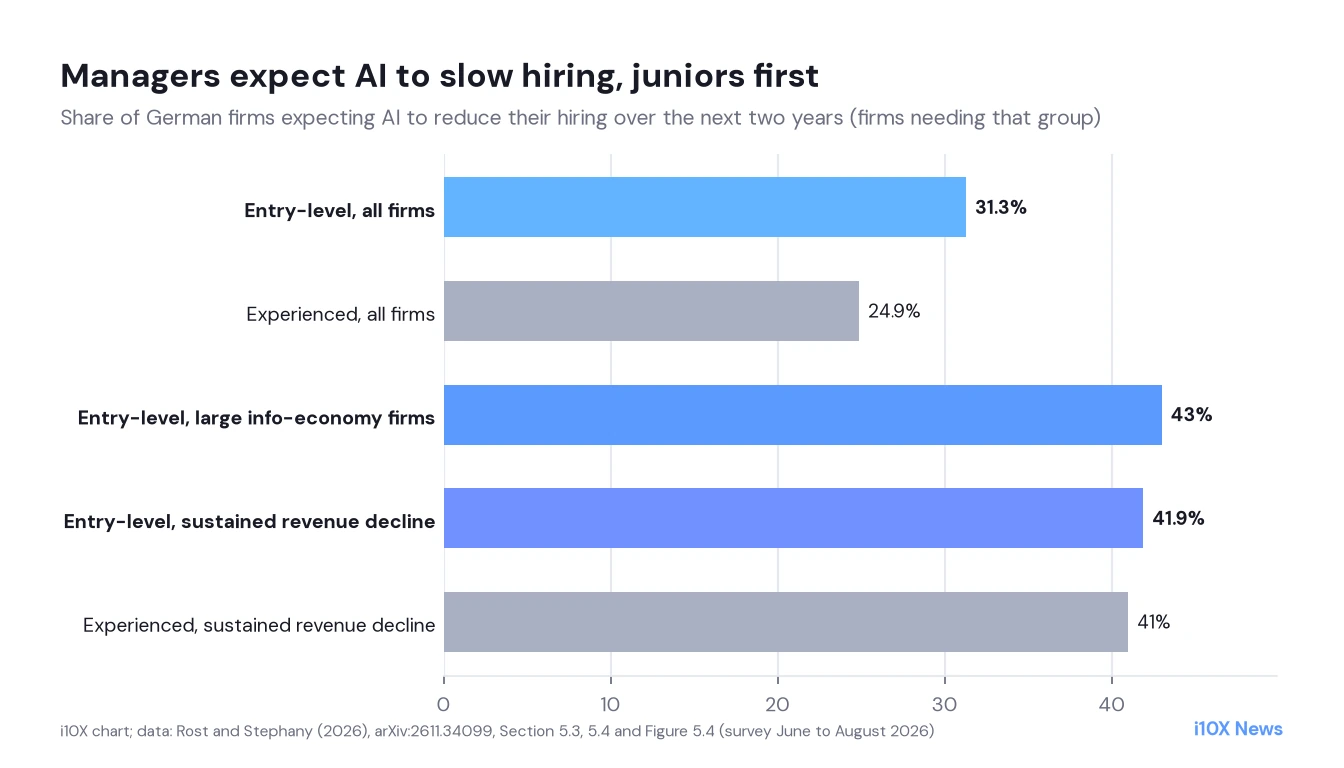
- Juniors: 31.3% expect fewer entry-level hires, 5.5% more. That is a net balance of about minus 26 points by our calculation.
- Experienced staff: 24.9% expect fewer hires, 10.1% more, a net balance of about minus 15 points. The authors had predicted that AI would raise demand for experienced workers; the data do not support that.
- Where it is strongest: Among large information-economy firms with at least 100 employees, 43% expect fewer junior hires. In an exploratory, not preregistered analysis, firms with falling revenue in the last quarter and expected for the next were much more pessimistic: 41.9% expect fewer junior hires and 15.5% a substantial drop, against 5.6% among firms with mixed business trends.
So the study does not describe juniors being swapped for seniors. Managers expect to hire less overall, with a relative tilt toward experience. The authors also warn that the survey records direction, not headcount: many firms cutting a little could be offset by a few firms hiring a lot.
Why the design holds up
Random assignment is the strength here. Observational labour data cannot separate AI from the economic cycle or remote work, a problem the authors point to in earlier research. Here the scenario was identical except for the task description, the hypotheses were registered in advance, the two groups were balanced on firm and respondent traits, and the sample comes from a long-running quarterly ZEW business survey sent to company leaders. In an earlier wave, about 73% of respondents were CEOs or board members. The managers were also no AI novices: 67.3% use AI tools daily or several times a week.
Who answered and how
The survey ran from June 19 to August 5, 2026, with late paper replies accepted until August 26. Of the 1,435 firms, 53.5% belong to the information economy (ICT, media and knowledge-intensive services) and 46.5% to manufacturing, all with at least five employees. 705 firms saw the complex scenario and 730 the standardised one. The main models use ordinary least squares with robust standard errors and add industry, firm size, respondent traits and hiring history step by step; the effect barely moved.
What the study cannot say
- Stated, not real choices: Managers answered a hypothetical scenario. Wages, implementation costs, applicant supply and regulation were not part of it.
- Broad wording: AI applications was left undefined on purpose, so respondents may have pictured very different tools.
- Limited reach: German firms in two sectors only, with large firms overrepresented; the authors caution against reading the pooled results as representative.
- One documented deviation: A question on the importance of juniors for the talent pipeline was moved after the experiment to avoid priming, and is therefore not used as a control. The preprint has not been peer reviewed, the data are not public, and the only funding mentioned is a DAAD scholarship; no conflicts are stated.
How it fits with other evidence
The result lines up with what Anthropic heard in 66 interviews with 58 enterprise customers, published on November 23: very few AI-driven layoffs, but most companies hiring less because of AI. It also echoes the Purdue analysis of U.S. job postings we covered, which found employers rewriting what jobs contain rather than simply cutting them, and the OpenAI data on how companies use ChatGPT Enterprise, where junior staff were among the heaviest users. Our AI Jobs Barometer adds the market side: in Germany, 5.7% of Indeed postings mentioned AI on September 30, 2026, against 3.6% a year earlier. In the U.S., postings for customer service (index 87.5) and data and analytics (62.1) remain below their February 2020 level. Those are exactly the kinds of tasks the experiment framed as standardised, although the posting data alone cannot show that AI caused the gap.
What it means for juniors and the people who hire them
- For career starters: Look for roles and projects where you interpret, recommend and deal with unclear cases. In this experiment, those were the tasks managers kept for people.
- For applicants in Germany: Large information-economy firms and companies with falling revenue were the most likely to expect fewer junior hires. That is where competition for entry roles may get tougher first.
- For managers: If AI takes over the standardised work juniors used to learn on, plan where the next experienced employees will come from: rotation, mentoring or deliberately assigned judgement tasks.
- For budgeting AI: Managers rated human review at 4.32 of 5 even for simple work. Replacing a hire with AI still means paying for someone’s time to check the output.
About this analysis
Based on the full text of arXiv:2611.34099v1, submitted on November 25, 2026 and dated November 26. All study figures come from the paper’s text, tables and figure labels. The net balances, the shifted scale value and the comparison of the complexity effect with AI-use coefficients are our own arithmetic. The chart was redrawn by i10X; the paper is published under CC BY 4.0.
i10x Perspective
The comforting reading, that AI only takes the boring junior tasks, misses the uncomfortable one the authors raise themselves: those boring tasks are how people became experienced. A labour market that values judgement but stops paying people to acquire it on simple work will run short of exactly the seniors managers say they want. We expect the first visible effect not in layoffs but in fewer and more demanding entry roles, starting at large knowledge-economy firms. The next step should be follow-up waves that track actual hires against these expectations. More research on AI and work is collected in our Society and Economy section.