
Google’s decision to bake Gemini into the world’s most valuable slice of digital real estate is more than a routine update.
It amounts to a forced, large-scale inference experiment — and one that is already stirring pushback across publishers, enterprises, and everyday users.
⚡ Quick Take
Summary: Google’s rollout of AI Overviews has set off a parallel scramble among users, publishers, and IT teams to sidestep or mute the generative layer. Since the company skipped a universal toggle, people have pieced together workarounds with URL parameters and browser extensions — essentially a quiet digital workaround against the forced integration.
What happened: Gemini-powered answers now sit at the top of results for millions of queries. Traditional blue links get pushed down or replaced, and the only global escape routes are a manual “Web” filter or tacking on the udm=14 parameter each time.
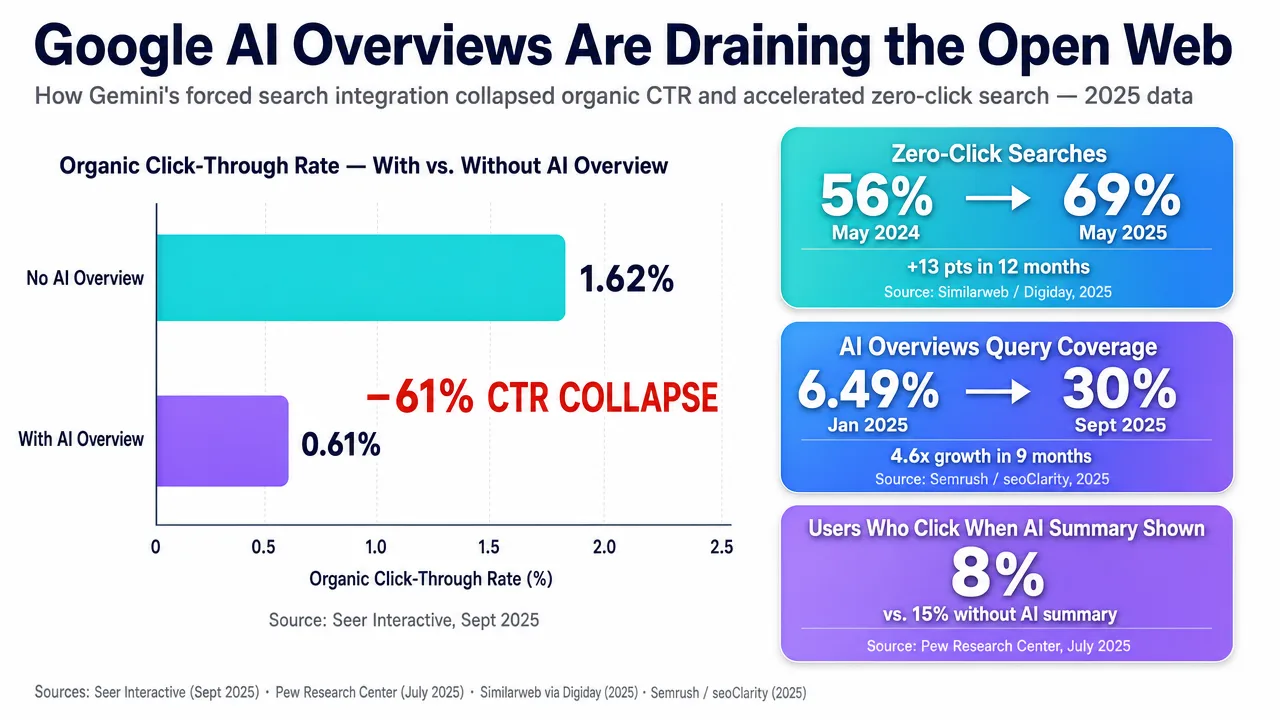
Why it matters now: This is one of the largest LLM inference deployments the web has seen, and it is already reshaping how traffic flows. The friction that has followed points to a larger tension: Google’s need to monetize its AI stack versus the market’s preference for direct, verifiable sources.
Who is most affected: Regular searchers deal with extra clicks and clutter, but publishers watch top-of-funnel visits vanish and enterprise IT groups spend time locking in org-wide defaults to keep older research habits intact.
The under-reported angle: While most stories highlight consumer extensions, the bigger story sits inside companies. They are quietly engineering ways to hide AI Overviews at scale, all while Google keeps burning GPU cycles on answers that many recipients immediately suppress.
🧠 Deep Dive
Have you ever searched for something specific only to land on a tidy paragraph that still leaves you doubtful? That experience is now default for a growing share of queries. Google’s move from the earlier Search Generative Experience test to today’s always-on AI Overviews is not a small UI shift; it is a live stress test of how much inference the company can push through its infrastructure. By running Gemini on billions of daily searches, it demonstrates real technical reach. Yet search logs show a meaningful slice of users actively looking for an exit.
Coverage in places like PCMag, Ars Technica, and Search Engine Land tends to frame the issue as a minor annoyance and lists quick fixes such as the udm=14 parameter. The deeper issue, though, is strategic. The absence of a one-click opt-out is not an oversight; it protects rapid adoption and keeps rival AI search tools at bay.
The practical battle has moved into enterprise and specialized workflows. IT teams are exploring network-level policies that can suppress the new layer for compliance or accuracy reasons. Their worry centers on telemetry, the chance of hallucinations in technical work, and the steady reliability that plain web results once delivered. The result is a two-speed web: one group accepts the synthesized answers, while another group builds workarounds to reach the original sources.
There is also a quiet infrastructure cost. Every time an unwanted AI Overview is generated and then hidden by CSS or an immediate filter click, compute is spent with nothing to show for it. At a moment when power and chip capacity are under close watch, that inefficiency is hard to ignore.
📊 Stakeholders & Impact
| Stakeholder / Aspect | Impact | Insight |
|---|---|---|
| AI / LLM Providers | High | Shows Gemini can scale, yet risks driving users away if the friction grows. |
| Enterprise IT & Privacy | High | Pushes teams toward managed browser policies that keep classic results for compliance and precision. |
| Publishers & SEOs | Critical | Organic traffic is being cut off at the top of the funnel, putting pressure on established revenue models. |
| Infra & Compute | Medium | Creates repeated “wasted” cycles whenever generated answers are blocked or ignored downstream. |
✍️ About the analysis
Researched and written with AI assistance under the editorial responsibility of the i10X News team. The title image is an AI-generated illustration. Read our AI Use Policy. Spotted an error? Request a correction.
This review draws on search behavior data, competitor reporting, and SERP structure to assess how the market is responding to AI Overviews. It is aimed at CTOs, SEO teams, and developers who track how LLM choices affect user control and web performance.
🔭 i10x Perspective
The udm=14 workaround signals a broader shift in how knowledge is accessed. If the everyday interface becomes a synthesized layer, the raw web itself turns into something that requires extra steps to reach. Google’s approach could hand competitors an opening with more modular, opt-in tools. Over the next several years, it will be worth watching how regulators treat efforts to lock users into AI-generated answers by default.