
Localized LLMs in Restaurants
⚡ Quick Take
Summary: Facing chronic staffing crunches and margin-crushing overheads, restaurants are rapidly adopting ChatGPT and other LLMs to automate everything from menu engineering to guest communications.
What happened: Hospitality operators form a fast-growing cohort of localized AI users, leveraging generative models to draft marketing copy, manage reviews, and build workflows—even as diners push back against inauthentic “AI slop.”
Why it matters now: High-turnover, low-margin sectors serve as the ultimate proving ground for LLM utility. They test whether conversational AI can reliably integrate with existing physical retail infrastructure (POS, CRMs) at scale.
Who is most affected: Independent restaurant operators, food tech software vendors, front-of-house staff, and diners negotiating a new wave of automated service interfaces.
The under-reported angle: The severe health and compliance risks of LLM hallucinations—specifically the liability of an AI misclassifying regional ingredients and hallucinating away vital allergen warnings on automated menus.
🧠 Deep Dive
Generative AI has left the high-tech office and walked into the commercial kitchen. Driven by a relentless squeeze on margins and a persistent labor shortage, local restaurant operators are leaning heavily on ChatGPT. What started as a novelty for drafting quick social media captions has morphed into an urgent operational crutch. But here’s the thing—as mainstream coverage begins critiquing the emergence of “AI slop,” those hyper-generic, soulless bits of marketing copy that alienate diners—a deeper infrastructural shift is quietly happening behind the back of house.
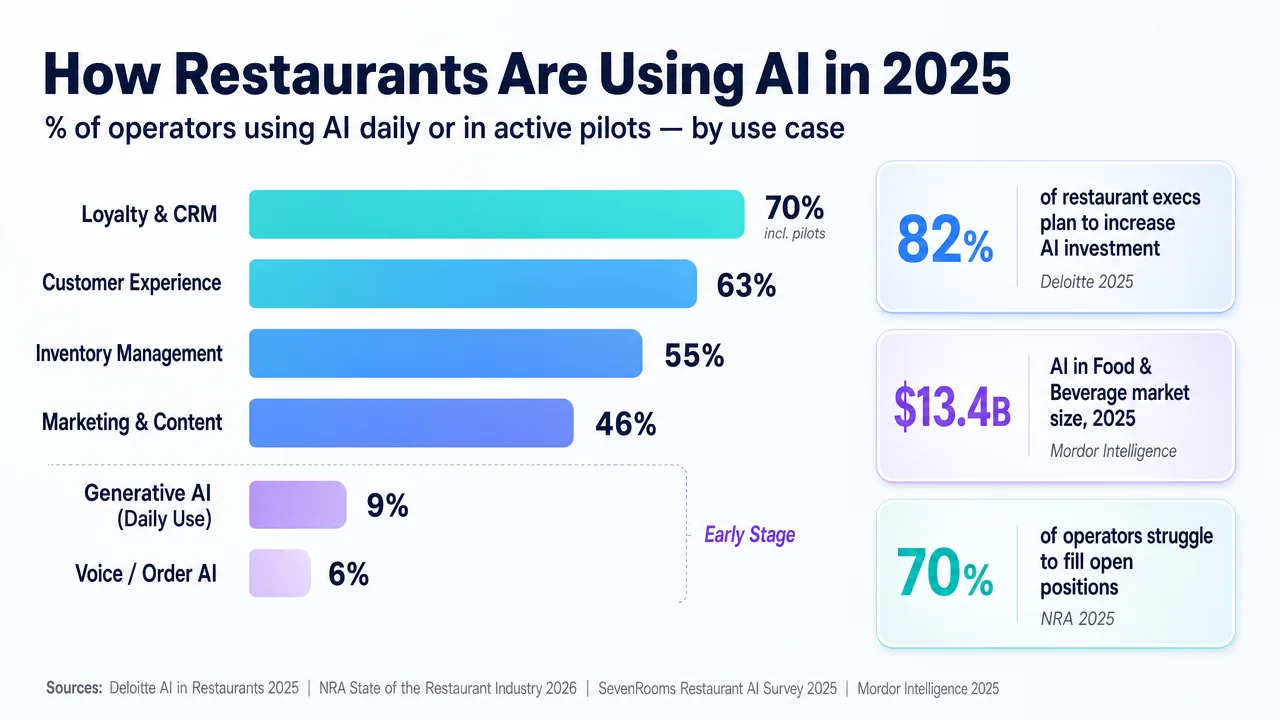
From what I’ve seen, we’re witnessing the transition from ad-hoc browser usage to integrated AI infrastructure. Operators aren’t just looking for a chatbot. They are demanding AI integrations directly within their vendor stack, including POS systems, reservation platforms like OpenTable, and delivery aggregators. The use cases keep expanding into menu engineering, dynamic pricing, inventory forecasting to reduce waste, and multilingual guest communication. This signals a massive API opportunity for LLM providers willing to tackle fragmented, local-business software ecosystems.
That said, the hospitality sector presents unique, high-stakes physical risks for LLM deployment. AI hallucination is merely an annoyance in an internal corporate memo. On a restaurant menu, though, it becomes a liability. Generating a recipe description that invents local ingredients or drops a critical allergen warning turns an LLM hallucination into a genuine health and compliance crisis. This exposes a massive gap in the current AI tooling market—the need for localized governance frameworks, human-in-the-loop verification, and strict brand voice guardrails tailored to the rigorous safety constraints of food service.
We’re also seeing the frontiers of edge AI pushed at the drive-thru and the kiosk. As voice-enabled conversational AI moves into phone orders and fast-service lanes, latency, regional slang parsing, and immediate task execution become paramount. Foundation models face real stress tests in noisy, real-time, high-pressure environments where a two-second API lag means lost revenue.
Ultimately, this trend forces an industry built on human connection to audit what parts of its operation truly require a human touch. Operators report saving five to ten hours a week on administrative tasks using automated templates and AI prompt pipelines. Yet the real challenge lies in scaling those efficiencies without diluting the localized, authentic brand voice that keeps a restaurant alive.
📊 Stakeholders & Impact
| Stakeholder / Aspect | Impact | Insight |
|---|---|---|
| AI / LLM Providers | Medium–High | Massive surface area for API growth, but requires shifting from generic conversational agents to highly localized, vertical-specific models. |
| Food Tech Vendors (POS/CRM) | High | Providers (Square, Lightspeed, OpenTable) face pressure to natively integrate LLM workflows to prevent operators from churning to AI-native startups. |
| Restaurant Operators | High | Enables significant reduction in administrative baseline costs (5–10 hours/week), but introduces new vulnerabilities regarding data privacy and strict compliance (e.g., allergens). |
| Diners & Regulators | Significant | Increased regulatory scrutiny over consumer transparency, false advertising, and ingredient safety as “AI generation” replaces traditional oversight. |
✍️ About the analysis
Researched and written with AI assistance under the editorial responsibility of the i10X News team. The title image is an AI-generated illustration. Read our AI Use Policy. Spotted an error? Request a correction.
This independent, research-based analysis models search intent data, global SERP feature extraction, and competitive content gaps surrounding the localized use of generative models. It is designed for AI product managers, food tech CTOs, and enterprise developers mapping the integration of LLMs into low-margin, high-volume retail environments.
🔭 i10x Perspective
Main Street businesses like restaurants are the canary in the coal mine for next-generation LLM agentic workflows. When an AI transitions from writing a Yelp reply to autonomously optimizing a kitchen’s inventory forecasting and updating pricing across five delivery apps natively, it evolves from a copilot to a co-operator.
The absolute winners in the enterprise AI race over the next five years will not merely be those who build the smartest standalone models. The true victors will be the infrastructure players who successfully bridge the chasm between digital reasoning and localized, physical execution—without poisoning the customer experience with “AI slop.”