
Quick Take
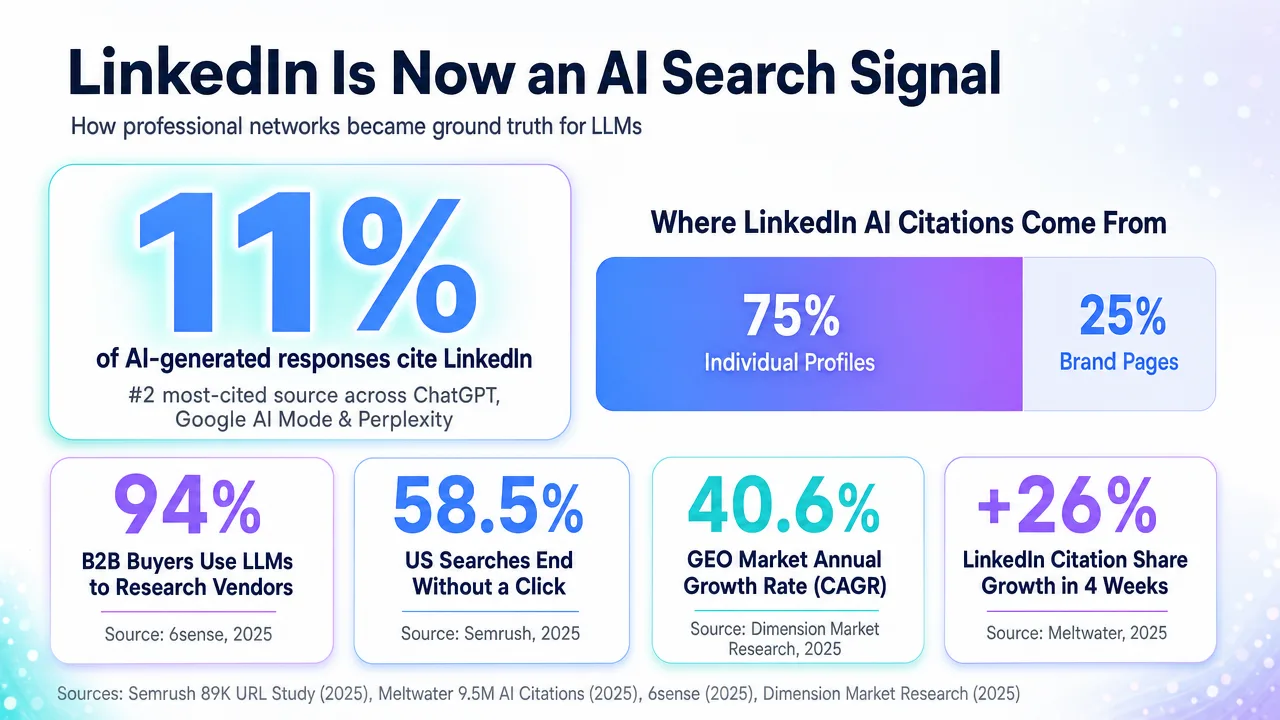
- Summary: The idea of an “AI search footprint” is pushing a real rethink of platforms like LinkedIn. What once felt like straightforward professional networking is turning into a key data source for AI answer engines. With the open web filling up with synthetic content, large language models are leaning harder on authenticated spaces to pin down ground truth for brands and industry topics.
- What happened: Among Generative Engine Optimization (GEO) strategists, a new view is taking hold – LinkedIn activity now shapes how often a brand gets cited in places like ChatGPT Search, Perplexity, and Google AI Overviews. Engagement metrics and social proof are becoming significant signals in how RAG pipelines build real-time responses.
- Why it matters now: Search is moving away from simple blue links toward synthesized answers. To steer clear of hallucinations, the models favor high-signal, human-verified sources that show clear E-E-A-T signals. Companies or leaders without a steady presence in these networks run the risk of getting overlooked – or worse, mischaracterized – in AI summaries.
- Who is most affected: CMOs, SEO and GEO teams, and B2B founders now have to treat their digital presence as something machines will parse, not just people. The same applies to the teams building the AI tools themselves.
The under-reported angle
This shift isn’t mainly about posting more. It’s about Entity SEO. The sharpest operators are deliberately linking their LinkedIn profiles to website schemas and Wikidata, so human updates become machine-readable signals that flow straight into how LLMs understand a brand.
Deep Dive
Traditional SEO is losing ground fast, giving way to Generative Engine Optimization (GEO). As the open web gets noisier with AI-generated material, the models behind Perplexity, Claude, and ChatGPT Search are looking for cleaner, verified inputs. That search has led them toward platforms that already verify identity and track real engagement.
LinkedIn, in particular, has moved from a useful B2B channel into something more structural – a reliable input for RAG systems. From what I’ve seen, most teams still treat optimization here as a human PR exercise: track the likes, measure reach, hope for leads. The real mechanics have tilted toward machine consumption, though. When someone asks an AI to compare enterprise AI infrastructure providers, the model pulls from recent, engaged thought leadership and verified updates, not just static pages. A strong article starts functioning like a direct data point in the model’s working memory.
There’s still a sizable gap in execution. Plenty of enterprises lack any way to connect their social activity to actual AI citations. Closing that gap means adopting Entity SEO practices – mapping LinkedIn profiles and executive pages to brand knowledge graphs and structured schema so models can reference the source cleanly instead of guessing.
Different systems handle this differently, of course. Perplexity tends to surface deeper, technically dense long-form work. ChatGPT Search puts more weight on recency. The practical response is to test formats deliberately, track what moves the needle in AI mentions, and adjust.
At the end of the day, the organizations pulling ahead are the ones treating employee advocacy and technical documentation as connected systems. When several verified voices reinforce the same narrative, it creates a signal cluster that LLMs treat as consensus – often overriding older or weaker sources.
Stakeholders & Impact
| Stakeholder / Aspect | Impact | Insight |
|---|---|---|
| AI / LLM Providers | High | Authenticated identity graphs improve RAG quality and reduce hallucination risks in live search. |
| Brands & Enterprises | High | Marketing pipelines need to shift from human-focused content to machine-readable Entity SEO to stay visible. |
| Data Scraping & GEO Tooling | Significant | A new set of tools is emerging to track AI citations instead of traditional backlinks. |
| Search Engines (Google/Bing) | Medium-High | Traditional algorithms are folding in more social and identity signals for AI Overviews. |
About the analysis
Researched and written with AI assistance under the editorial responsibility of the i10X News team. The title image is an AI-generated illustration. Read our AI Use Policy. Spotted an error? Request a correction.
This independent analysis looks at how generative retrieval systems interact with social identity platforms. It’s written for CTOs, CMOs, and AI infrastructure leads who need to understand how models establish trust when so much online content is no longer reliable.
i10x Perspective
The growth of the “AI search footprint” highlights a real convergence between verified identity and what AI systems accept as ground truth. Walled gardens with built-in authentication are becoming preferred data sources as the open web degrades. Over the next five years, the bigger concern isn’t just visibility – it’s distortion. As more companies master these tactics, the risk is that AI answers will simply reflect whichever corporate voices optimized most aggressively.