
Meta’s Reverse Acqui-Hire for Kunal Shah: A New Talent Playbook
Summary
Meta’s rumored move to secure Cred founder Kunal Shah through a “reverse acqui-hire” signals a dramatic evolution in Big Tech’s talent acquisition playbook.
What happened
Meta is reportedly utilizing a reverse acqui-hire structure—a maneuver where a founder and key talent are absorbed into a mega-cap without a traditional corporate buyout—to bring Shah into its ecosystem.
Why it matters now
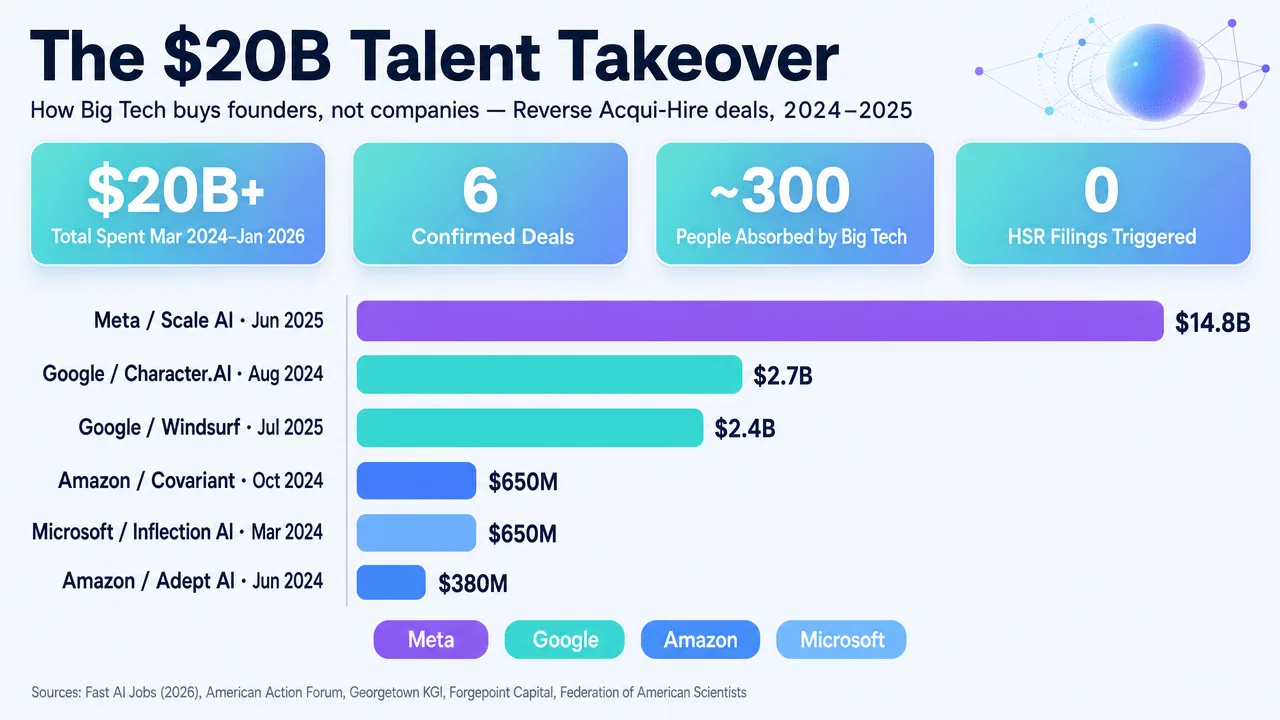
Born out of the AI talent wars to dodge antitrust scrutiny (seen in Microsoft-Inflection and Amazon-Adept deals), the reverse acqui-hire is now becoming the gold standard for acquiring elite execution DNA required to scale consumer AI and agentic infrastructure.
Who is most affected
Startup founders, tech investors modeling exit liquidity, and antitrust regulators who are struggling to classify these non-M&A talent bypasses.
The under-reported angle
Beyond circumventing traditional M&A, this is a massive cross-border arbitrage play; absorbing top-tier Indian tech leadership directly into US Big Tech reflects a shift toward globalizing the AI-era “founder-in-residence” model.
Deep Dive
The traditional tech acquisition model is breaking down. Facing unprecedented antitrust headwinds from global regulators, mega-caps like Meta, Google, and Microsoft have largely lost the ability to outright buy mid-stage companies just to acquire their talent. Enter the reverse acqui-hire—a structural loophole that gained traction during the recent AI gold rush. It lets companies absorb world-class builders without tripping FTC or CMA wires. While the tactic started with LLM startups, Meta’s reported interest in Cred founder Kunal Shah shows the playbook has moved into the broader executive market.
A reverse acqui-hire flips the old acqui-hire script. Rather than scooping up a struggling company for its engineers, a firm like Meta can license technology, pay sizable integration or non-compete packages, and pull the leadership layer from an otherwise healthy operation. In AI and complex platforms, Big Tech rarely needs yesterday’s products. It needs founders who know how to take an idea from zero to one and then get it in front of billions of users. Structuring these deals involves careful IP transfers, earn-outs, and vesting that tries to keep some of the startup upside while limiting integration risk.
From what I’ve seen, this approach exposes a real gap in how talent economics are valued. For founders it offers a fast off-ramp with big-tech equity attached. For Meta the cost, even if it runs into the hundreds of millions, still looks cheaper and quicker than a multi-billion-dollar deal stuck in court. In effect the builder gets unbundled from the business they built.
Geopolitically, the Kunal Shah situation points to a second layer: the India-US tech corridor is speeding up. Once foundational models start to look similar, companies like Meta (with Llama and open-source stacks) will compete on application-layer execution. Bringing in someone with deep Indian fintech experience gives Meta a shot at hyperscale consumer intuition—pairing Silicon Valley infrastructure with the kind of rapid product cycles that play well at volume.
That said, the model is not risk-free. Legal and cultural firewalls have to be built carefully to avoid IP leakage or simple rejection. Measuring success will require new yardsticks beyond whether the person stayed twelve months. The real test is whether these founder-led groups can ship AI-native features faster than the surrounding organization, essentially acting as well-funded internal startups.
Stakeholders & Impact
| Stakeholder / Aspect | Impact | Insight |
|---|---|---|
| AI & Big Tech Giants | High | Standardizes a new build-vs-buy model, allowing platforms to aggregate specialized leadership to deploy LLM infrastructure without M&A blockages. |
| Startup Founders & VCs | High | Redefines “exit” scenarios; founders can achieve liquidity and massive scale without forcing an IPO or traditional corporate sale. |
| Antitrust Regulators | Significant | Forces agencies to rethink oversight; these deals bypass traditional HSR filings, moving consolidation from companies to pure human capital. |
| Global Talent Ecosystems | Medium–High | Accelerates cross-border mobility; top non-US founders (e.g., India) are heavily targeted to lead specific high-velocity tech or AI consumer orgs. |
About the analysis
Researched and written with AI assistance under the editorial responsibility of the i10X News team. The title image is an AI-generated illustration. Read our AI Use Policy. Spotted an error? Request a correction.
This independent, research-based analysis synthesizes emerging talent acquisition trends within Big Tech, drawing on M&A patterns, regulatory shifts, and high-visibility executive moves to provide strategic foresight for tech executives, startup founders, and infrastructure investors mapping the fallout of the AI arms race.
i10x Perspective
The spread of the reverse acqui-hire shows that elite, battle-tested executive judgment has become the scarcest resource—more so than raw compute or the latest model architecture. As regulators block conventional consolidation, mega-caps start behaving like corporate nation-states, granting “citizenship” to founders who can run focused operations inside the larger machine. Over the next five to ten years, the question worth watching is how long antitrust authorities will treat the concentration of top human capital any differently from the concentration of GPUs or market share.