
Quick Take
Mistral AI is quietly shifting its identity from a European open-weight darling to a formidable, full-stack enterprise orchestration platform, actively targeting the “messy middle” of unregulated generative AI workflows.
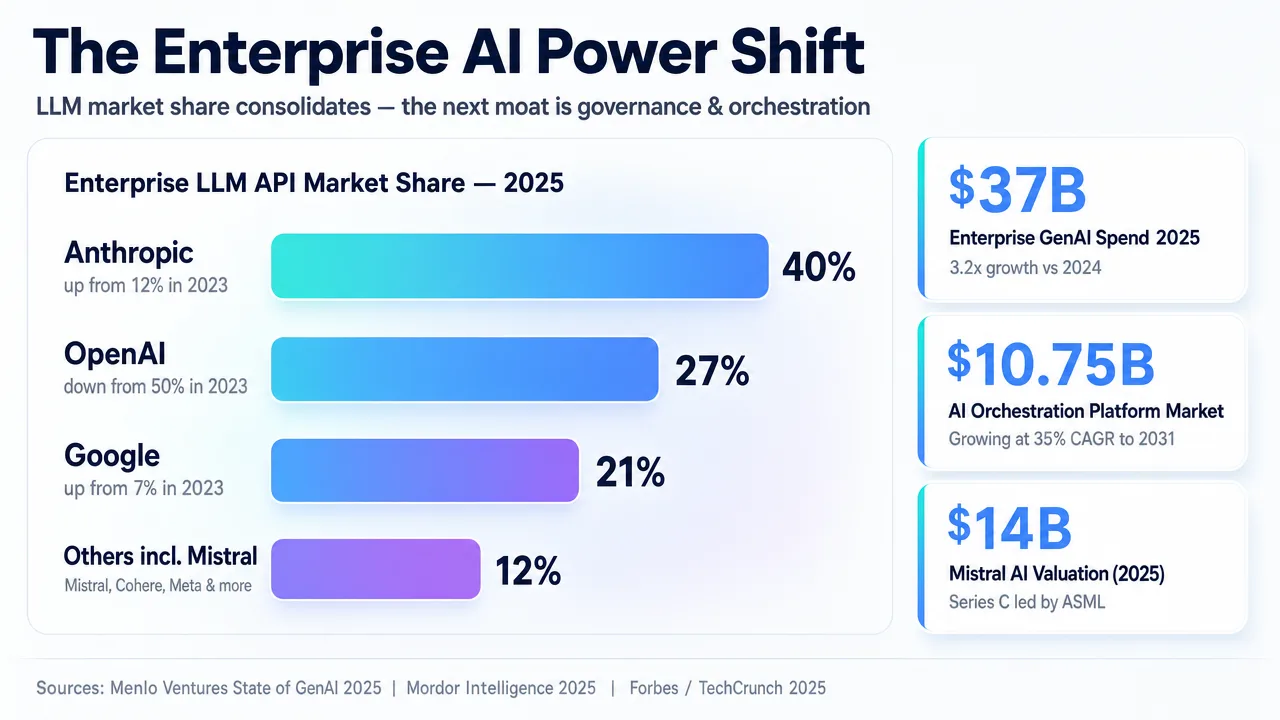
Summary: While public attention remains fixated on raw parameter counts and benchmark scores, Mistral has aggressively expanded its AI Studio, pivoting toward infrastructure and multi-agent lifecycle management.
What happened: Mistral introduced a comprehensive registry system within its platform that tracks, versions, and manages datasets, agents, tools, workflows, and crucially, “judges” (automated evaluation engines).
Why it matters now: As the price of frontier intelligence drops, model capability is becoming commoditized; the new moat for AI vendors is the enterprise governance layer—enabling companies to deploy agents without losing control, lineage, or compliance.
Who is most affected: Enterprise CTOs, AI product teams, and MLOps developers who are struggling with fragmented generative AI stacks and looking for auditable, production-ready infrastructure that avoids vendor lock-in.
The under-reported angle: Most coverage treats Mistral simply as an OpenAI competitor, but its new built-in “judges” and entity registries position it as a direct challenger to orchestration and observability frameworks like MLflow, LangChain, and Weights & Biases.
Deep Dive
Have you ever tried stitching together half a dozen tools just to keep a single agent running in production? For the past year, Mistral AI’s market identity has been defined by its slick open-weight models (like Mixtral 8x7B) and its role as the de facto champion of European AI sovereignty. But a closer look at the evolution of Mistral’s developer docs and the recent expansion of its AI Studio reveals a much more ambitious infrastructure pivot.
Mistral is no longer just selling intelligence; it is selling the connective tissue required to manage intelligence in production. The core of this strategy sits inside the newly minted AI Studio registry. Right now, enterprise developers are stuck building “Frankenstein” stacks—gluing together an LLM API here, a vector database there, and an orchestration framework somewhere in the middle. Mistral’s registry attempts to centralize this chaos. By enabling developers to explicitly define, version, and track data models for agents, tools, and workflows in one place, Mistral is building a system of record for generative AI. I’ve noticed how this creates the necessary lineage for complex multi-agent architectures that regulated industries demand.
Perhaps the most strategic addition to this registry is the concept of “judges.” Transitioning from a single-prompt experiment to a reliable enterprise application requires rigorous, continuous evaluation. By baking evaluators directly into its ecosystem, Mistral offers a closed-loop design: you can build an agent, orchestrate its workflows, and immediately evaluate its outputs against standardized, version-controlled metrics. This transforms abstract AI alignment into a concrete, measurable engineering process.
That said, this governance-first approach intertwines perfectly with Mistral’s geographic and strategic positioning. As the EU AI Act and GDPR push enterprises toward stricter data residency and auditability requirements, Mistral’s end-to-end tooling becomes a powerful compliance mechanism. The platform makes it possible to maintain clear audit trails of which dataset trained which agent, using which tool, and how a judge evaluated it—a critical necessity for banking, healthcare, and public sector adoption.
Ultimately, Mistral is redefining the TCO (Total Cost of Ownership) equation for AI. By pairing its hybrid model approach—offering both highly efficient open-source weights for self-hosting and managed enterprise endpoints on Google Vertex and Azure—with this new registry infrastructure, Mistral provides a realistic off-ramp from proprietary vendor lock-in. It gives CTOs a clear migration playbook: start with OpenAI, realize the compliance and orchestration complexities, and migrate to a sovereign, auditable ecosystem.
Stakeholders & Impact
- Enterprise AI Teams | High | Gain a native, unified environment for versioning agents and evaluators, reducing reliance on third-party orchestration tools.
- Regulators & Auditors | Significant | The registry creates clear, version-controlled audit trails for AI decisions, directly mapping to EU AI Act compliance requirements.
- Incumbent Cloud & AI Platforms | Medium | OpenAI, Anthropic, and Google face increased pressure as Mistral provides a “lock-in-free,” governance-focused alternative for regulated clients.
- Open-Source Community | Medium | Simplifies the transition from downloading Hugging Face weights to deploying manageable, production-grade applications.
About the analysis
Researched and written with AI assistance under the editorial responsibility of the i10X News team. The title image is an AI-generated illustration. Read our AI Use Policy. Spotted an error? Request a correction.
This independent, research-based analysis tracks shifts in developer tooling and platform strategies by examining Mistral Docs, GitHub repositories, and industry evaluations. It is designed for technical decision-makers, CTOs, and AI engineers architecting resilient, multi-agent systems in regulated environments.
i10x Perspective
The LLM API price war is a race to the bottom, and raw cognitive capability will eventually become a utility. Mistral’s aggressive move into registries, judges, and workflow lineage proves that the real value capture of the current AI cycle lies in “intelligence logistics.”
Over the next five years, the winners of the AI platform wars won’t necessarily be those with the largest compute clusters, but those who can make autonomous agents predictable, auditable, and legally compliant for the global enterprise.