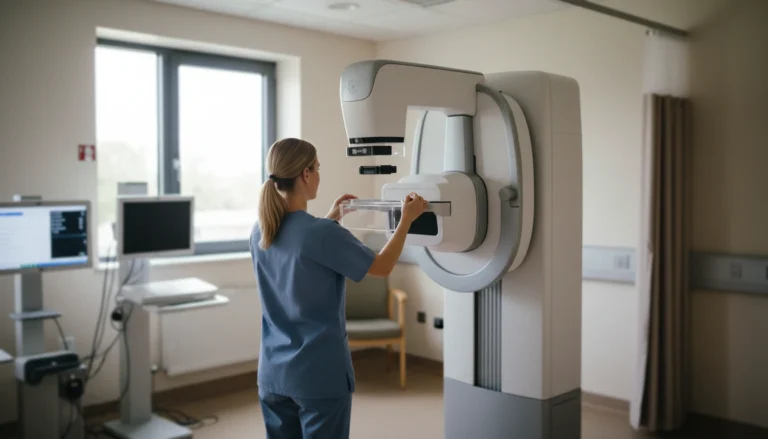
Pro Medicus, the Australian maker of the Visage 7 medical imaging platform, said on November 25 that its US subsidiary Visage Imaging has received FDA 510(k) clearance for Visage 7 AI Mammography, software that marks suspicious areas on 2D and 3D screening mammograms while the radiologist reads, according to the company’s ASX announcement. It enters one of the most crowded corners of medical AI, with one twist that matters for hospitals: the detector ships inside the viewer radiologists already use instead of arriving as another vendor’s add-on.
What the software does
The tool is cleared as a concurrent reading aid for full-field digital mammography and digital breast tomosynthesis, the 3D form of screening. It highlights clusters of calcifications and soft-tissue regions that look suspicious, and it gives each finding and each breast a score for how likely cancer is. The results appear in the Visage 7 diagnostic viewer as part of the normal reading workflow, and the product is available now to Visage 7 customers in the US.
Two details in the fine print shape who can use it. At launch it is cleared only for images from Hologic Selenia Dimensions systems. And the clearance comes with a Predetermined Change Control Plan, an FDA-reviewed plan that lets the company make defined updates, including support for more mammography systems, without filing a new 510(k) each time.
What the announcement does not say
Pro Medicus backs the clearance with a multi-reader, multi-case study in which radiologists performed better reading with the tool than without it, plus a standalone test on a large group of US screening exams. It gives no numbers: no sensitivity or specificity, no change in recall rate, no reader count, no cohort size and no breakdown for dense breasts. Chief executive Sam Hupert says the aim is to help radiologists “find more cancers early” and to spare women unnecessary call-backs or biopsies, but neither effect is quantified. The FDA’s public 510(k) summary, once posted, is where the study design and results should appear.
A crowded field, by our count
Our FDA AI Medical Device Tracker holds 1,614 AI-enabled devices, and 1,230 of them, 76 percent, sit in radiology. Breast screening is among the busiest niches. The list already includes detection tools from Hologic (Genius AI Detection), iCAD (ProFound), ScreenPoint (Transpara), Lunit (INSIGHT MMG and INSIGHT DBT), Therapixel (MammoScreen) and DeepHealth (Saige-Dx). In the first half of 2026 alone, the list shows at least five clearances for mammography detection software: Lunit INSIGHT DBT in March, Lunit INSIGHT MMG in April, MammoSightAI in May, and Saige-Dx plus another MammoScreen clearance in June. How far detection AI can go in practice is being tested in the UK’s EDITH trial, which checks whether AI support lets one specialist instead of two read most screening images for about 700,000 women. Visage itself is not new to breast AI; its earlier Visage Breast Density tool was cleared in January 2021, but that one estimates density rather than looking for cancer.
There is one more wrinkle in that list. Hologic makes the Selenia Dimensions systems this clearance is limited to, and it also sells its own Genius AI Detection software. So Pro Medicus starts out on hardware whose maker already offers a competing detector.
Same week, a different question: who will get cancer
A day earlier, RadNet’s DeepHealth unit announced clearance of Mammo Risk, which estimates a woman’s three-, four- and five-year breast cancer risk from a 3D mammogram. DeepHealth says it was trained on 220,000 studies and tested in an independent study of more than 65,000 screening mammograms at 10 US sites. The two tools answer different questions. Visage looks for cancer that may be in the image now, while Mammo Risk estimates who is likely to develop it later and might need extra imaging. Large screening programmes may end up running both.
Questions for imaging centres before switching it on
- Ask for the effect size. Request the reader study numbers (sensitivity, recall rate, reading time) and how the cohort was composed, especially for dense breasts.
- Check the scanner fleet. Only Hologic Selenia Dimensions images are covered at launch. Sites with mixed fleets depend on future updates under the change control plan.
- Avoid stacking detectors. If you already license Genius AI, Transpara, Lunit or another tool, decide which one is the reference. Two sets of AI marks on the same exam can slow readers down rather than help them.
- Get the price in writing. The announcement is silent on pricing and on whether the module is bundled with existing Visage 7 contracts.
i10x Perspective
Cancer detection on mammograms is turning from a product into a feature. When the company that owns the viewer ships its own cleared detector, a standalone AI vendor has to justify a second contract with better evidence, wider scanner coverage or lower cost. We expect more viewer and archive vendors to follow and price pressure on standalone algorithms to rise. The underrated part of this clearance is the change control plan: it lets Pro Medicus extend scanner support and improve the model faster than rivals that need a new filing for each step. What we still need to see is the reader study data, because “radiologists performed better” can mean a large gain or a small one.