Quick Take
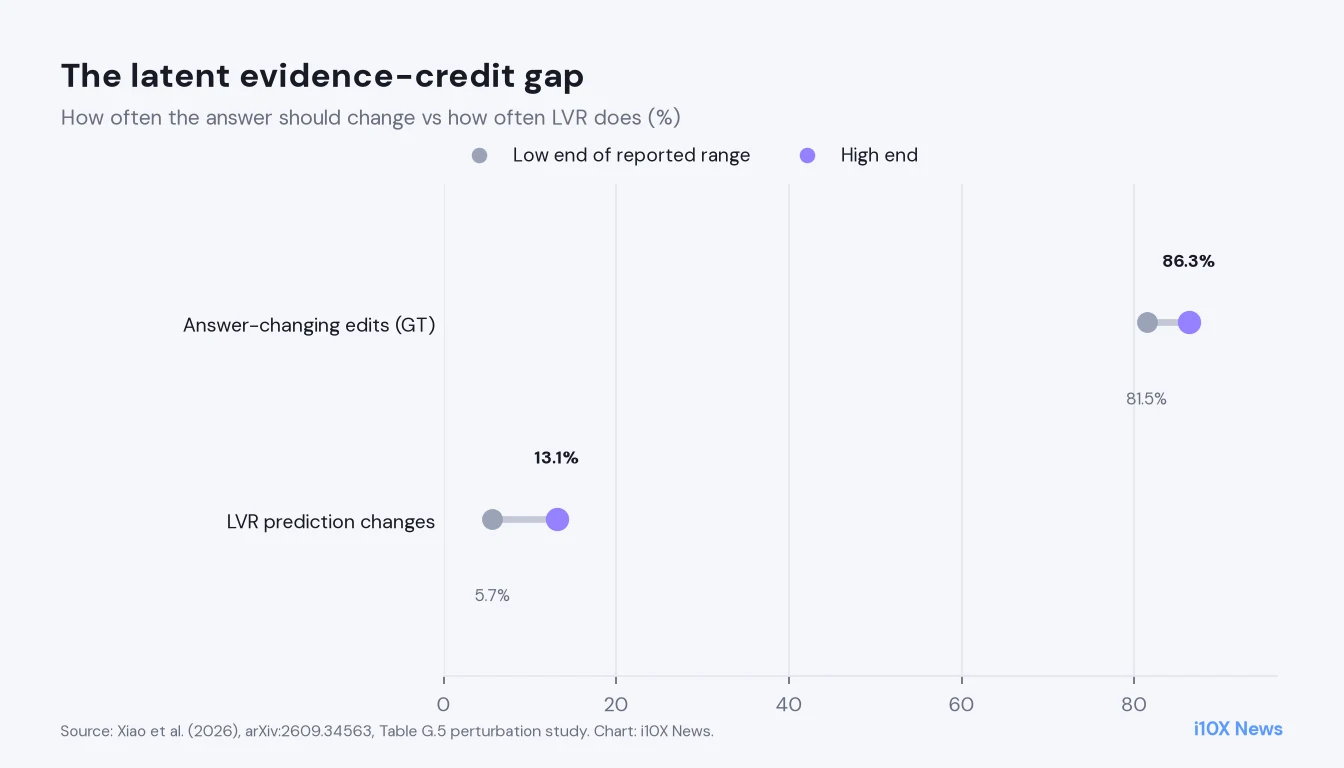
- The finding: When image perturbations change the correct answer in 81.45–86.33% of pairs, standard LVR models flip predictions only 5.66–13.09% of the time — a 68–81 point evidence-credit gap.
- The fix: ReaLVR supervises free-running latent trajectories with visual-evidence contrasts under GRPO.
- The gain: Highest five-task averages among evaluated LVR methods: 63.7% on Qwen2.5-VL-7B, 61.2% on Qwen3-VL-8B, 65.2% on Qwen3-VL-30B.
Latent visual reasoning lets MLLMs think in continuous tokens instead of words — but those tokens are hard to supervise. University of Alabama at Birmingham and Amazon AGI researchers measure whether latent tokens actually track visual evidence.
What the study shows
Final-answer rewards alone leave a credit gap. ReaLVR contrasts trajectories with evidence-aware signals. Linear probes still recover BLINK task labels at 99.9% from mean latents — states are informative but poorly grounded.
- Beats LVR-RL: +3.1 and +2.6 points five-task mean on reported backbones.
- Cross-family consistency: Gains hold across three model families.
Why it matters: silent mis-reasoning
If latent tokens ignore the pixels that decide the answer, multimodal CoT is theater. ReaLVR makes evidence part of the training signal.
Method in brief
Perturbation analysis; GRPO with evidence contrasts; multi-backbone evals.
What remains open
- Latent opacity remains: Even with better grounding, tokens are not human-readable.
- Task suite: Five-task averages; broader coverage TBD.
Context
Related multimodal reasoning in Multimodal and Reasoning.
What it means for MLLM trainers
- Test evidence sensitivity: Perturb images that flip labels.
- Supervise latents: Answer reward is not enough.
- Probe representations: High probe accuracy ≠ grounded use.
About the analysis
Researched and written with AI assistance under the editorial responsibility of the i10X News team. The title image is an AI-generated illustration. Read our AI Use Policy. Spotted an error? Request a correction.
This article is based on the full text of the preprint “Rethinking Latent Visual Reasoning: Grounding Latent Reasoning in Visual Evidence” (arXiv:2609.34563v1, submitted September 28, 2026). All numbers are taken from the paper’s text, tables and figures; i10X did not rerun the experiments. The paper is distributed under arXiv’s non-exclusive license, so i10X does not reproduce its figures; the chart was drawn by i10X from numbers reported in Table G.5 perturbation study.
i10x Perspective
An 80-point gap between what should change and what does is devastating for latent reasoning hype. ReaLVR’s contribution is insisting that continuous thoughts still need visual receipts.