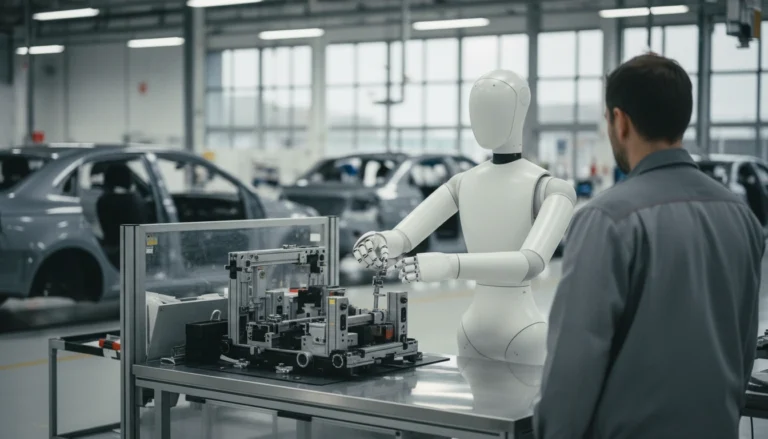
UBTech has formally launched the Walker S3, the next model in the industrial humanoid line it sells to Chinese carmakers and factories. The company’s launch video on X, posted on Sunday at 16:01 CET, puts the headline numbers on screen: 174 cm and 59.3 kg, 51 degrees of freedom, 2,070 TOPS of onboard compute, a hot-swappable battery that changes in 30 seconds and a rating of 3,000 charge cycles. It names no price, no customer and no delivery date. Because most of the figures are percentages against an unnamed predecessor, we worked out what they imply and set them against the Walker S2 spec page and UBTech’s own half-year filing.
What the percentages are measured against
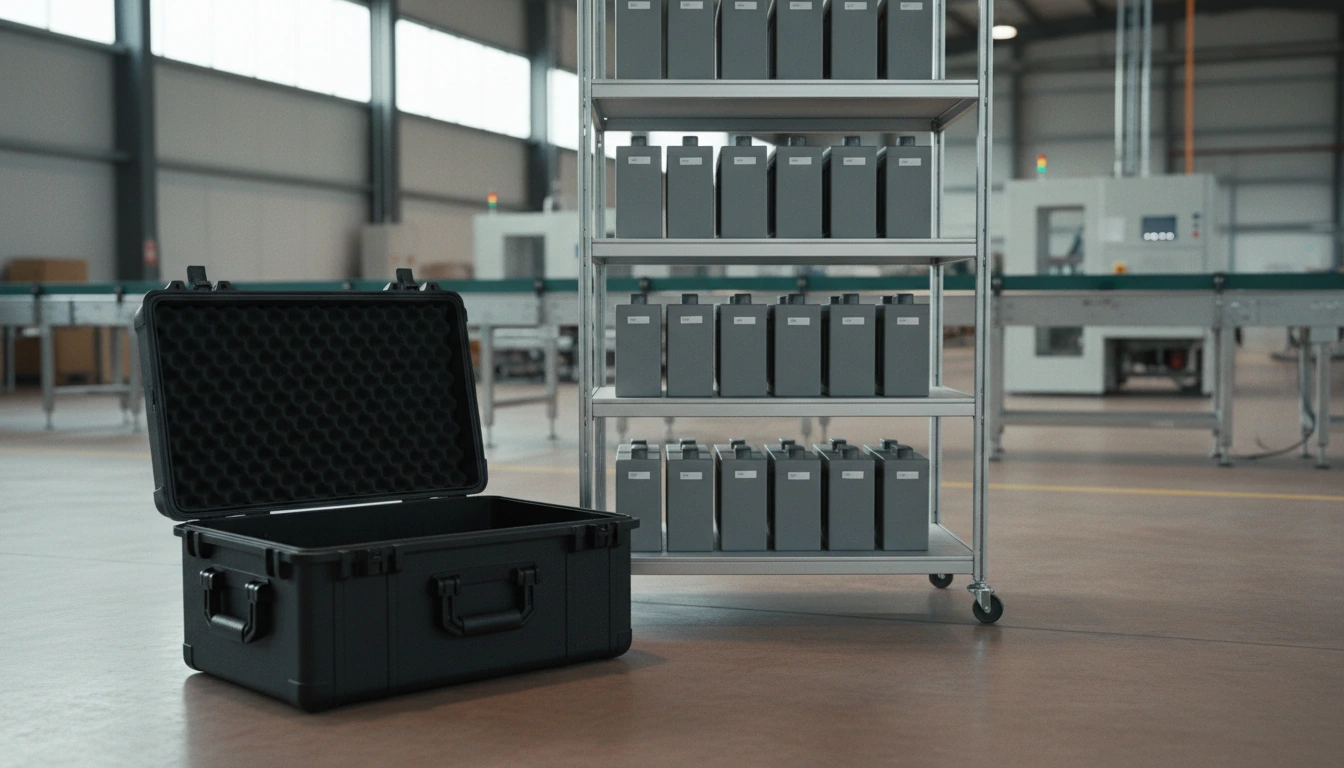
UBTech’s video shows the S3 climbing out of its own shipping crate and then runs through a list of gains. Here is each claim next to what UBTech documents for the Walker S2, and what the number implies.
| Spec | Walker S3 (launch video, Nov 29) | Walker S2 (UBTech product page) | What it implies |
|---|---|---|---|
| Size and weight | 174 cm, 59.3 kg, weight down 14.29% | Not listed | A predecessor of about 69 kg |
| Onboard compute | 2,070 TOPS, up 500% | Not listed | About 345 TOPS before, if read as six times |
| Waist rotation | 332 degrees | Plus or minus 162 degrees (324 degrees) | About 8 degrees more range |
| Battery | 30 s hot swap, 3,000 charge cycles | Swaps its own battery in about 3 minutes | Different claims; who swaps on the S3 is not stated |
| Payload | Not stated | 15 kg, from floor level to 1.8 m | S3 payload unknown |
| Build and service | Harnesses down 66%, screws down 50%, repair time down 76% | Not listed | Aimed at cost and uptime |
| Vision and hand | 3 MP binocular stereo, recognition accuracy up 46%; hand motion accuracy up 22% | Passive RGB binocular stereo with learned depth | All gains vendor-measured |
| Deployment | Deployment efficiency up 38% | Not listed | Metric not defined |
Sources: UBTech Walker S3 launch video on X (Nov 29, 2026) and UBTech Walker S2 product page, checked by i10X on November 29, 2026. Implied values are i10X calculations.
Two rows deserve a closer look. The waist figure looks like a big step until you compare it: the S2 already turns 162 degrees each way, so the S3 gains about 8 degrees of range. And the battery claims are not the same kind of claim. The S2 page describes a robot that swaps its own battery in about three minutes; the S3 video only says “30s hot-swappable battery” and does not say who does the swapping.
A VLA model on board, but no task list
UBTech says the S3 is driven by a vision-language-action (VLA) model, the type of model that turns camera input and a spoken or written instruction directly into motor commands. Chinese tech outlet IT Home, reporting the launch materials, quotes UBTech as saying the model adapts to new tasks more than 50 percent faster and that the robot works up to eight hours per run. UBTech has not published which tasks were tested, success rates, or a benchmark that outsiders could rerun. The compute jump is real hardware, the intelligence gain is so far a vendor statement.
The battery math buyers should run
The most practical number in the video is the one most coverage skips: 3,000 charge cycles. If one charge covers one eight-hour run, as the launch materials suggest, a battery set rated for 3,000 cycles stands for about 24,000 hours of work. A robot that runs three shifts a day burns three cycles a day, so it uses up the rated life of one battery set roughly every 1,000 days, or about 2.7 years. Spare packs in rotation spread the wear, they do not reduce it. That makes the replacement price of a battery pack, and the capacity UBTech counts as end of life, part of the real operating cost.
What UBTech’s filing says about the business
UBTech is not launching into an empty order book. Its interim results for the first half of 2026, filed with the Hong Kong exchange in August, report RMB 590.3 million in revenue from full-size humanoid robot products and services, up from RMB 38.2 million a year earlier, on 921 units sold. That segment made up 46.5 percent of group revenue.
Dividing one by the other gives about RMB 641,000 per unit. Treat that as an upper bound for the average selling price, because the line also includes services and covers several models (Walker S2, Cruzr Y1, Walker C1 and the U1 series). The same filing cites an annual production target of 10,000 full-size humanoids. Against 921 units sold in six months, that is a steep ramp, and the S3’s delivery date will show whether it is meant to carry it. Our Humanoid Robot Price Tracker still lists the Walker S2 with an undisclosed price and pilot-program availability; the S3 changes nothing there yet.
Questions to put to UBTech before a pilot
- Payload and reach. The video gives none. The S2 lifts 15 kg anywhere from floor level to 1.8 m. For comparison, Hexagon’s AEON, which Volvo is training at its Ghent plant, is rated for 10 kg.
- Who swaps the battery. Ask whether the S3 keeps the S2’s autonomous self-swap or needs a worker for the 30-second change, and how many spare packs a 24-hour station needs.
- End-of-life definition. Get the capacity at which a pack counts as worn out after 3,000 cycles, and its replacement price.
- What “deployment efficiency up 38%” measures. Setup hours per workstation, commissioning days, or something else.
- Validated tasks. Which jobs the VLA model has been tested on, in which plants, with what success and intervention rates.
- Delivery and upgrades. When the S3 ships, and whether open S2 orders can switch.
i10x Perspective
On the evidence UBTech has shown, the S3 is above all a cost and serviceability release: two-thirds fewer wiring harnesses, half the screws, modular arms that cut repair time by three quarters, and automotive-grade parts. That is what a company needs when it moves from hundreds of units to thousands, and it matters more on a factory floor than the 2,070 TOPS headline. Compare that with XPENG, whose IRON humanoid slipped to a 2027 release: UBTech is iterating on a line that already sells. Our expectation is that buyers will judge the S3 on uptime per shift and battery cost, two numbers UBTech has not published. Until there is a price, a payload and a first named S3 customer, read the percentages as marketing deltas against an unnamed baseline.
What is still open
UBTech has not said which model the percentages compare against, what the S3 costs, how much it lifts, when it ships or whether any customer has ordered it. Its X post promises more details; we will update this article when they appear.