MultimodalGoogleGemini
Evidence check
  • Preprint
  • No code released
  • Not independently replicated

Crisis Deepfake Detectors Collapse From 90%+ AUC to Chance on Real Generators

RA-Bench: traditional detectors fall from 67.6–98.6% public AUCs to 43.9–57.3% source-level means. Social dissemination cuts fine-tuned FakeR from 46.0% to 1.4%.

Christopher Ort
By Christopher Ort · 2 min read
Share
A crumbling digital wall under attack, illustrating the failure of deepfake detection.
Illustration: i10X
On this page
  1. Quick Take
  2. What the study shows
  3. Why it matters: crisis misinformation
  4. Method in brief
  5. What remains open
  6. Context
  7. What it means for platforms and newsrooms
  8. About the analysis
  9. i10x Perspective
i10X Quick Take

Quick Take

  1. The finding: Traditional detectors drop from public-reference AUCs of 67.6–98.6% to source-level means of 43.9–57.3% on RA-Bench, and rankings reshuffle across generators.
  2. Humans struggle too: Reviewers spot 68.6% of open-source fakes but only 52.9% of closed-source ones; Seedance2.0 and Kling fall to 40.7% and 45.1%.
  3. Social sharing kills detection: Full social-dissemination simulation cuts mean FakeR across fine-tuned configs from 46.0% to 1.4%.

AI video generators can fabricate crisis footage. A large multi-university team builds RA-Bench to test detectors, generators and how social dissemination further degrades detection.
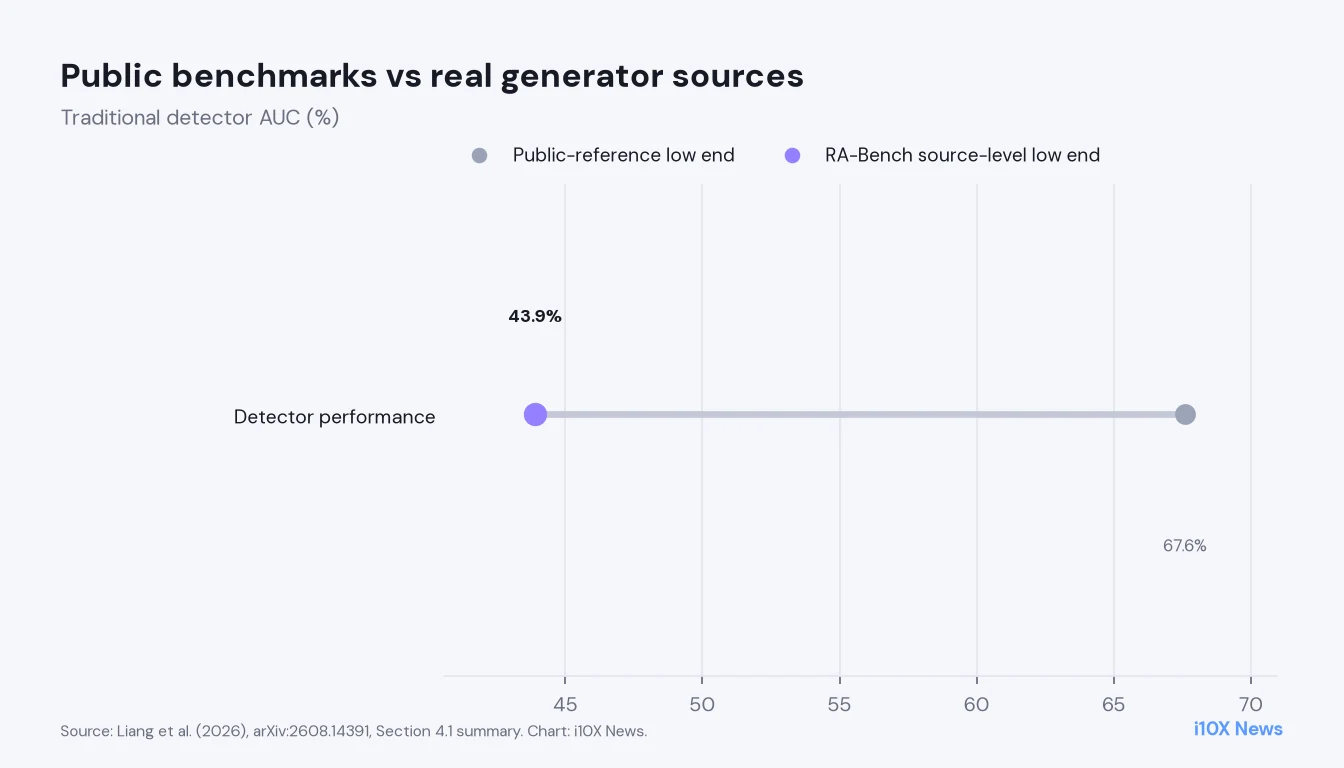
Dumbbell illustrating drop from public-reference AUCs starting at 67.6 percent down to source-level means starting at 43.9 percent.
i10X chart based on data from Liang et al. (2026), arXiv:2608.14391, Section 4.1 summary (arXiv non-exclusive license).

What the study shows

Generation mode matters: seven-detector mean AUC moves from 33.4% (T2V) to 50.9% (first-frame I2V) and 44.6% (first+last I2V). Videos that fool people also fool machines (Gemini binary ~54.7% BAcc on that subset).

  • Timestamps help some systems: Replacing timestamps with frame indices drops Skyra to 54.4–54.9% mean BAcc.
  • MLLM FakeR varies: Fine-tuned MLLM FakeR falls from 70.5% (T2V) to 28.3% (first+last I2V).

Why it matters: crisis misinformation

Detectors that ace academic sets can fail on the exact generators used in the wild — and social reposting nearly erases remaining signal.

Method in brief

Multi-generator RA-Bench; human review; social dissemination simulation; traditional and MLLM detectors.

What remains open

  • Moving generators: New models will shift rankings again.
  • Simulation ≠ full platforms: Social condition is controlled.

Context

Related multimodal safety in Multimodal and Safety & Alignment.

What it means for platforms and newsrooms

  • Retest per generator: Public AUC is not transferable.
  • Assume reposts degrade cues: Plan layered defenses.
  • Combine human+model review: Neither alone suffices on closed-source fakes.

About the analysis

Researched and written with AI assistance under the editorial responsibility of the i10X News team. The title image is an AI-generated illustration. Read our AI Use Policy. Spotted an error? Request a correction.

This article is based on the full text of the preprint “Can We Defend Against AI-Generated Video Attacks on Real-World Crisis Events? A Systematic Evaluation of Detectors, Generators and Social Dissemination” (arXiv:2608.14391v2, submitted August 14, 2026). All numbers are taken from the paper’s text, tables and figures; i10X did not rerun the experiments. The paper is distributed under arXiv’s non-exclusive license, so i10X does not reproduce its figures; the chart was drawn by i10X from numbers reported in Section 4.1 summary.

i10x Perspective

RA-Bench’s social result — FakeR from 46% to 1.4% — should end any complacency about upload-time detectors. Once a clip circulates, the forensic signal is largely gone.

Christopher Ort

Christopher Ort

Christopher Ort handles SEO, AI agent workflows and PR & partnerships at i10x.ai, the all-in-one AI workspace built by i10X Global Pte. Ltd. in Singapore. He is a graduate of Friedrich-Alexander-Universität Erlangen-Nürnberg (FAU). He is the author of “The Style Penalty”, a study published on SSRN that analyses 1,576 evaluation decisions by four frontier AI models to show how AI-written CVs fare in automated hiring screens; the research has been covered by heise online and t3n.

Timeline

What happened before

  1. Release

    Gemini 4 Argon

    1.05M context · $2 / $10 per 1M tokens

    Google's most capable model for complex coding, agentic, math and science tasks.

    ai.google.dev (source, opens in a new tab)
  2. Release

    Gemini 3.8 Flash

    1.05M context · $0.75 / $3.75 per 1M tokens

    ai.google.dev (source, opens in a new tab)
  3. Release

    Gemini 3.7 Flash

    1.05M context · $0.75 / $3.75 per 1M tokens

    ai.google.dev (source, opens in a new tab)
  4. Release

    Gemini 3.6 Flash & 3.5 Flash-Lite

    1.05M context · $0.75 / $3.75 per 1M tokens

    ai.google.dev (source, opens in a new tab)
  5. Release

    Gemini 3.5 Flash

    1.05M context · $1.5 / $9 per 1M tokens

    Launched at I/O 2026 as the first Gemini 3.5 model; Google later dropped the planned 3.5 Pro.

    blog.google (source, opens in a new tab)
Full Gemini timeline ›

Editor's picks

  1. Anthropic IPO Filing Reveals Extreme AI Safety Risks
  2. Grok Imagine Odyssey Pilot Exposes AI Video Limits
  3. Anthropic Files S-1 for Nasdaq IPO Under Ticker ANT
  4. Jakarta Agentic AI Milestone Delivers Standardized AI Agents for Java
  5. llm-deepseek Serialization Bug Replays Text After Tool Use